.png)
Your pipeline is clean. The dashboard loads perfectly. No errors, no failed jobs, no broken relationships in the database. Everything looks fine until finance questions the revenue numbers, sales says the customer count is wrong, and marketing discovers half the contact list is outdated.
The engineering team investigates and finds nothing broken. So what went wrong?
Most data teams never see it coming because data integrity and data quality are two different problems, and conflating them leads to broken pipelines, misleading reports, and AI models that confidently produce wrong answers.
Gartner’s 2024 data and analytics trends research highlighted that growing concerns around data quality and trust are becoming a major barrier to reliable AI and business decision-making.
Many organizations still struggle to distinguish between structural reliability issues and business-quality issues, which means teams often spend time fixing the wrong problem.
This guide cuts through the confusion, what each concept actually means, how they differ, where they overlap, and why both matter for analytics, governance, and AI.
What is data integrity vs data quality (quick answer)
Both terms describe data reliability, but they operate at different levels.
Data integrity is about structure. It asks whether data is stored, linked, and maintained correctly across systems. Think valid relationships, enforced constraints, and consistent records.
Data quality is about usefulness. It asks whether data is accurate, complete, timely, and fit for the business decision at hand.
A simple way to keep them straight:
|
Question |
Concept |
|
Is the data structurally correct and consistent? |
Data Integrity |
|
Is the data accurate, complete, and usable? |
Data Quality |
A database can pass every structural check and still contain outdated customer emails or incorrect revenue figures. That is the core of the distinction and exactly what this guide unpacks.
Here's what we'll cover: what each concept means in practice, how they differ, where they overlap, and why analytics, governance, and AI use cases need both.
What is data integrity?
Data integrity ensures data remains structurally correct and consistent as it moves through databases, applications, and pipelines. It is less about what the data says and more about whether the system can store and connect it reliably.
Integrity is enforced through constraints: primary keys, foreign keys, and validation rules that prevent invalid entries from entering the system. If an order record exists without a matching customer ID, that is an integrity failure. The relationship is broken, and downstream reports will reflect that through orphan records, inconsistent outputs, and pipelines that silently produce wrong results.
Engineering and database teams typically own this layer because the fixes live at the schema, pipeline, or application level.
What is data quality?
Data quality measures whether data is fit for its intended business use. A record can exist perfectly within a database and still be wrong, incomplete, or irrelevant.
Quality is evaluated across dimensions like accuracy, completeness, timeliness, and validity. A customer record with a two-year-old email and a missing phone number passes every structural check but fails every business one, whether the use case is reporting, personalisation, compliance, or AI.
Unlike integrity, quality cannot be enforced at the system level alone. Business teams define what "good" looks like, governance teams set the standards, and data teams build the checks. Without active monitoring, quality quietly degrades even when systems are running perfectly.
Data integrity vs data quality - a comparison table
These two terms are often used interchangeably, but they solve different problems. Conflating them is where governance gaps begin.
|
Aspect |
Data Integrity |
Data Quality |
|
Core Focus |
Ensures data is structurally correct and consistent across systems |
Ensures data is accurate, complete, and useful for business needs |
|
Primary Concern |
System reliability and correctness |
Decision-making and usability |
|
Ownership |
Typically handled by engineering and database teams |
Managed by business, governance, and data teams |
|
Key Components |
Referential integrity, constraints, consistency rules |
Accuracy, completeness, timeliness, validity |
|
Failure Impact |
System errors, broken pipelines, inconsistent data relationships |
Misleading insights, poor decisions, unreliable reporting |
|
Example |
No orphan records across related tables |
Customer data has correct and updated information |
|
Key Insight: Data can have high integrity but still be low in quality, and that's where most confusion happens. A structurally sound pipeline can still feed an AI model data that is outdated, incomplete, or contextually wrong. Integrity is the floor. Quality is what determines whether data is actually fit for use. |
How to identify whether you have a data integrity issue or a data quality issue
The fastest way to distinguish between the two is to ask where the failure shows up.
Signs you have a data integrity issue:
-
Broken relationships or orphan records across tables
-
Failed constraints or validation rules at the database level
-
Pipeline errors caused by inconsistent data structures
-
Records that don't match across systems that should be in sync
Signs you have a data quality issue:
-
Reports or dashboards producing misleading or conflicting outputs
-
AI model predictions are degrading without any pipeline errors
-
Records that passed validation but contain outdated or incorrect information
-
Business terms are being interpreted differently across teams and systems
|
The diagnostic question to ask: Did the system accept the data, but the business can't trust it? If yes, it's a quality problem, not an integrity one. |
The reason this distinction matters operationally is simple. Integrity issues are fixed at the engineering layer: schema constraints, referential rules, pipeline controls. Quality issues require governance: ownership, definitions, freshness standards, and accountability for what "correct" actually means in a business context.
How data integrity and data quality work together: the trust layer model
Data integrity and data quality are not competing priorities; they are sequential ones. Think of them as layers that build on each other, where each layer is a prerequisite for the next. Here is how that plays out in practice:
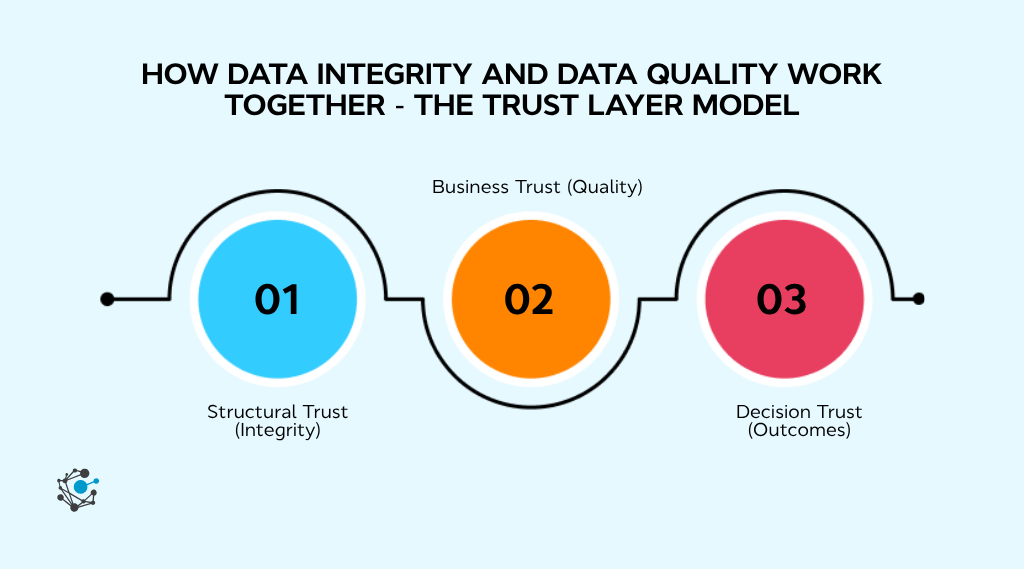
Layer 1: Structural trust (integrity)
This is the foundation. Data is valid, relationships between records are intact, and systems can store and process information without breaking. Without this layer, nothing built on top of it is stable. Even the most accurate values become unreliable if the system cannot preserve them consistently as data moves across databases, pipelines, and applications.
For example, an e-commerce platform processes thousands of orders daily. If order records are not linked to valid customer IDs because a migration broke the foreign key relationship, downstream reports silently drop those transactions. Revenue figures look clean, but they are incomplete.
Layer 2: Business trust (quality)
Once the structure holds, quality determines whether the data actually means something useful. Are the values accurate? Is anything missing? Is the data recent enough to act on? This is where business rules, governance standards, and domain knowledge come in. A structurally sound database full of outdated or incorrect values still fails at this layer.
For example, a marketing team runs a re-engagement campaign using a customer database that passes every structural check. But 30% of the email addresses were last validated two years ago. The structure is intact, the data is useless.
Layer 3: Decision trust (outcomes)
This is where both layers pay off. Teams trust their dashboards, AI outputs are reliable, and business decisions are grounded in data that is both structurally correct and meaningfully accurate.
A 2025 PwC survey found that 79% of organisations are already adopting AI agents in some form, and in those environments, weak data foundations do not just affect one report; they trigger hallucinated outputs and model drift at scale.
For example, a financial services firm builds a credit risk model on top of clean, well-governed customer data. Because both integrity and quality are in place, the model produces reliable risk scores, and the business acts on them with confidence.
Integrity creates the foundation. Quality builds usability. Together, they create the confidence teams need to act.
Data integrity or data quality: which one is more important?
This is the wrong question. Most data failures happen because organisations optimise for one and ignore the other. The real issue is understanding what each one protects and what breaks when either is missing.
Without integrity: A single broken foreign key cascades into orphan records, failed reports, and inconsistent outputs across every dependent system. Data becomes unstable the moment it moves across pipelines, platforms, or applications.
Without quality: A perfectly structured database still produces wrong answers. Incorrect revenue figures, outdated customer records, and inconsistently labelled categories cost the business in poor decisions, failed campaigns, and compliance risks.
Integrity makes everything possible. Quality makes it all useful. Neither works without the other.
Where both data integrity and data quality matter in real-world scenarios
The integrity vs quality distinction is not just theoretical. It shows up in every system where data drives decisions. Here is where getting both wrong or prioritising one over the other creates the most damage.
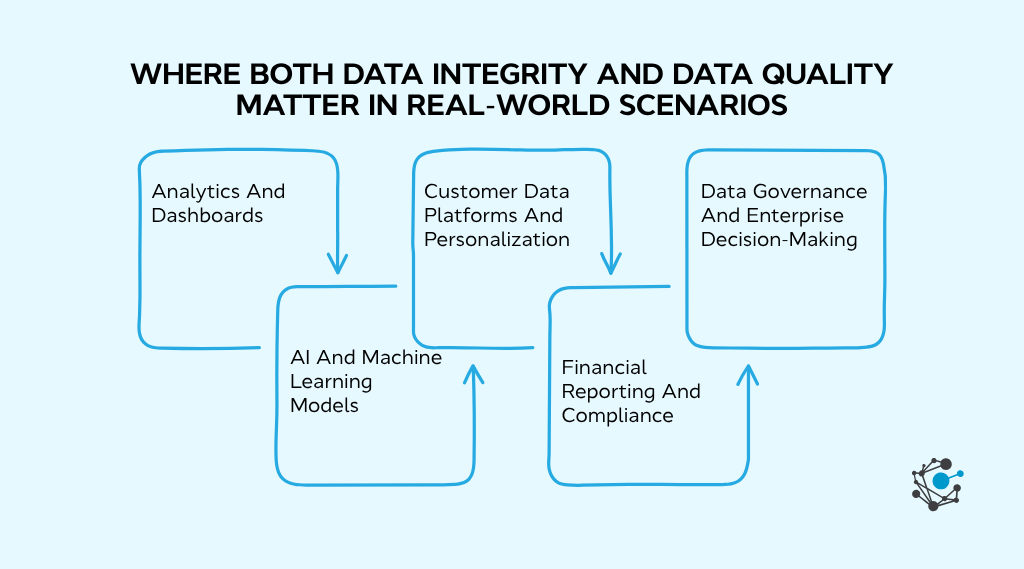
1. Analytics and dashboards
Dashboards depend on integrity to keep pipelines stable and metrics consistent across tables. They depend on quality to ensure those metrics actually reflect reality.
A revenue dashboard may pull from perfectly linked sales, invoice, and customer tables; that is, integrity is working as intended. But if discount logic is applied inconsistently or invoice values are entered incorrectly at the source, the dashboard produces clean-looking numbers that are simply wrong. Teams make pricing decisions, forecast targets, and evaluate performance on KPIs that do not reflect what is actually happening.
2. AI and machine learning models
AI models are particularly unforgiving when both layers are not in order. Integrity ensures training datasets are complete, consistently structured, and free of duplicated or conflicting records. Quality ensures the labels, attributes, and inputs the model learns from are accurate and relevant.
A model trained on duplicate records will skew its predictions. A model trained on incorrectly labelled data will learn the wrong patterns entirely. According to IBM’s 2025 insights, nearly 45% of business leaders cite concerns about data accuracy or bias as a leading barrier to scaling AI initiatives, and when that data is inconsistent or incomplete, models do not just underperform; they amplify every flaw at scale.
3. Customer data platforms and personalisation
Customer data platforms rely on integrity to link records correctly across CRM, marketing, support, and billing systems. They rely on quality to ensure those unified records are actually accurate.
If the same customer appears as two separate profiles across systems, that is an integrity problem; campaigns get duplicated, support history gets split, and revenue attribution breaks. If the profile is unified but carries an outdated email or stale preferences, that is a quality problem. Both lead to irrelevant personalisation, wasted spend, and lower customer trust.
4. Financial reporting and compliance
Few areas carry higher stakes. Integrity ensures every transaction, invoice, and adjustment connects correctly across financial systems. Quality ensures the values within those records are accurate and compliant.
A missing transaction link is an integrity failure; it creates gaps in audit trails and distorts financial summaries. An incorrect transaction value is a quality failure; it affects reported revenue, tax calculations, and regulatory filings. Either way, the risk lands on the same desk: finance, legal, and the board.
5. Data governance and enterprise decision-making
Governance is where integrity and quality get formalised into organisational standards. Integrity controls ensure data lineage is traceable and records stay consistent as they move across systems. Quality controls ensure that business users can trust what they are looking at when they open a report or query a dataset.
Deloitte’s 2024 insights notes that governance must now actively support data quality, transparency, and trust in AI-generated outputs, not just manage access and lineage. Organisations that treat governance as purely a technical function miss the quality layer entirely. The goal is to move from data collection to data trust to decision confidence, and that journey requires both layers working together.
|
Case Study: Delta Community Credit Union, Georgia's largest credit union with $9.1 billion in assets, struggled with a classic quality problem: data that was structurally intact yet untrustworthy. Different teams defined "member" differently, KPIs were inconsistently calculated, and spreadsheet-based processes created confusion across business units. After implementing OvalEdge, audit preparation time dropped from 5 days to 4 hours, delivering a 312% ROI over three years. |
Key techniques to ensure data integrity and data quality
Knowing the difference between integrity and quality only matters if teams act on it. Each layer requires its own controls, applied at the right point in the data lifecycle. Here is what that looks like in practice.
Techniques for data integrity
Integrity is enforced closest to where data is created and stored, at the database, schema, and pipeline levels. These controls prevent structural problems from entering the system in the first place.
-
Enforcing database constraints: Primary keys ensure every record is uniquely identifiable. Foreign keys enforce valid relationships between tables. Uniqueness constraints block duplicate entries. Applied at the database or schema level, these rules stop structural problems before they propagate downstream.
-
Maintaining referential integrity: Every order should link to a valid customer ID. Every payment should connect to a valid invoice. When those links break, reports miss transactions, pipelines return incomplete results, and applications surface records with no meaningful context.
-
Ensuring consistency across systems: CRM, ERP, data warehouse, and analytics platforms all need to reflect the same reality. When syncs fail or schema changes go unmanaged, systems drift and produce conflicting outputs. ETL and ELT pipelines need embedded validation checks to catch mismatches before they reach reporting or AI layers.
Techniques for data quality
Quality controls operate at a different level. They validate whether data is meaningful and fit for purpose, not just structurally sound. This is where business rules, monitoring, and accountability come in.
-
Defining data quality rules and standards: Quality starts with agreement on what good looks like. Rules cover accuracy, completeness, format, and validity. The critical detail is alignment: technical rules enforce structure, but business teams must define what values are acceptable for each use case. Without that, teams end up enforcing the wrong standards.
-
Data profiling and quality assessment: Profiling surfaces patterns, anomalies, and gaps before they affect downstream systems, identifying missing values, duplicates, and outliers. It also establishes baseline quality metrics, giving teams a reference point to measure whether quality is improving or quietly degrading over time.
-
Data cleansing and standardisation: Cleansing corrects what profiling finds, standardising date formats, unifying address structures, removing duplicates, and fixing values that fail business rules. It is not a one-time project. As systems evolve and new data enters, standardisation needs to be continuous rather than periodic.
-
Continuous monitoring and alerting: Automated checks track quality metrics over time and trigger alerts when values breach thresholds or anomalies appear. For AI systems and operational workflows that depend on fresh data, the difference between real-time and periodic monitoring is not a minor detail; catching issues hours later is often too late.
-
Governance and stewardship processes: Controls only work when someone is accountable for acting on them. Data stewards define quality rules, review flagged issues, and coordinate fixes across technical and business teams. Without clear ownership and resolution workflows, quality issues get identified but never resolved.
|
Pro tip: The most effective organisations connect integrity and quality through a unified governance layer, shared ownership, documented standards, and continuous monitoring across technical and business teams. OvalEdge is built for exactly this, bringing data quality monitoring, lineage tracking, business glossary management, and stewardship workflows into one place. See how OvalEdge can help → Book a Demo |
Common misconceptions about data integrity vs data quality
These two concepts are closely related, which is exactly why they get misunderstood. The misconceptions below are not just semantic; they lead teams to diagnose problems incorrectly, apply the wrong fixes, and build data strategies with blind spots baked in.
1. They mean the same thing
The confusion is understandable. Both concepts support data reliability, and both appear in governance and engineering conversations. But integrity focuses on structure and consistency, while quality focuses on usability and accuracy. Treating them as identical means a broken foreign key and an outdated customer address get lumped into the same category and solved with the wrong tools.
2. Integrity guarantees quality
This is one of the most common assumptions and one of the most damaging. A database can enforce every constraint correctly, maintain every relationship, and still be full of incorrect values. A customer record with a valid ID, intact relationships, and a three-year-old email address passes every integrity check. It fails every business one. Integrity is necessary, but it is nowhere near sufficient.
3. Data quality is only a business problem
Business teams define what good data looks like, but quality cannot be maintained through governance alone. Validation rules, profiling tools, monitoring pipelines, and integration checks are all technical functions that directly shape quality outcomes.
A 2025 IBM report found that 43% of chief operations officers identify data quality as their most significant data priority.
Yet, most organisations still treat it as a business-side concern, leaving the technical layer that actually produces and validates that data largely unmanaged. Quality is a shared responsibility, and treating it as purely a business concern leaves the technical layer unmanaged.
4. Fixing one fixes the other
Resolving a duplicate customer record improves integrity. It does nothing for an incorrect phone number or a missing consent field. Each layer has its own failure modes, its own controls, and its own owners. A database can be structurally clean and still produce reports that mislead. Managing both requires intentional effort at both levels; they do not fix each other by default.
5. Data quality can be fixed once and ignored
Data is not static. Customers move, products change, systems update, and new fields get created. A dataset that is clean today will degrade without continuous monitoring and validation. Quality is not a project with an end date; it is an ongoing operational function. Teams that treat it as a one-time cleanup consistently find themselves back at the same problems six months later.
Conclusion
Data integrity and data quality are not interchangeable, and the cost of treating them that way shows up in broken pipelines, misleading dashboards, and AI systems that confidently produce wrong answers.
Integrity keeps systems stable. Quality makes data meaningful. Neither works without the other. Ignore integrity and the foundation cracks. Ignore quality, and the insights built on that foundation cannot be trusted.
Organisations that get this right do not manage them as separate workstreams. They build a unified data trust strategy, one where structural controls and quality standards reinforce each other across analytics, governance, and AI.
That is exactly what OvalEdge is built for. Whether you are establishing data governance from scratch, scaling AI initiatives, or simply trying to get your teams to trust the same numbers, OvalEdge gives you the tools to manage both layers with confidence.

Book a Demo with OvalEdge if you are ready to build a data foundation your business can trust.
FAQs
1. What is the difference between data integrity and data quality?
Data integrity governs how data is stored, linked, and maintained across systems. Data quality governs whether that data is accurate, complete, and fit for business use. One prevents structural failures; the other prevents decision failures. Both are necessary, but they operate at different layers and require different controls.
2. Can data have integrity but not quality?
Yes, and it happens more often than teams expect. A customer database can enforce every structural rule perfectly while still containing wrong addresses, outdated contact details, or missing consent fields. Passing technical validation does not mean the data is reliable enough to act on.
3. Which is more important: data integrity or data quality?
Neither can substitute for the other. Poor integrity breaks systems and pipelines. Poor quality breaks decisions and insights. Organisations that prioritise one over the other tend to discover the gap only after a costly failure, in a report, an audit, or an AI output.
4. Why do organisations need both data integrity and data quality?
Because they fail differently. Integrity failures surface as system errors, orphan records, and broken pipelines, visible to engineering teams. Quality failures surface as wrong decisions, missed targets, and unreliable AI outputs, visible to business teams. Addressing only one leaves the other layer entirely unprotected.
5. How do you improve data quality and integrity?
Treat them as parallel workstreams rather than a single initiative. Integrity improves through enforced constraints, referential rules, and pipeline validation. Quality improves through profiling, cleansing, business rule alignment, and continuous monitoring. The most effective organisations connect both through clear data ownership and governance accountability.
6. How does poor data integrity or quality affect AI models?
AI models inherit and amplify whatever is wrong in their training data. Integrity issues, such as duplicate or inconsistently structured records, distort what the model learns. Quality issues, such as incorrect labels or outdated attributes, produce predictions that are confidently wrong. In agentic AI systems, these errors do not stay contained; they propagate across every decision the model influences.
.png?width=1081&height=173&name=Forrester%201%20(1).png)
.png?width=1081&height=241&name=KC%20-%20Logo%201%20(1).png)