.jpg)
Governance programs rarely stall because teams lack policies or good intentions. They slow down because too much work depends on manual coordination, repeated approvals, and one-off decisions that are difficult to scale.
A data governance accelerator helps change that by giving teams a faster, more repeatable way to move from planning into execution. The real value comes from shortening the time between identifying a governance need and putting the right controls, ownership, and workflows in place. Done right, the payoff shows up as measurable
This guide explains how to accelerate data governance using a practical acceleration framework, shows where automation and governance agents can remove delays, and compares the main implementation approaches. We’ll also cover how to measure adoption so faster rollout leads to lasting governance outcomes.
What is a data governance accelerator?
A data governance accelerator is a repeatable model that helps organizations quickly move from governance planning to execution. It combines proven frameworks, policy templates, automated workflows, and governance agents to reduce setup time and avoid building processes from scratch. Think of it as a data governance framework accelerator: a structured package that compresses months of design work into a repeatable launch sequence.
While automation handles tasks like data discovery, classification, stewardship, and monitoring, governance leaders remain responsible for setting priorities, approving policies, and managing exceptions.
How it differs from traditional governance rollouts
Traditional programs often begin with lengthy design cycles. Teams define every role, policy, approval path, and control before showing meaningful value. This increases consulting costs and makes governance difficult to expand across domains.
An accelerator starts with reusable components that teams can adapt to their environment. Governance agents can also surface missing ownership, classify sensitive data, recommend actions, and route routine tasks to the right people.
|
Dimension |
Traditional rollout |
Accelerator-based rollout |
|
Timeline |
Sequential design and implementation over several months |
Faster deployment using reusable assets |
|
Cost profile |
High manual and consulting effort |
Lower repeated setup effort |
|
Governance execution |
Manual reviews, assignments, and follow-ups |
Agent-assisted workflows with human oversight |
Who uses governance accelerators
Governance accelerators are particularly useful for organizations that need results quickly, including:
-
Enterprises preparing data for AI initiatives, for building trusted, well-governed datasets for model training, feature engineering, and responsible AI deployment.
-
Regulated organizations expanding governance coverage, for meeting compliance requirements such as data privacy, auditability, and industry-specific reporting standards.
-
Companies consolidating data after mergers or acquisitions, for standardizing definitions, resolving duplicate datasets, and unifying governance across previously separate systems.
-
Teams restarting a stalled governance program, for quickly re-establishing structure, ownership, and operational workflows without rebuilding everything from scratch.
-
Data offices with limited stewardship capacity, for automating routine governance tasks like classification, policy enforcement, and workflow routing to reduce manual effort.
In each case, the accelerator provides a practical starting point while leaving room for organization-specific policies and controls. The common thread is the need to accelerate enterprise data governance without sacrificing oversight or flexibility.
Why traditional governance implementation is too slow
Most governance programs stall in execution, not planning. Strategy is clear, but progress slows when every policy, role, and workflow needs separate meetings, approvals, and manual follow-up.
The most common delays come from:
-
Building everything from scratch: Teams spend months defining ownership models, policy language, and approval paths that could be adapted from proven templates.
-
Rolling out one domain at a time: Sequential implementation prevents teams from reusing work across business areas and delays enterprise-wide coverage.
-
Relying on manual governance tasks: Stewards spend valuable time assigning owners, documenting metadata, reviewing access requests, and chasing incomplete actions.
-
Using disconnected tools: Metadata may exist, but teams cannot easily turn it into classifications, policies, workflows, or remediation tasks.
-
Treating governance as a temporary project: Once the initial rollout ends, processes often return to spreadsheets, tickets, and informal coordination.
The impact reaches beyond the data office. Slow governance delays analytics and AI initiatives, extends audit preparation, and encourages teams to create shadow pipelines when approved data takes too long to access.
According to the Enterprise Data Strategy Board’s 2025 State of Enterprise Data Governance report, 54% of modernization efforts focus on embedding governance into workflows and increasing automation.
The priority reflects a wider recognition that manual oversight cannot keep pace as data environments and governance responsibilities expand.
The 6-phase data governance acceleration framework
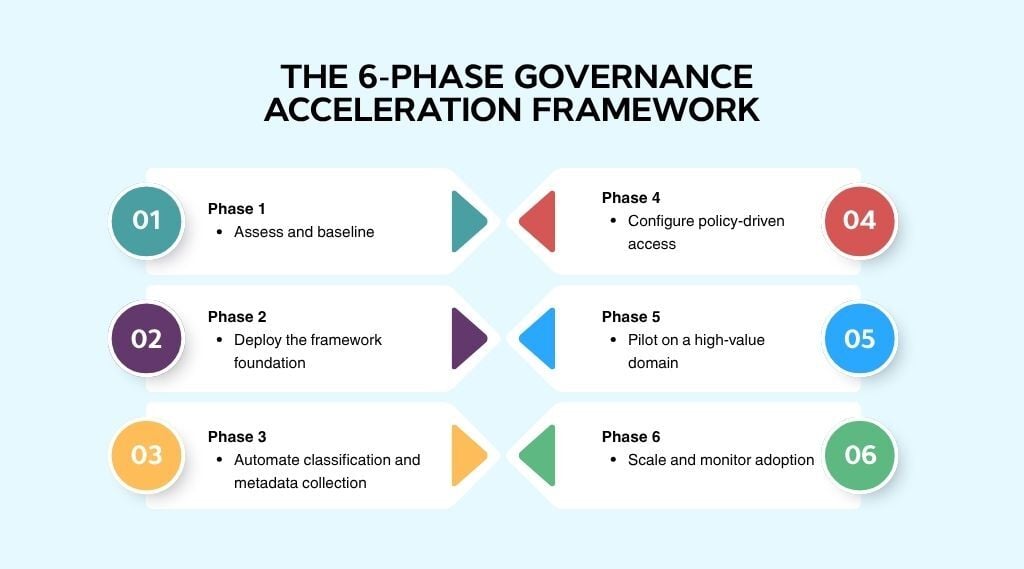
A data governance acceleration framework turns implementation into a repeatable sequence, enabling faster delivery without gaps in ownership, policy, or oversight.
It works across cloud, hybrid, and regulated environments and can be applied once to establish an operating model, then reused across domains with the same templates, workflows, and governance agents.
Phase 1: Assess and baseline
Start with automated discovery across priority data sources. The goal is to understand what exists before defining what must change.
Focus on:
-
Ungoverned or unowned datasets.
-
Sensitive data with limited controls.
-
Missing classifications or metadata.
-
Existing policies that must be retained.
-
High-value domains suitable for an initial pilot.
Governance agents can help surface ownership gaps, identify sensitive data exposure, and prioritize assets that require immediate attention. Human teams should validate the findings before using them as the basis for the rollout.
This phase should end with a documented current-state baseline. That baseline gives the next phase a clear view of where governance is strongest, where it is missing, and where implementation should begin.
Phase 2: Deploy the framework foundation
With the baseline in place, define how governance will operate.
Use pre-built role templates for:
-
Data owners
-
Data stewards
-
Data custodians
-
Policy approvers
-
Exception reviewers
Next, adapt policy templates for access, retention, privacy, classification, and data quality. These templates should reflect the organization’s regulatory obligations and business priorities.
Governance agents can recommend likely owners or stewards based on metadata, usage patterns, and organizational context. However, accountable leaders should approve those assignments before workflows go live.
This phase should close with a clear operating model, named owners, and approved policy scaffolding. Those elements give the automation in later phases something reliable to work against.
Phase 3: Automate classification and metadata collection
Once roles and policies are defined, automate the metadata work that usually slows governance down.
In research from Harvard Business Review Analytic Services sponsored by AWS, 52% of respondents moving forward with generative AI rated their data foundation’s readiness at five or lower out of 10.
Automated classification and metadata enrichment help teams identify those readiness gaps before they affect model development or production use.
Enable automated discovery and classification for:
-
Personally identifiable information.
-
Protected health information.
-
Financial and regulated data.
-
Business-critical datasets.
-
High-risk AI training data.
Capture lineage at the same time. This helps teams understand where data originates, how it changes, and which downstream systems depend on it.
Governance agents can enrich metadata, suggest classifications, and identify missing context. Teams should spot-check a sample of recommendations before scaling automation across larger environments.
This phase should produce a live metadata layer that updates as data changes. That gives the access, policy, and monitoring workflows in the next phase the context they need.
Phase 4: Configure policy-driven access
Translate approved policies into enforceable access workflows.
Standard requests should follow predefined rules. Sensitive use cases may require masking, time-limited access, or additional approval. High-risk exceptions should reach the appropriate owner or reviewer.
Governance agents can support this process by:
-
Detecting policy conflicts.
-
Recommending access decisions.
-
Triggering approval workflows.
-
Escalating unusual requests.
-
Recording decisions for audit review.
Define exception criteria before launch. Without clear boundaries, routine requests can still create manual bottlenecks.
This phase should end with a self-service access model that handles common requests quickly while preserving human review for higher-risk cases.
Phase 5: Pilot on a high-value domain
Choose a domain from the Phase 1 shortlist. Prioritize business value and governance urgency instead of selecting the easiest option.
Run the domain through Phases 2 to 4 on a compressed timeline. This proves whether the roles, policies, classifications, and workflows work together in practice.
During the pilot, monitor:
-
Ownership coverage.
-
Metadata completeness.
-
Classification accuracy.
-
Access request time.
-
Policy adherence.
-
Stewardship task completion.
Governance agents can surface gaps and recommend corrective actions while the pilot is still manageable. Capture before-and-after metrics so leaders can see the operational impact.
This phase should close with a tested implementation template that can be reused across other domains.
Phase 6: Scale and monitor adoption
The question now shifts to how to scale data governance across the enterprise. Apply the pilot template across additional domains, reusing approved roles, policies, workflows, and automation wherever possible.
As coverage expands, shift measurement from implementation activity to adoption outcomes. Track whether people are using governed data, completing stewardship tasks, and relying on approved access workflows.
Governance agents can continuously identify:
-
Missing ownership.
-
Metadata gaps.
-
Policy violations.
-
Classification changes.
-
Data quality issues.
-
Overdue governance actions.
Human owners should remain responsible for consequential decisions and complex exceptions.
Review the framework on a recurring cadence, especially when regulations change, new data sources are added, or AI use cases expand. The result should be scalable data governance that continues to run without returning to spreadsheets, tickets, and manual follow-up.
How governance agents automate and accelerate data governance
Accelerating data governance with AI creates the most value when automation removes repetitive work while keeping people in control of important decisions. OvalEdge Governance Agents support this approach by handling high-volume governance tasks within approved policies and routing exceptions to owners and stewards.
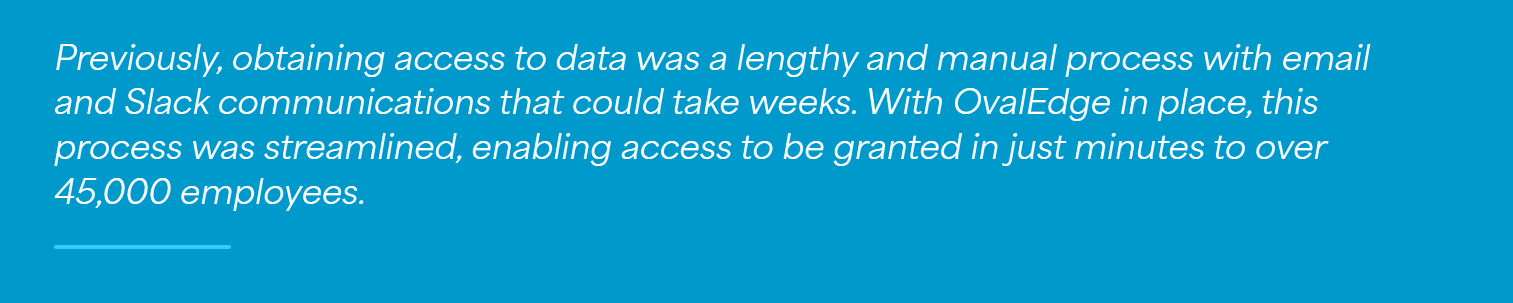
The impact can be seen in how a global consulting firm used OvalEdge to replace email- and Slack-based data access processes with governed automated workflows, reducing turnaround time from weeks to minutes for more than 45,000 employees.
Governance agents extend this same principle across metadata, ownership, quality, and policy execution. This kind of AI-powered data governance acceleration helps teams complete routine work faster without weakening accountability.
Metadata discovery and classification
Governance agents can continuously scan the data environment and identify assets that need attention.
For example:
-
Sift identifies sensitive, regulated, and business-critical data, then applies the relevant classifications and governance policies.
-
Curo finds missing descriptions, documentation, metadata, and business context within the catalog.
-
Lingo discovers business terms, suggests definitions, and flags duplicate or conflicting terminology.
This reduces the manual effort required to keep metadata complete and usable as the data estate changes.
Ownership and stewardship automation
Unclear ownership often delays policy execution and issue resolution. OvalEdge’s Helm agent analyzes organizational structures, usage patterns, and domain expertise to recommend suitable data owners and stewards for approval.
Governance teams can then focus on validating assignments and resolving genuine ownership conflicts instead of coordinating every decision manually.
Prioritization and quality management
Automation also helps teams decide where to act first.
-
Apex evaluates metadata, usage, quality issues, business impact, and governance policies to prioritize high-value governance work.
-
Litmus analyzes data profiles, schema patterns, and known issues to recommend technical data quality rules.
-
Notary evaluates assets against governance, quality, lineage, documentation, and ownership standards before recommending certification.
These agents help teams direct limited stewardship capacity toward the issues with the greatest business impact.
Human-controlled execution
Governance agents should operate within approved policies and confidence thresholds. Teams remain responsible for approving assignments, certifications, rules, and other consequential actions.
This approach helps organizations accelerate data governance while preserving accountability, traceability, and control.
Build vs. buy: Choosing your accelerator approach
The right approach depends on how quickly you need results, how much internal capacity you have, and whether governance must continue evolving after the initial rollout.
|
Approach |
Speed |
Cost |
Best fit |
|
Build in-house |
Slow |
High internal investment |
Organizations with strong governance engineering and platform teams |
|
Consulting-led accelerator |
Moderate |
High project cost |
Organizations that need hands-on implementation support |
|
Platform-native accelerator |
Fast |
Subscription and implementation cost |
Organizations seeking reusable automation and continuous governance |
Build in-house
An internal build offers the most control over workflows, integrations, and policy logic. However, teams must develop and maintain discovery, classification, stewardship, access, monitoring, and reporting capabilities themselves.
This works best when governance is strategically unique and the organization has dedicated engineering resources. It may be less practical when rapid governance implementation is the priority.
Use a consulting-led accelerator
Consulting firms can provide proven templates, operating models, and implementation expertise. This helps teams avoid common design mistakes and move faster than a fully internal build.
The main consideration is continuity. Confirm who will maintain the workflows, policies, and integrations after the engagement ends.
Choose a platform-native accelerator
A platform-native approach combines reusable governance capabilities with ongoing automation. It can support discovery, metadata enrichment, ownership recommendations, policy workflows, and continuous monitoring within one environment.
This approach fits organizations that want to accelerate data governance without creating and maintaining the supporting technology themselves.
When evaluating options, look beyond deployment speed. Assess:
-
Automation depth
-
Integration coverage
-
Human approval and exception controls
-
Metadata and classification capabilities
-
Policy and stewardship workflow support
-
Ongoing monitoring after implementation
The strongest option should support governance as a continuing operating capability, with enough flexibility to adapt as domains, policies, and AI use cases change.
Measuring governance adoption after acceleration
A faster rollout only matters if people use the governance model consistently. Adoption metrics show whether the new workflows are reducing friction, improving accountability, and helping teams work with governed data.
Track a focused set of measures:
-
Access turnaround time: Measure how long it takes to move from request to approval. A shorter cycle shows that policy-driven workflows are working.
-
Self-service access rate: Track the percentage of requests completed without manual intervention. This indicates whether users trust and understand the process.
-
Ownership coverage: Measure how many governed assets have approved owners and stewards. Gaps here often delay decisions and remediation.
-
Metadata completeness: Monitor whether priority datasets have descriptions, classifications, lineage, and business context.
-
Stewardship completion rate: Track how consistently stewards complete assigned reviews, validations, and issue-resolution tasks.
-
Policy exception resolution time: Measure how quickly unusual or high-risk cases are reviewed and closed.
-
Governed data usage: Check whether analysts, AI teams, and business users are adopting approved datasets instead of creating shadow pipelines.
-
Agent recommendation acceptance: Track how often teams approve, adjust, or reject agent-generated suggestions. This helps improve confidence thresholds and oversight rules.
Review these measures by domain rather than relying only on enterprise averages. A strong overall result can hide areas where ownership is weak or workflows remain difficult to use.
The goal is sustained governance adoption: faster access, clearer accountability, and fewer manual workarounds as coverage expands.
Common pitfalls to avoid when accelerating governance
Moving faster can expose weak decisions sooner. These are the mistakes that most often reduce the value of a governance accelerator:
-
Treating acceleration as a one-time project: Build a repeatable operating model that continues after the initial rollout.
-
Skipping stakeholder alignment: Confirm ownership, decision rights, and approval paths before automating workflows.
-
Automating unclear processes: Fix gaps in policy or accountability first. Automation will otherwise scale confusion.
-
Using generic templates without adaptation: Map policies and workflows to actual regulatory, business, and domain requirements.
-
Replacing human judgment with automation: Use governance agents to recommend, route, and monitor. Keep consequential approvals with accountable owners.
-
Ignoring exception handling: Define confidence thresholds, escalation paths, and review rules before agents begin acting at scale.
-
Measuring activity instead of adoption: Task volume means little without faster access, stronger ownership, and fewer workarounds.
The safest way to accelerate governance is to automate repeatable work while keeping accountability visible.
Accelerate governance with a model built to scale
A data governance accelerator should do more than shorten implementation. It should help teams establish clear ownership, automate repeatable work, improve governance adoption, and keep controls effective as the data environment changes.
OvalEdge brings these capabilities together through reusable governance workflows, metadata intelligence, policy-driven processes, and governance agents that support continuous execution with human oversight.
Instead of rebuilding governance from scratch for every domain, teams can apply a repeatable model that delivers value faster and scales with new data and AI priorities.
Ready to accelerate your governance program? See how OvalEdge Governance Agents and reusable workflows can take your team from planning to execution in weeks. Book a demo with OvalEdge.
.png?width=1081&height=173&name=Forrester%201%20(1).png)
.png?width=1081&height=241&name=KC%20-%20Logo%201%20(1).png)