.png)
DAMA-DMBOK, short for the Data Management Body of Knowledge, is a vendor-neutral framework from DAMA International that defines best practices for managing data as an enterprise asset. It organizes data management into 11 knowledge areas, with data governance at the center of the DAMA wheel coordinating the other 10.
Structure alone is not enough.
According to a Gartner press release from 2024, 80% of data and analytics governance initiatives will fail by 2027 because they lack a real crisis to anchor them to an outcome the business cares about.
DAMA-DMBOK gives you the reference model. The hard part is applying it at your own pace, where it matters most.
This guide covers what DAMA-DMBOK is, the DAMA wheel, all 11 knowledge areas, the DMBOK 3.0 update, and how to adopt it step by step.
What is DAMA-DMBOK?
DAMA-DMBOK is a globally recognized framework that defines best practices for managing data as a strategic enterprise asset. It is published by DAMA International, a non-profit professional association focused on advancing the data management and data governance disciplines.
Rather than prescribing specific tools or technologies, DAMA-DMBOK gives organizations a common language, a structure, and a set of principles for how to govern, design, secure, integrate, and use data across its full lifecycle. It works as a reference model that helps teams align data initiatives across business and IT.
In practice, organizations use DAMA-DMBOK to:
-
Treat data as a managed asset, not a by-product of systems
-
Define clear ownership, decision rights, and accountability
-
Standardize data definitions, policies, and governance processes
-
Support analytics, compliance, and operational decision-making
DAMA-DMBOK does not tell you how to implement governance in one prescribed way. It defines what good data management looks like and lets you adapt it to your maturity, your regulatory environment, and your business goals. It is the most widely adopted data governance framework, and the reference model most other approaches borrow from.
Why the framework matters
Governance fails when it has no shared structure. DAMA-DMBOK connects governance with architecture, quality, metadata, and security so it scales across the enterprise instead of breaking under complexity.
It maps closely to the broader pillars of data governance, ties compliance obligations like GDPR, CCPA, and BCBS 239 to repeatable practices, and turns policy into an operating model rather than documentation that sits on a shelf. Where most teams still struggle is execution at scale, and that is where agentic data governance extends the framework into daily operations.
Done well, the payoff shows up as the measurable benefits of data governance: higher trust in data, fewer audit fire drills, and faster decisions.
The DAMA wheel: How the knowledge areas fit together
What is the DAMA wheel? The DAMA wheel is the visual model DAMA-DMBOK uses to show how data management works as one connected system. Data governance sits at the hub, and the 10 other knowledge areas, from architecture to data quality, sit around it. The wheel makes one point clearly: governance does not own the data work; it coordinates it, so no discipline runs in a silo.
At the center of the wheel, data governance acts as the control layer that defines decision rights, policies, standards, and accountability. Around it sit the 10 other knowledge areas, each with its own practices, none operating alone.
The point the wheel reinforces is that governance is not an extra layer of bureaucracy. It is the coordinating function that makes scale and consistency possible, so technical and business teams work within shared rules.
The wheel also captures the interdependencies. No discipline succeeds in isolation, as the table below shows.
|
Knowledge area |
Leans on |
So it can |
|
Data Quality |
Modeling for clear definitions, Governance for ownership |
Trust accuracy and fix issues at the source |
|
Metadata and Lineage |
Integration, Architecture, Operations |
Trace where data came from and how it changed |
|
Data Security |
Classification standards, lifecycle rules, access policies |
Protect data without blocking legitimate use |
|
Analytics and BI |
Trusted, governed data through the pipeline |
Produce reporting people can actually rely on |
|
Every area |
Data Governance at the hub |
Work to shared rules instead of in silos |
Implement these areas separately, and you get duplicated effort, conflicting rules, and gaps in accountability. Design controls that span the dependencies, and the whole system holds together.
The 11 knowledge areas of DAMA-DMBOK explained
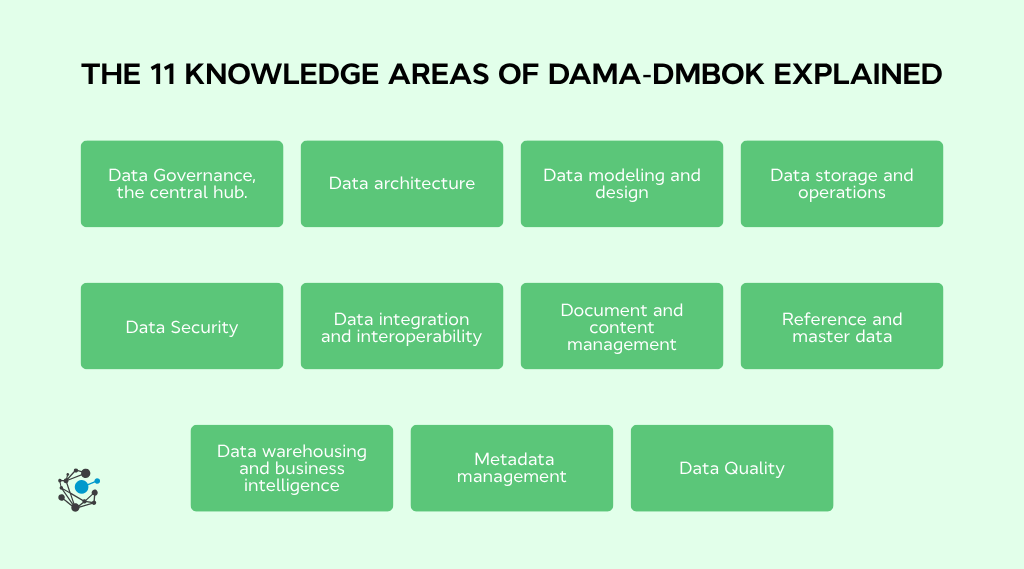
Each knowledge area covers a specific discipline, and data governance sits at the center, coordinating standards and accountability across all of them.
1. Data Governance, the central hub
Governance defines who makes data decisions, how those decisions are enforced, and how accountability is maintained. It sits at the core of the wheel, with roles like data owners, stewards, and councils, plus the policies, decision rights, and escalation paths that hold them together.
2. Data architecture
How data is structured, integrated, and flows across the organization. The framework guides teams to design for scalability, interoperability, and long-term governance, so policies apply consistently whether data lives in operational systems, warehouses, or the cloud.
3. Data modeling and design
How entities, relationships, and definitions are designed. Standardized models reflect business concepts and support both transactional and analytical use. Clear modeling reduces ambiguity and helps different teams interpret data the same way.
4. Data storage and operations
How data is physically stored, accessed, backed up, and maintained across its lifecycle, from creation to archival or deletion. This area keeps data accessible, secure, and cost-effective while meeting retention and regulatory requirements.
5. Data Security
Protecting data from unauthorized access, misuse, or loss. Security is built into governance through access controls, classification standards, and compliance requirements, helping teams balance accessibility with risk.
6. Data integration and interoperability
Moving and transforming data reliably across many systems through ETL, ELT, streaming, and APIs. Strong practices here reduce silos and make enterprise-wide reporting and analytics possible.
7. Document and content management
Governing unstructured data such as contracts, emails, and documents. This is the area teams most often forget, yet unstructured content carries real compliance and discovery risk.
8. Reference and master data
Managing shared, critical data such as customer, product, supplier, and location records, including defining authoritative sources and maintaining consistency. It helps to understand metadata versus master data before defining golden records.
9. Data warehousing and business intelligence
Connecting analytics platforms and reporting with governance, so analytical data is governed, documented, and maintained from ingestion to consumption. This supports reliable reporting and self-service BI.
10. Metadata management
Governing "data about data" through catalogs, lineage, and business glossaries. Metadata is what makes data discoverable, and lineage is what makes it traceable and auditable. Most teams operationalize this with dedicated metadata management tooling.
11. Data Quality
Measuring, monitoring, and improving the accuracy, completeness, consistency, and timeliness of data. Quality rules, metrics, and stewardship tied to business impact reduce errors, rework, and downstream risk. Teams usually run this through a dedicated data quality framework.
Is there a DMBOK 3.0?
Yes, but it is not released yet. DAMA International is working on DMBOK 3.0 as an update that modernizes the framework rather than replacing its foundations. The core idea, data governance at the center coordinating the knowledge areas, is expected to carry forward.
Based on what DAMA has shared, the update focuses on a few themes:
-
AI and machine learning governance. Guidance for governing the data that trains and feeds AI systems, an area the framework did not originally address.
-
Cloud-native and modern data architectures. Bringing the framework in line with how data is actually stored and moved today.
-
A redesigned DAMA wheel. A clearer visual model that better reflects how the disciplines connect.
-
Streamlined, more consistent content. Tighter guidance that is easier to apply in practice.
Until DMBOK 3.0 is released, the current framework still applies. Any DAMA-DMBOK program you build today should be designed to absorb the 3.0 refinements when they land, not paused while you wait for them. The fundamentals, governance at the center, the knowledge areas, and the emphasis on managing data as an asset are not going away.
How to implement DAMA-DMBOK step by step
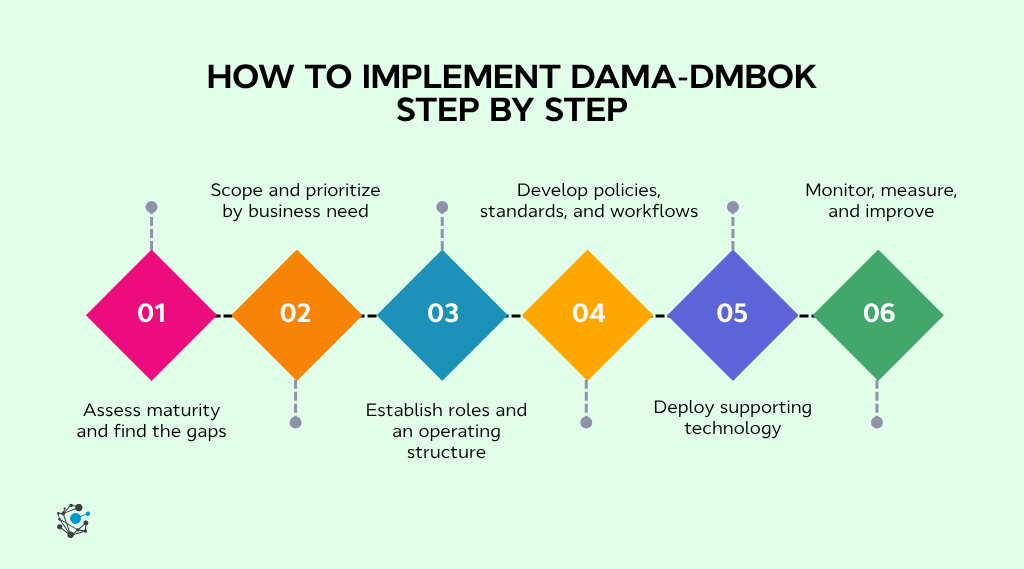
DAMA-DMBOK works best as a phased program, not a one-time rollout. The goal is to establish clear ownership, apply governance where it creates the most value, and mature over time.
Step 1: Assess maturity and find the gaps.
Get a clear view of where you stand: the governance roles you have today, your current quality issues and their business impact, the state of your metadata and lineage, and any gaps in security or compliance. The output is a prioritized list of risks to address first, not a perfect scorecard.
Step 2: Scope and prioritize by business need.
DAMA-DMBOK is broad by design, so effective adoption means narrowing focus. Identify the critical data domains that drive revenue, reporting, or compliance, map them to the relevant knowledge areas, and decide which areas to implement deeply and which to keep light. This is how you avoid a boil-the-ocean initiative.
Step 3: Establish roles and an operating structure.
Name data owners accountable for decisions, data stewards who handle day-to-day quality and definitions, and a council to resolve conflicts and set priorities. Pick a data governance model that fits your structure, and spell out escalation paths and decision rights.
Step 4: Develop policies, standards, and workflows.
Turn intent into executable rules: data definitions and a business glossary, access and usage policies, quality rules and thresholds, and lifecycle and retention policies. Keep them tied to real use cases rather than theoretical completeness.
Step 5: Deploy supporting technology.
Technology does not replace governance, but it enables scale. Choose tools that support your workflows rather than create new silos: a catalog and metadata management, quality monitoring, lineage automation, and access control. Tooling should follow your policies, not drive them.
Step 6: Monitor, measure, and improve.
Track KPIs for quality, usage, and issue resolution, review at regular intervals, and refine as the business changes. This is what keeps the program trusted rather than quietly abandoned.
What makes DAMA-DMBOK hard to adopt
Most of the difficulty with DAMA-DMBOK is specific to the framework itself, not to governance in general.
-
It is large. All 11 knowledge areas at once will overwhelm most teams. Adopt it modularly. Start with governance, quality, and metadata, then expand as maturity grows.
-
It is strategic, not operational. DAMA-DMBOK tells you what good data management looks like, not how to run it day to day. You have to translate the reference model into your own workflows, roles, and tooling.
-
It is tool-agnostic. The framework deliberately names no technology, so teams have to map each area to the platforms that actually enforce it. This is where a catalog, metadata management, and quality tooling turn the model into something operational.
-
It leans heavily on stewardship. The framework assumes people are actively curating definitions, quality, and ownership. Without that human layer, or automation that supports it, the model stays on paper.
DAMA-DMBOK in practice: Delta Community Credit Union
As Delta Community Credit Union (DCCU) expanded its analytics, it ran into familiar governance gaps: no single source of truth, inconsistent definitions, and data dictionaries passed around over email. One telling pain point was the absence of a shared definition for a core term, "member," which directly affected KPIs like growth and attrition.
How OvalEdge helped
DCCU built a governance model that maps closely to DAMA-DMBOK, and OvalEdge operationalized it:
-
Set up clear ownership and stewardship led by business stakeholders
-
Standardized definitions through a central business glossary
-
Made metadata and lineage visible, so anyone could see where data came from and how a metric was calculated
-
Ran a crowdsourced stewardship program that engaged business users to curate content and define terms
-
Centralized metadata, automated lineage, and enabled self-service access, so people could trust data without spreadsheets or email threads
The result
The payoff showed up as higher trust in data, stronger collaboration across locations, and proactive resolution of quality issues. As Dr. Su Rayburn, VP of Information Management and Analytics, put it, OvalEdge became "a water cooler where people collaborate and have meaningful data conversations." That is DAMA-DMBOK working the way it is meant to.
Conclusion
DAMA-DMBOK gives you a way to move from scattered data practices to a system that scales. The real shift happens when the framework stops living in documents and starts shaping daily decisions about who owns data, how issues get resolved, and how trust gets built across teams. The organizations that succeed treat it as a living operating model, not a one-time exercise.
The next step is turning structure into execution: translating knowledge areas into workflows, automating controls, and making ownership visible across your ecosystem. This is where many teams stall, not because the framework is unclear, but because they lack the foundation to operationalize it.
OvalEdge closes that gap with a unified platform for catalog, metadata management, lineage, quality, and stewardship, plus built-in agents that handle discovery, classification, and quality with humans in the loop.
If you are ready to move beyond theory and build governance that works at enterprise scale, book a demo with OvalEdge and start operationalizing DAMA-DMBOK with confidence.
.png?width=1081&height=173&name=Forrester%201%20(1).png)
.png?width=1081&height=241&name=KC%20-%20Logo%201%20(1).png)