Data Galaxy Alternatives: Compare Top Governance and Discovery Platforms
Compare leading Data Galaxy competitors and evaluate which platform best supports your governance workflows, discovery goals, and operational data management needs.
In this article
What are the best Data Galaxy alternatives?
The best Data Galaxy alternatives include OvalEdge, Collibra, Informatica, erwin Data Intelligence, Alation, and Atlan. These platforms differ in governance depth, lineage capabilities, AI readiness, workflow automation, and metadata management. Some focus more on business discovery and metadata collaboration, while others prioritize governance execution, lineage depth, workflow flexibility, and enterprise-scale governance management.
-
OvalEdge focuses on unified governance with built-in lineage, data quality, access workflows, and AI-driven governance automation.
-
Collibra is widely used for enterprise governance, stewardship, and compliance management.
-
Informatica provides enterprise-scale governance, MDM, lineage, and integration capabilities.
-
erwin Data Intelligence focuses on metadata management, lineage, and data modeling for governance-heavy environments.
-
Alation emphasizes search-driven data discovery and business-friendly cataloging.
-
Atlan supports modern metadata management with collaboration-focused workflows for data teams.
The right choice depends on whether your priority is governance automation, business discovery, lineage depth, AI capabilities, or implementation flexibility. Let’s compare these Data Galaxy alternatives side by side.
Data Galaxy alternatives compared
Here’s a quick comparison of the top Data Galaxy alternatives across governance, metadata management, AI readiness, and operational capabilities.
|
Tool |
Best for |
Core strength |
AI capability |
Limitation |
|
OvalEdge |
Unified governance operations |
Governance + quality + lineage |
askEdgi, AI & automated governance, MCP |
Broader platform scope |
|
Collibra |
Enterprise governance programs |
Stewardship and policy workflows |
AI-assisted governance |
Longer implementation cycles |
|
Alation |
Business-friendly discovery |
Search-driven catalog |
AI search and recommendations |
Limited native quality workflows |
|
Atlan |
Modern data collaboration |
Active metadata experience |
AI copilots and discovery |
Governance depth varies by use case |
|
Informatica |
Large-scale enterprise ecosystems |
MDM and enterprise integration |
CLAIRE AI engine |
Higher implementation complexity |
|
erwin Data Intelligence |
Metadata and lineage governance |
Data modeling and lineage |
Metadata intelligence |
Less business-user focused |
The right platform depends on how far you want to move beyond discovery into governance execution, automation, and operational data trust.
What users say about Data Galaxy
Data Galaxy is commonly used as a business-focused data catalog and governance platform that helps organizations improve data literacy, glossary management, and metadata discovery. Many teams adopt it to create a shared understanding of data across business and technical users. Reviews on G2 and Featured Customers highlight its focus on contextual discovery and user-friendly adoption experiences.
Strengths users mention
-
Users frequently highlight its intuitive interface and lightweight experience for business teams. Many reviewers mention faster adoption compared to heavier governance platforms.
-
Reviews often praise the platform’s glossary management and visual relationship mapping capabilities for improving collaboration and data understanding.
-
Several users mention that the platform helps centralize metadata documentation and makes discovery easier for non-technical stakeholders.
Limitations users mention
-
Governance workflows and operational governance capabilities can feel limited for complex enterprise environments.
-
Organizations needing deeper lineage visibility, governance coordination, or workflow flexibility may require broader governance tooling over time.
-
Limitations around customization depth, governance administration, and scalability for highly mature governance programs.
-
Organizations requiring native data quality operations or governed access workflows may evaluate platforms with broader operational governance coverage.
-
Some enterprise teams also mention that governance requirements can outgrow lightweight discovery workflows, particularly when governance expands into lineage operations, stewardship accountability, policy coordination, and operational governance management.
Many organizations initially adopt Data Galaxy to improve data literacy, business alignment, and metadata accessibility. As governance programs mature, requirements often expand into stewardship coordination, lineage operations, access governance, policy execution, and operational data quality management across enterprise environments.
That is typically where organizations begin evaluating alternatives based on governance maturity, operational requirements, and long-term governance scalability.
Best Data Galaxy alternatives for your use case
Organizations evaluate Data Galaxy for different reasons. Some teams need stronger governance execution, while others need deeper lineage visibility, automated access controls, AI-ready metadata, or built-in data quality operations. That is why it helps to compare alternatives based on the operational problems they solve after discovery and data literacy.
The following tools are grouped by the governance and metadata use cases buyers most commonly evaluate during enterprise data platform selection.
Tools for unified data governance and operational governance
This group fits organizations that need more than business glossary management or metadata discovery. These platforms are commonly evaluated by enterprises looking for governance workflows, stewardship operations, data quality controls, lineage visibility, and governed access management in one system.
1. OvalEdge
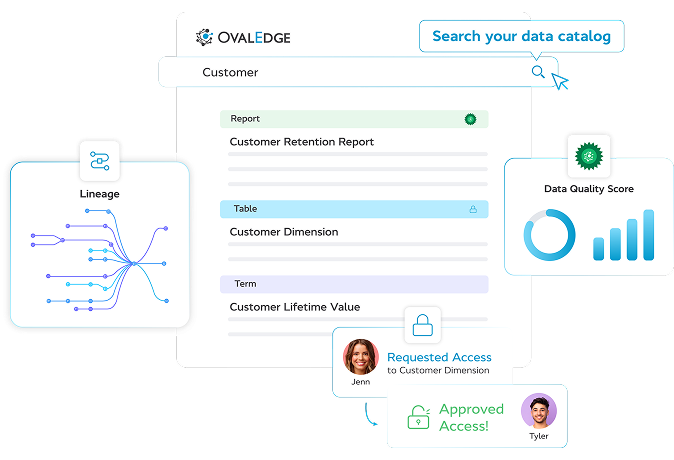
OvalEdge is an AI-first data governance and data intelligence platform built for enterprises that need governance execution at scale. It combines cataloging, lineage, data quality, access management, governance workflows, and AI-driven automation in one platform. The focus is on helping teams discover data and ensuring data is trusted, governed, and usable across analytics and AI initiatives.
What is it used for
Organizations use OvalEdge to operationalize governance across data ecosystems without relying on disconnected governance tools.
The platform supports enterprise data cataloging, automated lineage, stewardship workflows, governed data access, metadata management, business glossary creation, and data quality monitoring. Teams also use OvalEdge to improve AI readiness by grounding AI discovery and analytics in governed metadata, trusted definitions, lineage context, and approved business policies.
When buyers choose it over Data Galaxy
Organizations often evaluate Data Galaxy for business-friendly discovery, glossary management, and data literacy initiatives. Buyers typically look at OvalEdge when they need governance to move beyond discovery into execution across quality, access, lineage, stewardship, and AI readiness.
Governance execution beyond discovery
Data Galaxy helps teams understand and document data relationships effectively. However, organizations with mature governance programs often need deeper workflow flexibility, stronger governance administration, and broader execution capabilities across enterprise environments.
OvalEdge addresses this by embedding governance workflows directly into the platform. Governance teams can manage stewardship assignments, approvals, certifications, ownership tracking, policy enforcement, and governance analytics from one operational layer. The platform also helps teams identify ungoverned assets, unresolved quality gaps, and missing governance policies without relying on disconnected processes.
Deeper lineage visibility and contextual metadata
Data Galaxy is commonly adopted for contextual discovery and business glossary experiences. Enterprises with large-scale data environments may eventually require deeper lineage visibility and stronger context around how trusted data moves across systems.
OvalEdge combines technical metadata with business context, quality indicators, ownership information, stewardship data, certifications, lineage relationships, and governance policies inside a unified experience. The platform also supports deeper lineage coverage across enterprise systems and provides impact analysis capabilities that help teams understand downstream dependencies before changes are made.
Governance-ready self-service access
Many organizations want self-service access workflows as governance adoption grows. In several governance platforms, the workflow often stops after request creation and approval routing through external systems.
OvalEdge extends this process through governed access fulfillment. Once approvals are granted, the platform can automate provisioning for systems such as Snowflake and Databricks. This helps reduce manual administrative effort while maintaining governance visibility and auditability throughout the process.
Built-in data quality operations
Data Galaxy supports data understanding and metadata discovery well, but organizations with mature governance requirements often need stronger native data quality operations tied directly to governance workflows.
OvalEdge includes built-in profiling, trust scoring, rule engines, reconciliation workflows, anomaly detection, and data quality monitoring inside the governance platform itself. The platform also emphasizes reducing “data quality debt” by helping governance teams identify stale assets, undocumented datasets, incomplete governance coverage, and unresolved quality risks early.
AI-ready governance and contextual discovery
Data Galaxy focuses heavily on business understanding and collaborative discovery. Enterprises preparing data environments for AI initiatives often require stronger governance controls around how AI systems discover, interpret, and retrieve enterprise information.
Through askEdgi and Model Context Protocol (MCP) integrations, OvalEdge lets organizations connect governed metadata into tools like Claude and ChatGPT while grounding responses in approved enterprise context. The platform also adds lineage, quality signals, ownership details, and governance policies directly into AI-assisted discovery experiences to improve trust and reduce hallucinated responses.
What changes after adoption
Organizations moving from discovery-focused governance to execution-focused governance often see changes in how governance activities are executed across teams. Instead of governance remaining dependent on documentation and manual stewardship, governance activities become measurable, automated, and easier to scale across the data ecosystem.
Governance becomes measurable and scalable
After adopting OvalEdge, governance teams typically gain better visibility into ownership gaps, undocumented assets, unresolved quality issues, and missing policies. Built-in governance analytics help stewards identify governance risks earlier and prioritize remediation activities directly from the platform.
Teams also spend less time manually coordinating governance activities because stewardship workflows, certifications, approvals, and governance actions are integrated into the catalog experience itself.
Business users gain trusted discovery
Business users often move beyond static glossary experiences into governed self-service discovery. Instead of only finding datasets, they can also understand lineage, quality indicators, access permissions, ownership, certifications, and usage context from a single interface.
OvalEdge’s contextual metadata approach also improves confidence in analytics and AI usage because users can validate whether data assets are trusted, governed, and actively maintained before using them downstream.
Governance workflows accelerate
Organizations adopting OvalEdge frequently improve governance turnaround times through workflow automation and governed access fulfillment. Users can request access directly from cataloged assets while approvals, provisioning, and governance tracking remain connected to governance policies.
For teams using Snowflake or Databricks, approved access can be automatically provisioned without additional manual administration steps. This helps governance programs scale without increasing manual administrative effort.
Data quality becomes measurable
Many organizations also gain better visibility into data trust and data quality debt. OvalEdge provides built-in profiling, anomaly detection, reconciliation support, trust scoring, and rule-based monitoring to help teams continuously monitor reliability across enterprise data assets.
Gousto used OvalEdge to strengthen governance and improve trust in data across pricing, nutritional, and allergen information workflows. The company improved data reliability across critical customer-facing processes while aligning governance initiatives with operational decision-making and customer experience goals.

AI governance and automation capabilities
Enterprise AI initiatives require more than metadata discovery. Teams also need AI systems to retrieve trusted business context, respect governance controls, and stay aligned with approved enterprise definitions.
-
MCP integrations: OvalEdge’s Model Context Protocol (MCP) capability connects governed enterprise metadata with tools like Claude and ChatGPT so AI discovery remains tied to approved business context, stewardship information, lineage relationships, and governance policies.
-
Governed AI responses: AI-assisted answers are grounded in governed enterprise data instead of disconnected search results. This helps teams improve trust in AI-generated outputs across analytics, governance, and business workflows.
-
Metadata grounding: OvalEdge combines lineage, ownership, quality indicators, glossary definitions, and governance context to help AI systems retrieve more reliable enterprise information during discovery and decision-making processes.
The platform also supports AI-assisted governance through automated metadata enrichment, contextual relationship mapping, and AI-driven lineage discovery across enterprise systems. By grounding AI discovery in governed metadata, organizations can reduce hallucinated responses while improving consistency across analytics and AI initiatives.
This approach helps enterprises scale AI adoption while keeping governance processes connected to trusted enterprise data.
Things to consider
OvalEdge is designed for organizations looking to operationalize governance across large and growing data ecosystems. Teams evaluating the platform should assess governance maturity, workflow requirements, connector coverage, and long-term AI governance goals before implementation.
Important considerations include:
-
The platform supports a broad governance scope that includes lineage, quality, access management, stewardship, and governance workflows in one system. Teams should plan ownership and governance processes clearly before rollout.
-
Organizations with complex environments may benefit most from OvalEdge’s governance automation and metadata management capabilities.
-
Teams focused only on lightweight discovery or glossary management may not initially require the broader governance depth the platform provides.
-
AI governance capabilities such as MCP integrations, governed AI responses, and metadata-driven automation are especially valuable for enterprises scaling AI initiatives.
-
The platform’s configurability and workflow flexibility can support broad adoption across business and technical teams when governance programs mature over time.
Ratings, reviews, and analyst validation
OvalEdge is consistently recognized for governance depth, lineage visibility, workflow flexibility, and governance capabilities across analyst reports and review platforms. Users frequently mention the platform’s breadth of governance functionality, business glossary integration, automation capabilities, and responsive support experience.
Current review platform ratings include:
- G2 reviews: 5/5 rating. Users highlight governance workflows, lineage visibility, metadata discovery, and ease of collaboration across technical and business teams.
- Gartner Peer Insights: 4.7/5 rating. Customers frequently mention strong implementation support, governance coverage, and flexibility across enterprise governance programs.
- TrustRadius reviews: 10/10 rating. Reviews often point to operational governance capabilities, integrated quality visibility, and centralized metadata management.
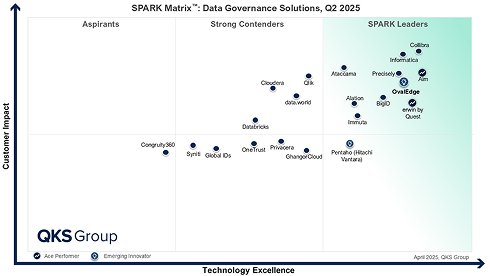
The platform has also received analyst recognition through the 2025 Gartner Magic Quadrant and SPARK Matrix evaluations for data governance and data intelligence capabilities.
Did you know?A Forrester Total Economic Impact study found that organizations using OvalEdge achieved 337% ROI with payback in under six months. The analysis linked those outcomes to faster governance execution, lower manual stewardship effort, improved access management, and stronger governance automation across enterprise environments. For teams evaluating long-term governance scalability, the study highlights how operational governance can deliver measurable business impact beyond metadata visibility alone. |
See how OvalEdge compares in your environment
If you are evaluating Data Galaxy alternatives, OvalEdge is worth a closer look. Explore how OvalEdge fits your architecture, governance needs, and rollout plan.
2. Collibra
Collibra is an enterprise data governance platform focused on stewardship, policy management, metadata governance, and regulatory compliance. It is commonly used by large organizations looking to standardize governance processes across distributed data environments.
What is it used for
Organizations use Collibra to manage governance workflows, business glossary initiatives, metadata management, stewardship programs, and compliance operations. The platform is also used to improve governance visibility across analytics, reporting, and enterprise data management initiatives.
When buyers choose it over Data Galaxy
Organizations evaluating Data Galaxy sometimes move toward Collibra when governance maturity increases and governance processes require more formal stewardship and policy management.
Common reasons buyers evaluate Collibra include:
- More structured governance workflows across enterprise teams.
- Stewardship and accountability models tied to governance operations.
- Governance policy management for regulated environments.
- Broader governance operating models across large organizations.
Buyers also evaluate Collibra when governance programs require centralized governance ownership across multiple business units instead of primarily focusing on discovery and business glossary experiences. The platform is often considered in organizations building governance operating frameworks tied to compliance and enterprise governance initiatives.
What changes after adoption
After adopting Collibra, organizations typically gain more centralized governance oversight and standardized governance processes across teams. Governance ownership becomes more formalized through stewardship assignments, governance domains, and policy-driven workflows.
Common operational changes include:
- Governance processes become more standardized across departments.
- Data ownership and stewardship responsibilities become easier to track.
- Governance documentation becomes more centralized.
- Compliance-focused governance initiatives gain more operational structure.
Organizations also use the platform to improve governance accountability and create more consistent governance processes across reporting, analytics, and enterprise data initiatives.
AI and automation capabilities
Collibra includes AI-assisted governance and metadata automation capabilities designed to improve cataloging, stewardship, and governance workflows.
Capabilities include:
- AI-assisted metadata enrichment and classification.
- Automated lineage and metadata discovery across connected systems.
- Governance workflow automation for stewardship processes.
- Policy management and governance rule orchestration.
- AI-assisted search and data discovery experiences.
The platform also integrates with broader enterprise data ecosystems to support governance visibility across analytics and operational environments. Organizations evaluating AI governance often use Collibra to improve governance consistency and metadata standardization across distributed data assets.
Things to consider
Collibra is commonly evaluated by large enterprises with formal governance operating models and dedicated stewardship teams. Organizations with smaller governance teams may require additional implementation planning and governance process alignment before rollout.
A few considerations buyers frequently evaluate include:
- Implementation timelines can be longer for enterprise-scale governance programs.
- Governance workflows may require dedicated administration and ongoing stewardship and ownership.
- Some organizations may need additional tooling for operational data quality workflows.
- Customization and governance configuration can require experienced governance teams.
Teams evaluating discovery-first or lightweight governance approaches sometimes compare Collibra against platforms with faster operational rollout models.
Ratings and reviews
On G2 and TrustRadius, users frequently mention governance workflow management, stewardship visibility, and metadata organization capabilities. Reviews also highlight governance standardization and enterprise governance support across large organizations.
Some reviewers mention implementation complexity, administrative overhead, and learning curve considerations for broader deployments. Users also discuss the effort required to maintain governance workflows and stewardship processes over time.
Real user discussions around Collibra often describe the platform as useful for formal governance initiatives and regulated environments. Some users mention that deployments can become process-heavy and may require dedicated governance ownership to maintain adoption consistently. Others mention that long-term adoption depends heavily on business participation and governance process maturity.
Also read → Comparing Collibra alternatives in 2026? Compare tools before you buy
Evaluate BigID alternatives with agentic analytics and governance frameworks
Understand how agentic analytics accelerates data governance through AI-driven workflows, real-time insights, and governed self-service. This whitepaper shows how teams operationalize governance for analytics and AI readiness.
Tools for enterprise metadata management and lineage
This group fits organizations managing large enterprise ecosystems where metadata consistency, lineage visibility, integration governance, and cross-system data movement are operational priorities. These platforms are commonly evaluated by enterprises with complex architectures, distributed data environments, and mature governance programs.
3. Informatica
Informatica is an enterprise data management platform focused on metadata management, data integration, lineage, governance, MDM, and cloud data operations. It is commonly used in large enterprises managing complex multi-system environments.
What is it used for
Organizations use Informatica to manage enterprise data integration, metadata governance, lineage visibility, master data management, cloud integration workflows, and compliance-driven governance initiatives. The platform is also used to centralize governance across large operational and analytics ecosystems.
When buyers choose it over Data Galaxy
Organizations evaluating Data Galaxy sometimes move toward Informatica when governance initiatives become tightly connected to enterprise integration, data movement, and operational data management requirements.
Common reasons buyers evaluate Informatica include:
-
Enterprise-scale integration across cloud and on-prem systems.
-
Centralized metadata management tied to operational data pipelines.
-
MDM and governance requirements within regulated environments.
-
Lineage visibility across complex enterprise architectures.
Buyers also evaluate Informatica when governance teams need stronger alignment between integration workflows, metadata operations, and enterprise-wide data management programs. The platform is commonly considered in environments with large existing Informatica ecosystems.
What changes after adoption
After adopting Informatica, organizations often centralize metadata visibility and operational governance processes across enterprise systems. Data integration teams, governance teams, and analytics teams gain more standardized visibility into data movement and lineage dependencies.
Operational changes commonly include:
-
Governance processes become more connected to integration workflows.
-
Metadata visibility improves across enterprise applications and pipelines.
-
Data lineage becomes easier to trace across operational systems.
-
Enterprise data management initiatives become more centralized.
Organizations also use the platform to improve consistency between governance operations, integration activities, and enterprise reporting environments.
AI and automation capabilities
Informatica includes AI-driven automation capabilities through its CLAIRE AI engine and broader cloud data management ecosystem.
Capabilities include:
-
AI-assisted metadata discovery and classification.
-
Automated lineage mapping across connected systems.
-
Intelligent data integration recommendations.
-
AI-driven data quality monitoring and anomaly detection.
-
Automated governance policy suggestions and metadata enrichment.
The platform also supports automation across integration workflows, governance processes, and enterprise metadata operations. Organizations evaluating AI-assisted governance often use Informatica to improve operational visibility across large enterprise environments.
Things to consider
Informatica is commonly evaluated by enterprises with large-scale integration and governance programs. Organizations with smaller governance initiatives may require significant implementation planning and operational ownership during rollout.
A few considerations buyers frequently evaluate include:
-
Implementation complexity can increase across large enterprise deployments.
-
Licensing structures may become difficult to manage across multiple products.
-
Administration and platform management often require experienced technical teams.
-
Some organizations may use only part of the broader Informatica ecosystem while still managing enterprise-scale operational overhead.
Teams primarily focused on lightweight discovery or business glossary experiences may evaluate simpler governance alternatives depending on governance maturity.
Ratings and reviews
On G2 and Gartner Peer Insights, users frequently mention integration flexibility, enterprise connectivity, metadata visibility, and support for large operational environments. Reviews also reference lineage capabilities and governance alignment across enterprise systems.
Some reviewers mention deployment complexity, licensing considerations, and operational maintenance requirements. Users also discuss the learning curve involved in managing broader Informatica product ecosystems across enterprise implementations.
Users on Reddit frequently mention reliable enterprise integration support and mature ETL functionality. Users also point to expensive licensing, slower development workflows, and additional operational overhead compared to newer cloud-native and dbt-centered engineering approaches.
4. erwin Data Intelligence
erwin Data Intelligence is a metadata governance and data intelligence platform focused on lineage visibility, data modeling, metadata management, and governance standardization across enterprise systems.
What is it used for
Organizations use erwin Data Intelligence to manage enterprise metadata, improve lineage visibility, support governance documentation, and align data modeling with governance initiatives. The platform is also used to improve impact analysis and metadata consistency across operational and analytics environments.
When buyers choose it over Data Galaxy
Organizations evaluating Data Galaxy sometimes move toward erwin Data Intelligence when metadata governance and lineage visibility become larger operational priorities.
Common reasons buyers evaluate erwin include:
-
Broader metadata management across enterprise systems.
-
Deeper integration with data modeling and architecture initiatives.
-
Lineage visibility tied to governance documentation efforts.
-
Governance alignment across technical and operational environments.
Buyers also evaluate erwin when governance programs require more technical metadata visibility and tighter alignment between architecture teams, governance teams, and integration teams. The platform is commonly considered in organizations managing mature enterprise data architecture initiatives.
What changes after adoption
After adopting erwin Data Intelligence, organizations often centralize metadata documentation and improve visibility into lineage dependencies across systems. Governance and architecture teams gain more structured governance documentation and metadata alignment across enterprise programs.
Operational changes commonly include:
-
Lineage visibility improves across operational and reporting systems.
-
Metadata governance becomes more standardized across teams.
-
Architecture and governance teams gain shared visibility into dependencies.
-
Impact analysis becomes easier during system or schema changes.
Organizations also use the platform to improve consistency between governance documentation, enterprise modeling activities, and metadata operations across distributed systems.
AI and automation capabilities
erwin Data Intelligence includes automation capabilities focused on metadata discovery, lineage analysis, and governance visibility.
Capabilities include:
-
Automated metadata harvesting across enterprise systems.
-
Lineage discovery and impact analysis automation.
-
Metadata standardization across governance repositories.
-
Governance visibility through centralized metadata management.
-
Data modeling integration tied to governance processes.
The platform focuses more heavily on metadata operations and governance visibility than AI-driven governance automation. Organizations evaluating erwin often prioritize lineage analysis, metadata documentation, and enterprise architecture alignment over broader AI governance workflows.
Things to consider
erwin Data Intelligence is commonly evaluated by enterprises with mature governance and enterprise architecture programs. Organizations focused primarily on business-user discovery or lightweight governance experiences may require additional evaluation before rollout.
A few considerations buyers frequently evaluate include:
-
Business-user adoption may require additional governance enablement and onboarding.
-
Governance workflows can feel more technical for non-technical teams.
-
Some organizations may require separate tooling for operational data quality management.
-
Implementation planning often involves coordination across governance, architecture, and metadata teams.
Teams evaluating AI-assisted governance experiences may also compare erwin against platforms with broader AI automation and self-service governance capabilities.
Ratings and reviews
On G2 and Gartner Peer Insights, users frequently mention metadata visibility, lineage documentation, and integration with enterprise modeling initiatives. Reviews also reference governance documentation capabilities and support for impact analysis across enterprise systems.
Some reviewers mention interface usability concerns, implementation complexity, and administrative effort during broader governance deployments. Users also discuss learning curve considerations for teams without prior metadata governance or enterprise architecture experience.
|
Did you know? Grand View Research projects the metadata management tools market to reach $36.44 billion by 2030 as enterprises invest more heavily in lineage visibility, governance standardization, and AI-ready metadata operations. This is also why organizations now evaluate metadata platforms based on governance execution, integration depth, and operational visibility instead of discovery alone. |
Tools for modern data cataloging and discovery
This group fits organizations prioritizing business-friendly discovery, collaborative cataloging, and faster metadata accessibility across analytics teams. These platforms are commonly evaluated by teams looking to improve data usability, search experience, and cross-functional collaboration around trusted data assets.
5. Alation
Alation is a data intelligence and catalog platform focused on search-driven discovery, metadata management, business collaboration, and data governance workflows for analytics and enterprise data environments.
What is it used for
Organizations use Alation to improve data discovery, centralize metadata documentation, manage business glossary initiatives, and help business users locate trusted data assets. The platform is also used to improve collaboration between analytics, governance, and business teams.
When buyers choose it over Data Galaxy
Organizations evaluating Data Galaxy sometimes move toward Alation when search-driven discovery and analytics-focused cataloging become higher priorities.
Common reasons buyers evaluate Alation include:
-
Search-focused discovery experiences for analytics users.
-
Collaboration features are tied to data usage and documentation.
-
Behavioral intelligence around trusted and frequently used assets.
-
Broader catalog adoption across analytics and business teams.
Buyers also evaluate Alation when organizations want to improve self-service analytics experiences and help users discover trusted assets faster through search, recommendations, and usage-based metadata experiences.
What changes after adoption
After adopting Alation, organizations often improve metadata accessibility and self-service data discovery across analytics environments. Business users and analysts gain easier visibility into trusted datasets, documentation, ownership details, and frequently used assets.
Operational changes commonly include:
-
Data discovery becomes more centralized across analytics teams.
-
Business glossary documentation becomes easier to maintain and search.
-
Collaboration around trusted data assets increases across departments.
-
Analytics users gain more visibility into commonly used datasets and queries.
Organizations also use the platform to improve consistency between governance documentation and day-to-day analytics usage across reporting and BI environments.
AI and automation capabilities
Alation includes AI-assisted discovery and metadata intelligence capabilities designed to improve search relevance and metadata usability across enterprise data environments.
Capabilities include:
-
AI-assisted search and recommendation experiences.
-
Automated metadata harvesting across connected systems.
-
Query and usage intelligence tied to asset discovery.
-
Automated lineage visibility across analytics environments.
-
Metadata enrichment and governance classification support.
The platform focuses heavily on improving discovery experiences for analysts and business users. Organizations evaluating AI-assisted discovery often use Alation to improve trusted search experiences and metadata accessibility across analytics ecosystems.
Things to consider
Alation is commonly evaluated by organizations focused on discovery, analytics collaboration, and business-user catalog adoption. Teams requiring broader operational governance workflows may need to evaluate governance coverage separately during implementation planning.
A few considerations buyers frequently evaluate include:
-
Governance workflows may require additional configuration for enterprise governance programs.
-
Some organizations may require separate tooling for operational data quality management.
-
Broader governance automation capabilities may vary depending on deployment scope.
-
Administration and metadata curation efforts can increase as catalog adoption scales across departments.
Teams evaluating deeper stewardship workflows or governed access automation may compare Alation against platforms with broader governance execution capabilities.
Ratings and reviews
On G2 reviews and Gartner Peer Insights, users frequently mention search usability, collaboration features, metadata accessibility, and support for self-service analytics initiatives. Reviews also reference glossary management and easier asset discovery for business users.
Some reviewers mention implementation effort, metadata curation overhead, and governance administration considerations as deployments scale. Users also discuss challenges around maintaining consistent metadata quality across large enterprise environments.
Reddit discussions around Alation frequently mention easier business-user adoption and intuitive discovery experiences. Users also point to governance limitations for highly regulated environments and additional operational effort required to maintain metadata consistency at enterprise scale
Also read → Top Alation alternatives listed for 2026
6. Atlan
Atlan is a modern data catalog and active metadata platform focused on collaboration, metadata discovery, governance visibility, and workflow integration for cloud-first analytics and data engineering environments.
What is it used for
Organizations use Atlan to improve metadata discovery, centralize data documentation, manage governance collaboration, and support self-service analytics initiatives. The platform is also used to improve visibility across modern cloud data stacks and distributed analytics environments.
When buyers choose it over Data Galaxy
Organizations evaluating Data Galaxy sometimes move toward Atlan when they want a more modern metadata experience tied closely to cloud analytics workflows and collaborative data operations.
Common reasons buyers evaluate Atlan include:
-
Cloud-native metadata experiences across modern data stacks.
-
Collaboration workflows for analytics and engineering teams.
-
Active metadata capabilities connected to operational workflows.
-
Faster onboarding for modern data and analytics environments.
Buyers also evaluate Atlan when organizations want metadata experiences that integrate closely with cloud warehouses, BI tools, and engineering workflows instead of focusing primarily on business glossary and contextual discovery initiatives.
What changes after adoption
After adopting Atlan, organizations often improve metadata accessibility and collaboration across analytics, engineering, and governance teams. Metadata discovery becomes more integrated into day-to-day operational workflows instead of remaining limited to governance documentation exercises.
Operational changes commonly include:
-
Analytics and engineering teams gain centralized metadata visibility.
-
Collaboration around data ownership and documentation increases.
-
Metadata discovery becomes more connected to cloud analytics workflows.
-
Self-service analytics initiatives become easier to operationalize across teams.
Organizations also use the platform to improve metadata consistency across modern cloud environments while increasing visibility into operational analytics assets and dependencies.
AI and automation capabilities
Atlan includes AI-assisted metadata management and active metadata automation capabilities designed for modern cloud data environments.
Capabilities include:
-
AI-assisted metadata enrichment and recommendations.
-
Automated lineage and metadata harvesting across cloud systems.
-
Workflow automation tied to metadata events and governance actions.
-
AI-powered discovery experiences for analytics users.
-
Active metadata synchronization across connected platforms.
The platform focuses heavily on metadata collaboration and cloud-native operational workflows. Organizations evaluating AI-assisted metadata operations often use Atlan to improve metadata accessibility and automate governance visibility across distributed analytics ecosystems.
Things to consider
Atlan is commonly evaluated by organizations operating modern cloud-first analytics environments. Teams with highly regulated governance requirements or extensive enterprise governance programs may need additional evaluation around governance operating depth and workflow standardization.
A few considerations buyers frequently evaluate include:
-
Governance operating models may require additional configuration for enterprise-wide governance programs.
-
Some organizations may require separate tooling for operational data quality management.
-
Metadata curation responsibilities can expand as adoption scales across departments.
-
Teams managing legacy enterprise systems may require additional integration planning during rollout.
Organizations with highly structured stewardship models sometimes compare Atlan against governance platforms designed for broader enterprise governance administration.
Ratings and reviews
On G2 reviews and Gartner Peer Insights, users frequently mention interface usability, metadata collaboration, cloud integration support, and easier adoption across analytics teams. Reviews also reference operational visibility and integration with modern data stack environments.
Some reviewers mention governance maturity considerations, metadata maintenance effort, and implementation planning requirements as deployments scale. Users also discuss limitations around broader enterprise governance administration for highly regulated governance environments.
Users on the Reddit forum frequently mention an easier setup for modern cloud stacks and cleaner collaboration experiences for analytics teams. Users also point to pricing considerations, metadata maintenance overhead, and governance limitations for organizations managing complex enterprise governance requirements.
Also read → Looking for Atlan alternatives in 2026? Start comparing platforms here | Compare OvalEdge vs Alation vs Collibra vs Informatica side-by-side
Not sure which Data Galaxy alternative fits your use case?
Get a tailored walkthrough based on your data stack and governance needs.
OvalEdge vs Data Galaxy: Side-by-side comparison
Here’s a practical comparison of how OvalEdge and Data Galaxy differ across governance execution, metadata depth, operational automation, and enterprise governance capabilities.
|
Evaluation factor |
OvalEdge |
Data Galaxy |
|
Positioning |
Operational governance platform |
Business-first discovery platform |
|
Governance execution |
Built-in workflows and governance actions |
Discovery-focused governance collaboration |
|
Data cataloging |
Catalog + governance + quality context |
Discovery-focused catalog experience |
|
Metadata management |
Technical + business + governance metadata |
Business contextual metadata |
|
Lineage depth |
End-to-end operational lineage |
Relationship and contextual lineage |
|
Data quality support |
Native rule engine and quality debt reduction |
Limited native quality operations |
|
AI capability |
MCP, askEdgi, governance-grounded AI |
AI-assisted discovery and context |
|
Workflow automation |
Governance workflows and fulfillment automation |
Workflow visibility and approvals |
|
Setup effort |
Broader governance implementation scope |
Faster lightweight discovery rollout |
|
Time-to-value |
Governance operationalization in weeks |
Faster discovery and glossary adoption |
|
User adoption |
Personalized workflows and governed discovery |
Business-friendly usability |
|
Ecosystem flexibility |
SaaS, cloud, and on-prem support |
SaaS-focused deployment |
|
Implementation effort |
Cross-functional governance rollout |
Simpler discovery-focused onboarding |
|
Cost model |
Unified governance platform investment |
Discovery and catalog-focused licensing |
|
Pricing fit |
Enterprises scaling governance operations |
Teams prioritizing discovery initiatives |
|
Best fit |
Governance execution and AI-ready governance |
Data literacy and business discovery |
Where Data Galaxy fits better: Data Galaxy generally fits organizations prioritizing business glossary management, contextual discovery, and business-friendly metadata adoption across teams.
Where OvalEdge fits better: OvalEdge fits organizations that need governance execution after discovery. That includes governance workflows, automated access fulfillment, deeper lineage visibility, operational data quality management, AI-ready metadata, and governed AI discovery across enterprise environments.
Evaluate OvalEdge for your automated governance needs
Get a focused walkthrough of how OvalEdge handles governance workflows, lineage, data quality, and business-user adoption based on your data setup.
How to choose the right Data Galaxy alternative
A lot of teams start by looking for a better catalog or discovery experience. The real evaluation usually becomes much broader once governance teams, analytics users, security teams, and AI initiatives all begin depending on the same platform.
Here are a few areas worth evaluating carefully before making a decision.
1. Look beyond discovery and glossary management
Discovery matters, but governance programs eventually require ownership tracking, stewardship workflows, lineage visibility, policy enforcement, and governed access management. Evaluate whether the platform supports operational governance activities or mainly focuses on metadata discovery and business context.
2. Check how deeply governance workflows are built into the platform
Many platforms support approvals or governance visibility. Fewer platforms operationalize governance through workflow automation, governance analytics, stewardship tracking, and automated fulfillment processes.
This becomes especially important when governance teams are managing large numbers of assets, access requests, and policy requirements across enterprise systems.
3. Evaluate how the platform handles lineage and contextual metadata
Lineage should help teams understand operational impact, downstream dependencies, trust levels, ownership, and usage context. Look for platforms that combine technical metadata with governance context instead of treating lineage as a standalone visualization feature.
4. Understand the platform’s approach to AI governance
AI-ready governance is becoming a practical requirement for analytics and enterprise AI initiatives. Review whether the platform supports governed AI discovery, metadata grounding, lineage-aware AI responses, and governance controls that reduce hallucinations and improve trust in AI-assisted discovery.
5. Assess operational data quality capabilities carefully
Many platforms surface quality indicators. Fewer platforms actively help governance teams reduce data quality debt through profiling, rule engines, anomaly detection, reconciliation workflows, and governance-driven quality monitoring.
If trusted analytics and AI readiness are priorities, this area deserves deeper evaluation during platform selection.
The right alternative usually depends on how far the organization wants governance to extend beyond discovery. Some teams prioritize lightweight adoption and business discovery, while others need governance execution, operational automation, AI-ready metadata, and continuous governance visibility across enterprise environments.
|
Did You Know? Gartner’s 2025 CDAO survey found that 70% of CDAOs own AI strategy and operating models, while the University of Melbourne and KPMG’s 2025 global AI study found that 58% of employees use AI regularly at work. For buyers comparing Data Galaxy alternatives, this makes governed data a practical requirement. Evaluate each platform for lineage depth, ownership, quality controls, and AI-ready data foundations. |
Where OvalEdge stands out among Data Galaxy competitors
Teams evaluating Data Galaxy alternatives often reach a point where discovery alone is no longer enough. Governance programs begin expanding into lineage visibility, stewardship accountability, AI readiness, data quality operations, and governed access workflows across enterprise systems.
Governance that moves into execution
OvalEdge is frequently evaluated by organizations that want governance activities operationalized instead of managed separately through disconnected workflows. The platform combines cataloging, lineage, governance workflows, stewardship tracking, data quality visibility, and access fulfillment into one governed environment.
This operational approach is also reflected in user reviews across G2 and Gartner Peer Insights, where customers frequently mention governance visibility, easier metadata management, lineage transparency, and collaboration between governance and analytics teams.
Proven operational impact backed by Forrester
Independent analysis from the Forrester Total Economic Impact study reported measurable operational improvements after OvalEdge adoption. Organizations achieved:
-
337% ROI with payback in under six months.
-
Up to 40% reduction in manual governance and metadata effort.
-
Up to 75% reduction in effort spent identifying and securing sensitive data.
-
Improved analyst productivity through governed self-service discovery and lineage visibility.
The study also highlighted how organizations replaced fragmented spreadsheets and manual governance processes with centralized governance operations.
AI-ready governance and governed discovery
OvalEdge’s positioning increasingly centers around governed AI and metadata intelligence. Its MCP-based architecture and askEdgi capabilities allow AI systems to retrieve answers grounded in governed enterprise metadata instead of relying on disconnected context.
This becomes especially important for enterprises evaluating AI-driven analytics, governed copilots, and trusted enterprise search experiences.
Recognition across analyst and review ecosystems
OvalEdge has also been recognized across independent analyst evaluations, including the QKS SPARK Matrix report and 2025 Gartner® Magic Quadrant market evaluations tied to governance, analytics, metadata management, and AI-enabled governance operations.
Across TrustRadius reviews, customers also frequently mention governance flexibility, lineage depth, configurable workflows, and operational visibility across distributed enterprise environments.
What does this mean for your decision?
For teams evaluating Data Galaxy alternatives, the real decision usually comes down to what happens after data discovery. As governance programs mature, organizations often need deeper lineage visibility, operational governance workflows, governed access management, AI-ready metadata, and continuous data quality oversight across enterprise systems.
Book a demo to see how OvalEdge supports governance execution, trusted AI discovery, and operational data governance in your environment.
Move beyond data discovery into operational governance
OvalEdge helps enterprises operationalize governance through AI-driven cataloging, automated lineage, governed self-service discovery, and continuous data quality oversight.
Frequently asked questions
1. What are the best Data Galaxy alternatives in 2026?
Popular Data Galaxy alternatives include OvalEdge, Collibra, Alation, Atlan, Informatica, and erwin Data Intelligence. Organizations usually compare them based on governance depth, lineage visibility, AI readiness, and metadata management capabilities.
2. How does OvalEdge compare to Data Galaxy?
Data Galaxy is commonly used for business-friendly discovery, glossary management, and metadata collaboration. OvalEdge extends further into governance execution through stewardship workflows, lineage visibility, governed access management, and operational data quality capabilities.
3. Which Data Galaxy alternative is best for enterprise governance?
Organizations with mature governance programs often evaluate OvalEdge, Collibra, and Informatica because they support governance workflows, policy management, stewardship operations, and enterprise-wide governance visibility.
4. Which platform is better for AI-ready governance?
Teams evaluating AI governance usually look for governed metadata, lineage-aware discovery, and trusted AI responses. OvalEdge focuses heavily on AI-ready governance through askEdgi, MCP-based context sharing, and governed AI discovery capabilities.
5. What should enterprises evaluate before replacing Data Galaxy?
Teams should evaluate how deeply the platform supports governance execution, metadata visibility, lineage depth, stewardship workflows, operational data quality, and governed access management. It also helps to assess how well the platform supports AI initiatives, self-service analytics, and long-term governance scalability.
6. Are Data Galaxy alternatives difficult to implement?
Implementation effort depends on governance scope and enterprise complexity. Discovery-focused deployments are usually faster, while broader governance programs involving stewardship, lineage, and policy enforcement require more planning and operational alignment.
Choosing a Data Galaxy alternative? Start here
- Need governance beyond discovery?
- Want lineage, quality, and governance in one platform?
- Looking for governed AI-ready metadata?
- Need faster stewardship and access workflows?
- Want business users involved in governance daily?
Implement data governance faster with a proven framework
Access a practical 5-step framework used across real deployments to scope, prioritize, and implement governance without over-engineering.
Learn how to identify high-impact use cases and apply AI and automation to reduce manual effort.
Proven by customer successes across industries
.png?width=151&height=151&name=Mask%20group%20(18).png)
How Delta Community Credit Union enhanced its data governance with OvalEdge
"We have seen dramatic results across the board by implementing these programs, centralizing our metadata with the OvalEdge data catalog, and enabling self-service data education."
Dr. Su Rayburn
Vice President, Information Management & Analytics

.png?width=151&height=151&name=Mask%20group%20(19).png)
Bedrock leverages OvalEdge to standardize definitions, improve data accuracy
"OvalEdge stands out for its holistic approach, providing everything from business glossary to data lineage, all seamlessly integrated. The auto-lineage feature saves us months of work, enabling us to quickly understand data flows and address issues at the source.”
Sergei Vandalov
Senior Manager, Data Governance & Analytics

.png?width=151&height=151&name=Mask%20group%20(20).png)
Gousto’s continued data governance journey to deliver exceptional customer experience
“Incorrect pricing, nutritional or allergen information can disrupt the customer experience. With quality data at every stage, Gousto aligns its customer promise with operational excellence.”
Cathy Pendleton
Senior Manager - Data Governance
OvalEdge Recognized as a Leader in Data Governance Solutions
.png?width=1081&height=173&name=Forrester%201%20(1).png)
“Reference customers have repeatedly mentioned the great customer service they receive along with the support for their custom requirements, facilitating time to value. OvalEdge fits well with organizations prioritizing business user empowerment within their data governance strategy.”
.png?width=1081&height=241&name=KC%20-%20Logo%201%20(1).png)
“Reference customers have repeatedly mentioned the great customer service they receive along with the support for their custom requirements, facilitating time to value. OvalEdge fits well with organizations prioritizing business user empowerment within their data governance strategy.”
Gartner, Magic Quadrant for Data and Analytics Governance Platforms, January 2025
Gartner does not endorse any vendor, product or service depicted in its research publications, and does not advise technology users to select only those vendors with the highest ratings or other designation. Gartner research publications consist of the opinions of Gartner’s research organization and should not be construed as statements of fact. Gartner disclaims all warranties, expressed or implied, with respect to this research, including any warranties of merchantability or fitness for a particular purpose.
GARTNER and MAGIC QUADRANT are registered trademarks of Gartner, Inc. and/or its affiliates in the U.S. and internationally and are used herein with permission. All rights reserved.