.png)
A retail analytics team recently spent three days tracing why executive revenue dashboards suddenly showed conflicting numbers across regions. Snowflake itself was not the problem. The warehouse performed exactly as expected.
The issue was visibility. Nobody could clearly identify which upstream pipeline transformed pricing tables, which dashboards depended on them, or whether schema changes had been approved.
As Snowflake environments expand across pipelines, BI tools, AI workloads, and multi-cloud architectures, metadata and governance complexity grow rapidly.
Snowflake’s 2024 Data Trends Report found that enterprises increased their use of governance features in the Data Cloud by more than 70%, reflecting how critical visibility and trust have become.
This guide explains how Snowflake data catalogs work, which platforms stand out, and how enterprises should evaluate governance, lineage, and discovery capabilities at scale.
Does Snowflake have a built-in data catalog?
Yes. Snowflake includes built-in catalog and governance capabilities through Snowflake Horizon.
Snowflake Horizon helps organizations manage metadata, classify sensitive data, track lineage, enforce governance policies, and improve dataset discovery directly within the Snowflake environment. These capabilities help teams improve compliance visibility, strengthen governance controls, and provide more trusted access to data across the Snowflake Data Cloud.
It is important to understand that Snowflake Horizon and Snowflake Open Catalog serve different purposes.
Snowflake Horizon focuses on governance and metadata management inside Snowflake. Snowflake Open Catalog is designed to support open data sharing and interoperability across different data engines and platforms.
This distinction matters because enterprise data environments rarely operate inside a single platform.
Many organizations, therefore, adopt third-party data catalogs alongside Snowflake Horizon to gain broader visibility across their entire data ecosystem.
|
Do you know? Platforms like OvalEdge extend Snowflake governance by connecting metadata, lineage, business glossary, data quality, and stewardship workflows across the broader data ecosystem instead of limiting visibility to the warehouse alone. |
What makes a strong Snowflake data catalog?
The best Snowflake data catalogs do far more than list tables and schemas. They create operational visibility across the entire data environment by connecting metadata, lineage, governance, quality, and business context into a single discovery layer.
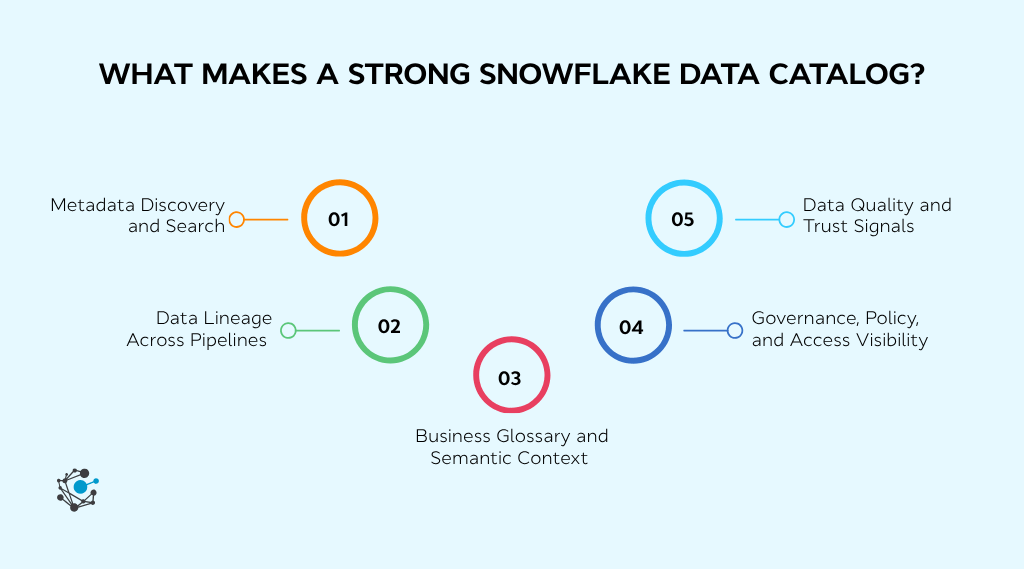
1. Metadata discovery and search
In Snowflake environments, metadata discovery means surfacing databases, tables, columns, views, and schemas in searchable, business-friendly formats through modernmetadata management tools.
Strong catalogs automatically crawl Snowflake environments, enrich metadata with descriptions and ownership context, and allow users to search by business domain or use case instead of relying on technical table names alone.
Weak implementations simply expose raw technical objects with little context or semantic structure. That forces analysts to rely on tribal knowledge instead of governed discovery, slowing reporting and increasing duplicate data usage across teams.
|
Operational insight: Modern platforms like OvalEdge improve discoverability further by combining metadata search with business glossary mapping, stewardship visibility, and relationship-aware asset discovery across Snowflake, BI, and pipeline systems. |
2. Data lineage across pipelines
Lineage is one of the most important capabilities in large Snowflake environments.
Modern organizations need column-level lineage that spans:
-
Snowflake
-
dbt
-
ETL pipelines
-
BI dashboards
-
Orchestration tools
-
Machine learning workflows
|
Good lineage answers practical operational questions immediately:
|
Weak lineage implementations only track Snowflake-internal dependencies and fail to map upstream or downstream systems.
This becomes especially problematic during compliance audits, production incidents, or AI model investigations, where teams need full visibility into how data moved and transformed across systems.
3. Business glossary and semantic context
Business glossaries bridge the gap between technical metadata and business understanding by aligning business definitions with data dictionary tools and operational metadata.
A strong glossary directly links business terms to Snowflake assets, ownership workflows, policies, and downstream analytics.
For example:
-
“Net Revenue”
-
“Active Customer”
-
“Gross Margin”
-
“Customer Churn”
These terms should connect directly to validated Snowflake tables and transformations so users understand not just where data exists, but what it actually means.
Disconnected glossary documents rarely survive long-term governance efforts because they drift away from operational metadata and reporting logic.
Modern governance platforms strengthen semantic consistency through business context management data platforms, glossary alignment, stewardship ownership, and lineage visibility.
4. Governance, policy, and access visibility
Governance becomes difficult when policies live separately from the assets they govern.
Strong catalogs surface the following directly at the point of data discovery.
-
Ownership
-
Sensitivity classification
-
Policy tags
-
Access visibility
-
Stewardship accountability
-
Compliance workflows
This operational integration matters because governance adoption, as users encounter governance context naturally within their daily workflows, instead of relying on disconnected documentation systems.
|
Practical insight: Platforms like OvalEdge extend this further by integrating governance workflows, stewardship responsibilities, and policy visibility through active data governance directly into Snowflake catalog experiences. |
5. Data quality and trust signals
A catalog without trust indicators creates uncertainty.
Strong Snowflake catalogs surface trust indicators directly alongside data assets.
-
Freshness indicators
-
Quality scores
-
Anomaly alerts
-
Failed pipeline visibility
-
Certification status
This allows analysts and business users to evaluate trustworthiness before using datasets in dashboards, executive reporting, or AI workflows.
When quality monitoring remains siloed outside the catalog experience, organizations often struggle with broader data observability vs data quality challenges.
Integrated governance platforms improve trust further by surfacing data quality visibility directly within discovery workflows, helping teams validate data confidence before operational use.
7 best data catalog tools for Snowflake
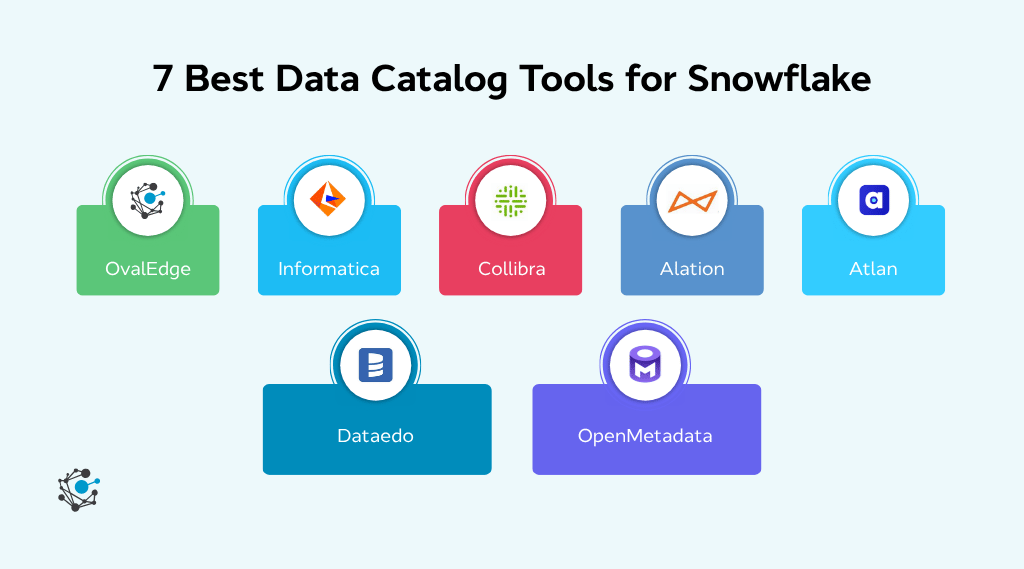
The best Snowflake catalog platforms differ significantly in governance depth, lineage scope, collaboration design, and enterprise maturity support. The right choice depends heavily on your governance requirements, stack complexity, and operational scale.
|
Platform |
Core strength |
Snowflake integration |
Governance depth |
Best for |
|
OvalEdge |
End-to-end governance + catalog |
Native, deep |
High |
Mid-to-large enterprises |
|
Atlan |
Collaborative metadata management |
Strong |
Moderate |
Data-team-centric organizations |
|
Alation |
Search and data literacy |
Strong |
Moderate-High |
Large enterprises |
|
Collibra |
Governance operating model |
Connector-based |
Very High |
Regulated industries |
|
Informatica |
Enterprise data management suite |
Strong |
High |
Large enterprise ecosystems |
|
Dataedo |
Lightweight documentation |
Moderate |
Low-Moderate |
SMBs |
|
OpenMetadata |
Open-source flexibility |
Strong |
Moderate |
Engineering-driven teams |
Each platform approaches Snowflake governance and metadata management differently. Some prioritize collaboration and discoverability, while others focus on enterprise governance depth, lineage visibility, or ecosystem-wide integration.
The following breakdown explores where each platform stands out, where limitations exist, and which type of organization it fits best.
1. OvalEdge
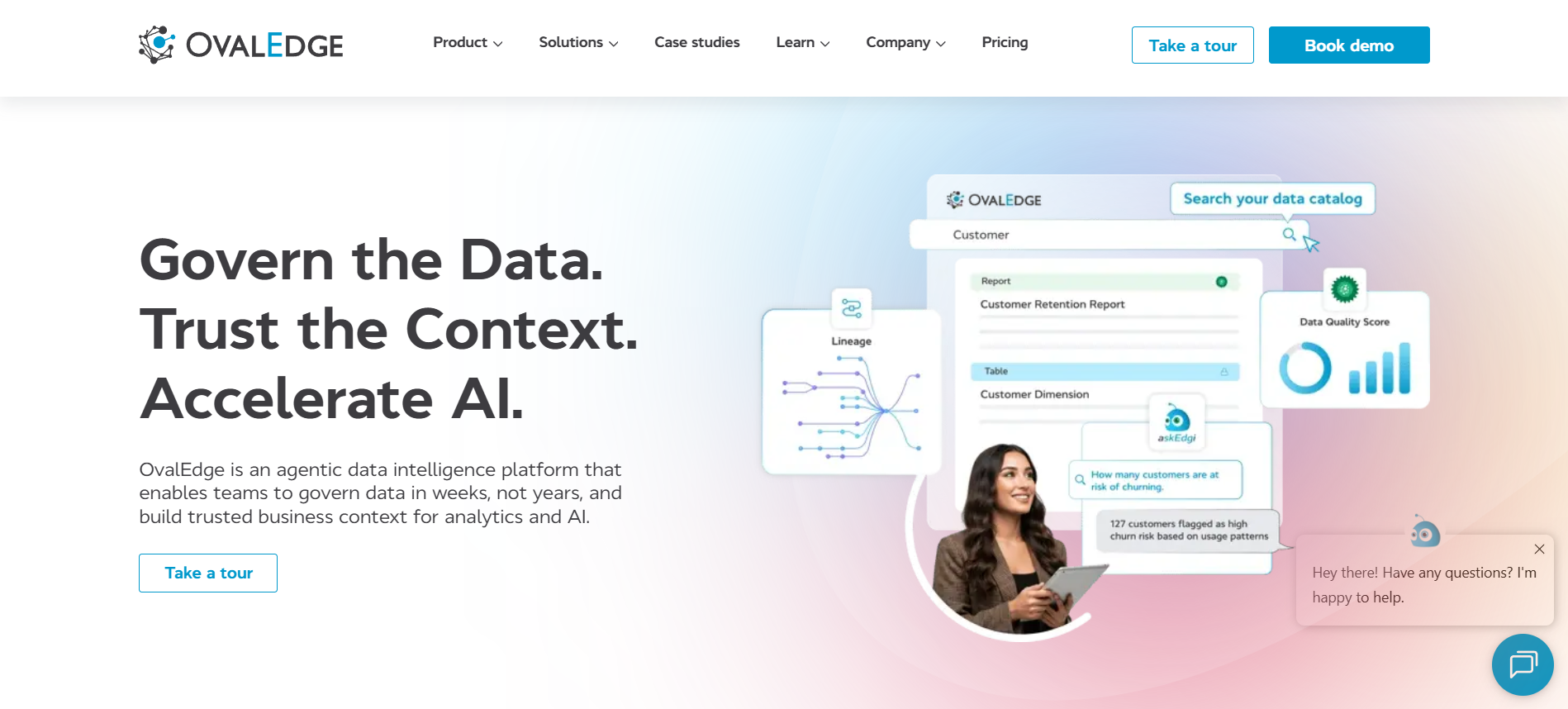
OvalEdge is designed for enterprises that need governance, lineage, quality, and metadata management to operate as a connected system instead of separate initiatives. Compared to collaboration-first or documentation-focused catalogs, OvalEdge places heavier emphasis on operational governance maturity, cross-platform lineage visibility, and enterprise-wide stewardship workflows.
The platform is particularly strong in Snowflake environments where metadata, governance, BI reporting, and pipeline visibility must work together across multiple systems.
Key strengths
-
Deep Snowflake governance integration: Automatically ingests metadata from Snowflake while connecting governance policies, stewardship ownership, and sensitivity classifications directly to data assets.
-
Cross-platform lineage implementation: Extends lineage visibility beyond Snowflake by mapping dependencies across dbt, ETL pipelines, orchestration tools, and BI platforms for end-to-end operational impact analysis.
-
Integrated business glossary workflows: Connects business terms, KPIs, and governance policies directly to Snowflake assets, reducing semantic inconsistencies across reporting environments.
-
Operationalized governance execution: Supports stewardship assignments, certification workflows, policy enforcement visibility, and governance accountability directly inside the catalog experience.
-
Embedded data quality visibility: Surfaces freshness indicators, quality scores, anomaly alerts, and trust signals alongside Snowflake assets to improve analytics confidence and AI readiness.
Best fit
Mid-to-large enterprises operationalizing governance, lineage, data quality, and metadata management together across modern Snowflake ecosystems.
Organizations evaluating governance-first Snowflake catalog platforms canbook an OvalEdge demo to explore how metadata visibility, lineage, stewardship, and governance workflows operate across enterprise data ecosystems.
2. Atlan
Atlan differentiates itself through collaboration-centric metadata management and modern user experience design. Compared to governance-heavy platforms, Atlan focuses more on usability, cross-team collaboration, and self-service analytics adoption across data teams.
Its governance capabilities are lighter than enterprise governance-first platforms, but its collaborative workflows help organizations improve metadata adoption quickly.
Key strengths
-
Collaboration-first metadata workflows: Encourage shared documentation, tagging, and metadata curation across analytics and engineering teams.
-
Strong Snowflake metadata synchronization: Automates metadata ingestion and discovery workflows across modern Snowflake environments.
-
Modern user experience: Simplifies metadata navigation and improves accessibility for analysts and business users.
-
Active metadata management: Continuously updates metadata relationships and asset visibility across integrated systems.
-
Self-service analytics enablement: Helps organizations improve data discoverability and adoption across distributed teams.
Best fit
Organizations prioritizing collaboration, metadata usability, and self-service analytics adoption.
3. Alation
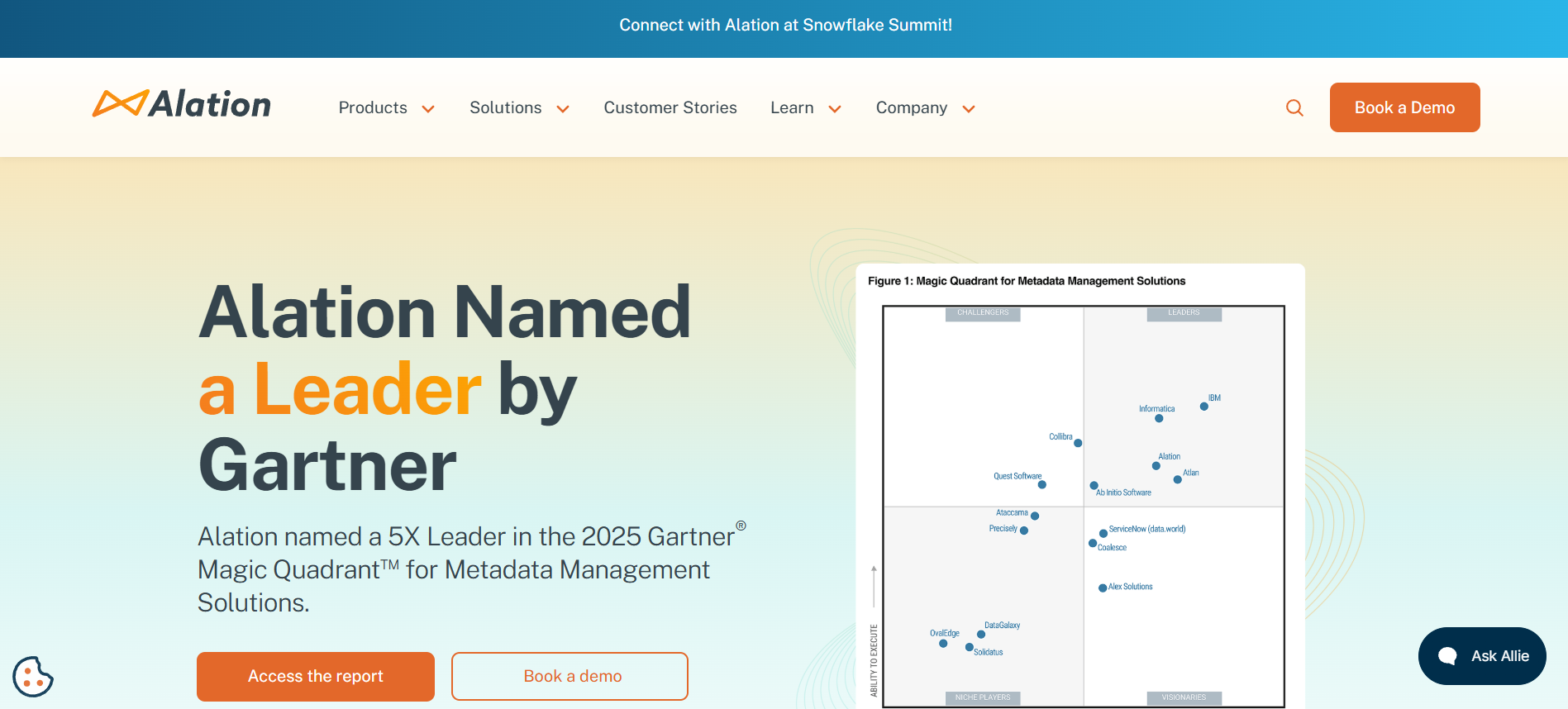
Alation is positioned strongly around enterprise search, data literacy, and metadata discoverability. Compared to governance-first platforms, it places greater emphasis on helping users find, understand, and trust data assets through behavioral intelligence and search-driven experiences.
Its mature Snowflake integration and stewardship workflows make it particularly strong for large enterprises scaling governed analytics adoption.
Key Strengths
-
Enterprise search and discovery: Improves dataset discoverability through search-driven metadata experiences.
-
Behavioral intelligence capabilities: Uses query patterns and usage signals to identify trusted and frequently used assets.
-
Strong stewardship workflows: Supports metadata curation and collaborative governance participation.
-
Mature Snowflake integration: Provides strong metadata ingestion and lineage support within Snowflake ecosystems.
-
Data literacy enablement: Helps organizations improve governed self-service analytics and metadata understanding.
Best fit
Large enterprises focused on metadata discoverability, searchability, and enterprise-wide data literacy.
4. Collibra
Collibra is fundamentally governance-first in both architecture and operating philosophy. Compared to collaboration-driven or lightweight catalog tools, it focuses heavily on policy management, stewardship accountability, compliance workflows, and enterprise governance standardization.
Its governance depth is among the strongest in the market, though implementation complexity is significantly higher than lighter catalog platforms.
Key strengths
-
Advanced governance operating model: Supports formal governance structures, stewardship ownership, and policy accountability.
-
Regulatory compliance workflows: Enable governance traceability, audit support, and compliance reporting.
-
Enterprise policy management: Centralizes governance rules, classifications, and operational controls.
-
Broad enterprise ecosystem integration: Connects governance workflows across enterprise data environments.
-
Strong stewardship accountability: Helps organizations operationalize governance ownership at scale.
Best fit
Highly regulated industries and enterprises with mature governance programs.
5. Informatica
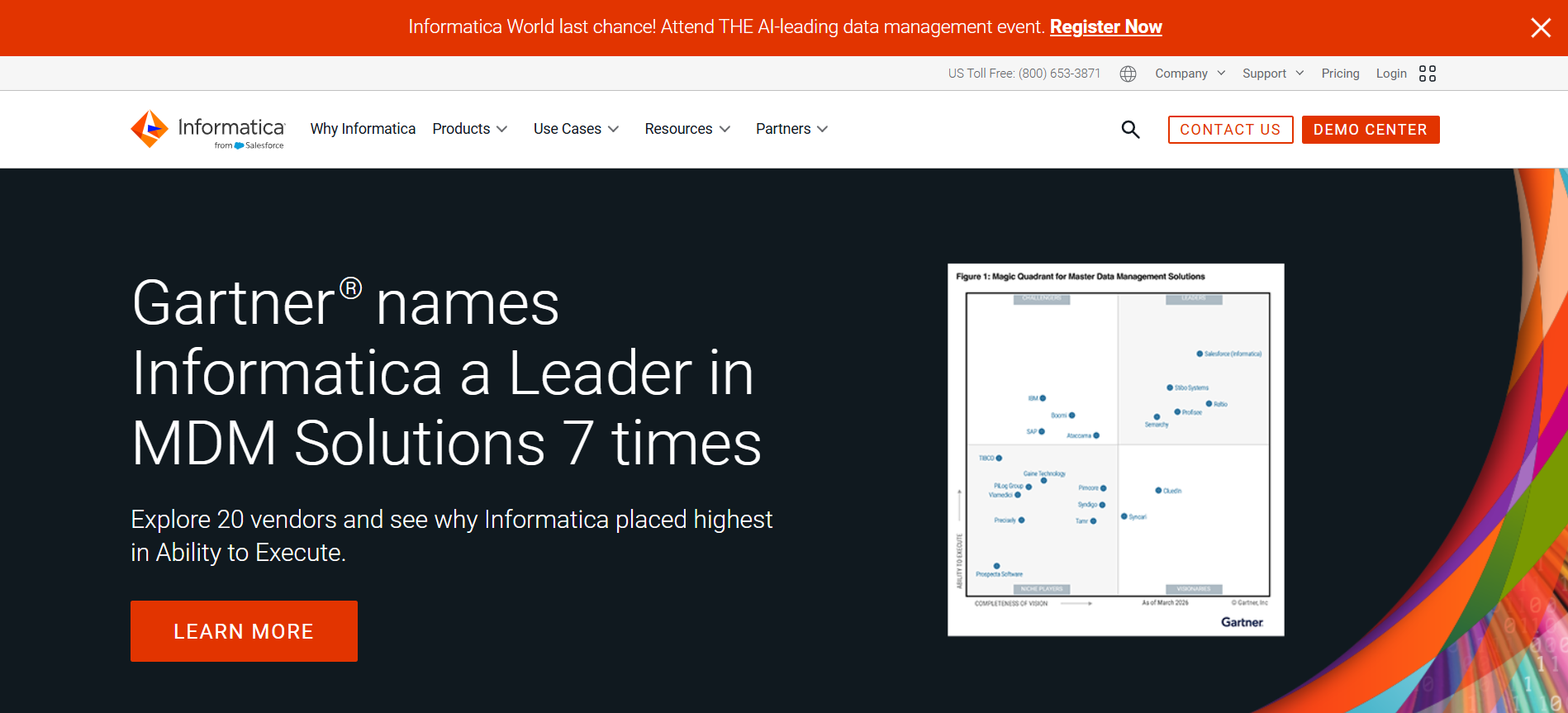
Informatica approaches cataloging as one component within a much broader enterprise data management ecosystem. Compared to standalone catalog platforms, it offers deeper integration across governance, integration, quality, and master data management initiatives.
Its strength lies in supporting large-scale enterprise data operations, though implementation and operational complexity can be substantial.
Key strengths
-
AI-powered metadata discovery: Uses the CLAIRE engine for automated metadata enrichment and classification.
-
Enterprise ecosystem integration: Connects governance, integration, quality, and metadata workflows.
-
Strong Snowflake connectivity: Supports large-scale Snowflake metadata synchronization and governance visibility.
-
Scalable governance capabilities: Helps enterprises manage governance across distributed operational environments.
-
Broad integration coverage: Connects enterprise analytics, operational systems, and governance infrastructure.
Best fit
Large enterprises have already invested in Informatica’s broader enterprise data ecosystem.
6. Dataedo
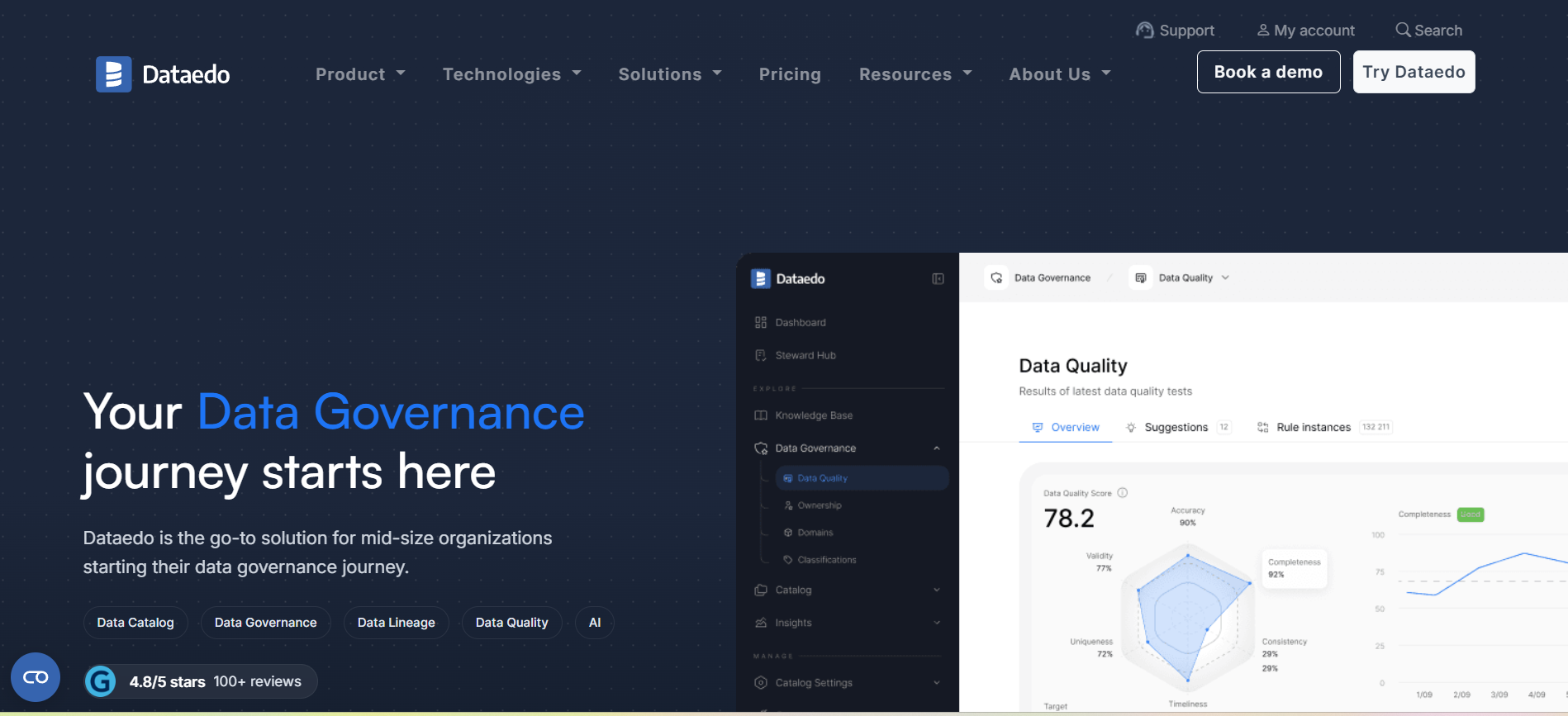
Dataedo focuses primarily on metadata documentation and data dictionary management rather than enterprise governance execution. Compared to governance-heavy platforms, it prioritizes simplicity, fast deployment, and lightweight metadata visibility.
Its capabilities are better suited for smaller organizations that need structured documentation without complex governance overhead.
Key strengths
-
Business-friendly documentation workflows: Simplifies metadata documentation and schema visibility.
-
Searchable data dictionaries: Helps teams improve discoverability through structured metadata organization.
-
Fast implementation model: Easier deployment and lower operational overhead than enterprise governance platforms.
-
Simple Snowflake metadata visibility: Supports documentation-focused metadata discovery across Snowflake assets.
-
Lightweight governance support: Provides basic governance functionality without enterprise governance complexity.
Best fit
SMBs and documentation-focused analytics teams.
7. OpenMetadata
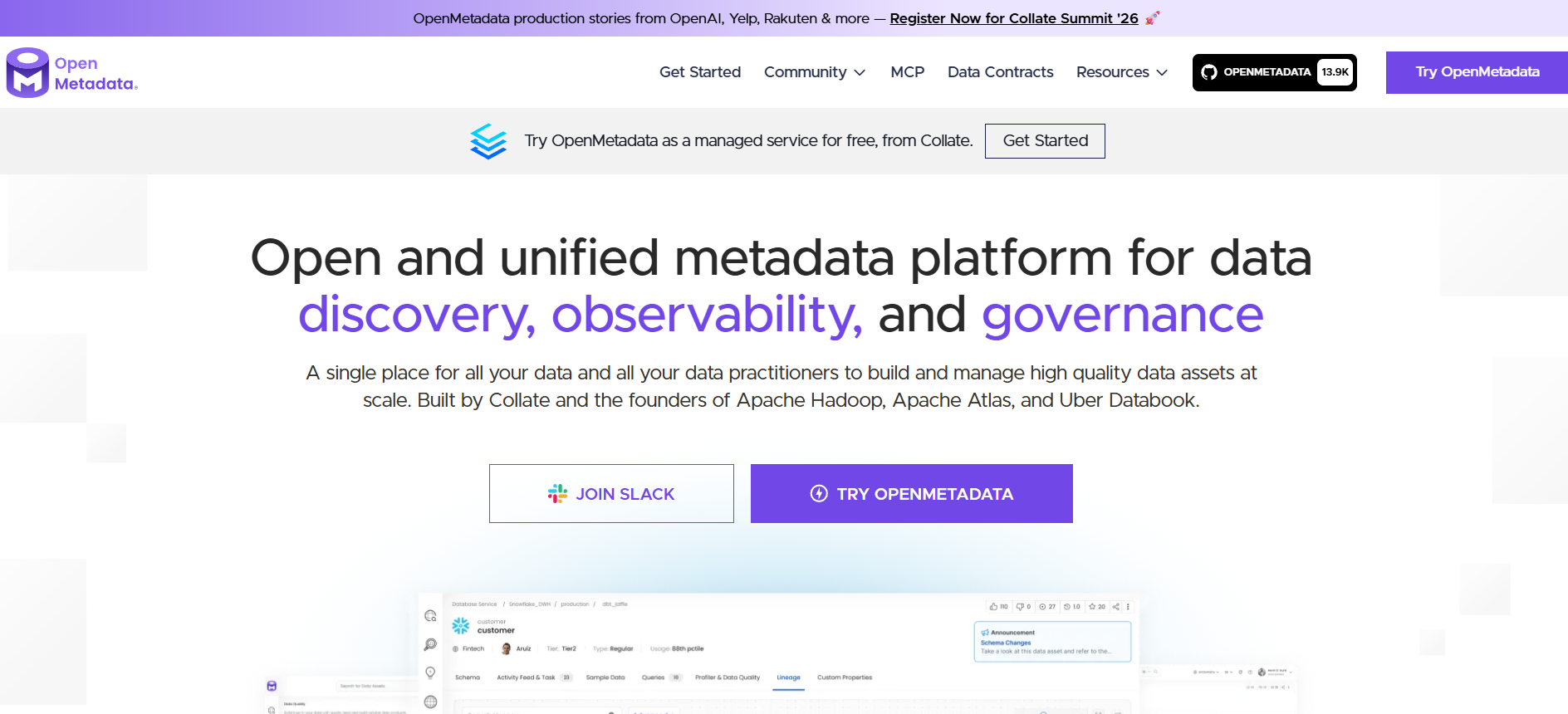
OpenMetadata differentiates itself through open-source flexibility and engineering-centric extensibility. Compared to commercial governance platforms, it provides greater infrastructure control and customization but requires stronger internal engineering ownership.
Its modern integration support and active open-source ecosystem make it attractive for technically mature organizations building customized metadata operations.
Key strengths
-
Open-source flexibility: Enables infrastructure customization and operational control.
-
Strong Snowflake integration: Supports metadata ingestion, lineage, and discovery workflows across Snowflake ecosystems.
-
Broad metadata capability coverage: Includes discovery, glossary management, lineage, and quality monitoring.
-
Engineering-driven extensibility: Allows organizations to customize governance workflows internally.
-
Active community ecosystem: Benefits from continuous feature expansion and open-source innovation.
Best fit
Engineering-driven organizations seeking flexible and customizable metadata infrastructure.
How to choose the right Snowflake data catalog
Selecting a Snowflake data catalog is less about feature volume and more about operational fit. The right platform should align with your governance maturity, analytics workflows, integration ecosystem, and long-term scalability requirements.
-
Prioritize connector depth: Native Snowflake connectors provide more reliable metadata ingestion, lineage visibility, and governance synchronization than generic API integrations, especially in modernenterprise metadata management strategies.
-
Evaluate lineage coverage: Modern environments rely on dbt, Airflow, Tableau, Power BI, Kafka, and ETL pipelines alongside Snowflake. Strong catalogs provide end-to-end lineage visibility across the entire stack.
-
Match governance maturity: Early-stage governance programs benefit from lightweight workflows and faster onboarding, while mature organizations often require policy orchestration, stewardship accountability, and compliance management.
-
Prioritize business usability: Non-technical users should be able to search datasets, understand glossary terms, and evaluate trust indicators without extensive training. Accessibility strongly influences catalog adoption.
-
Assess integration breadth: Broad integration coverage improves lineage completeness, metadata freshness, governance visibility, and stewardship consistency across analytics ecosystems.
-
Look for operational governance: Platforms like OvalEdge combine metadata visibility, lineage, stewardship, quality, and governance workflows into a unified operational experience.
Organizations beginning their catalog journey should usually prioritize connector quality, usability, and metadata discoverability first. More mature governance programs should place greater emphasis on policy depth, lineage breadth, and cross-platform governance orchestration.
Getting Snowflake data catalog implementation right
Successful Snowflake catalog initiatives are rarely determined by tooling alone. Most implementation failures happen because governance ownership, lineage integration, metadata quality, and adoption planning are treated as secondary priorities after deployment.
Organizations that achieve long-term value from Snowflake catalog investments typically approach implementation as an operational transformation initiative rather than a metadata documentation exercise.
-
Start with high-value domains: Begin with Snowflake environments supporting critical dashboards, finance reporting, or compliance workflows. Focused deployments create faster trust, adoption, and measurable business value.
-
Roll out adoption in phases: Prioritize finance, compliance, and other high-risk business domains first, where trusted data visibility is operationally critical. Next, expand into analytics-heavy teams that depend on shared reporting and cross-functional dashboards. Once stewardship workflows, lineage visibility, and governance processes are operationalized, extend catalog access to broader self-service analytics users across the organization.
-
Assign ownership before enrichment: Governance workflows fail when ownership remains unclear. Define stewardship accountability before glossary mapping, certification, policy tagging, or sensitivity classification begins.
-
Connect BI and pipeline tools early: Integrate dbt, Tableau, Power BI, Fivetran, and orchestration systems during the initial rollout. Retrofitting lineage later often creates fragmented visibility and inconsistent dependency mapping.
-
Build quality monitoring alongside discovery: Trust increases when freshness indicators, quality scores, anomaly alerts, and certification visibility appear directly within discovery workflows supported by data observability tools from the beginning.
-
Track adoption metrics immediately: Monitor search activity, glossary linkage rates, stewardship completion, lineage usage, and certified asset growth early to measure operational adoption and governance effectiveness.
Organizations that operationalize governance, lineage, quality, and stewardship together typically achieve stronger catalog adoption than teams treating metadata management as a standalone initiative.
Conclusion
As Snowflake environments grow, metadata complexity often expands faster than governance maturity. While Snowflake scales storage and compute efficiently, lineage visibility, business context, stewardship accountability, and trust frequently become fragmented across pipelines, BI tools, dashboards, and operational systems.
Snowflake Horizon provides a strong governance foundation, but many enterprises eventually require broader metadata visibility and cross-platform governance capabilities.
The right data catalog helps organizations operationalize metadata discovery, lineage, stewardship, governance workflows, and data quality visibility across the entire analytics ecosystem instead of treating them as disconnected initiatives.
Platforms like OvalEdge help unify governance and cataloging by connecting metadata, lineage, glossary management, stewardship workflows, and trust indicators into a single operational experience for Snowflake environments.

Organizations looking to improve governance maturity, analytics trust, and enterprise-wide metadata visibility can book an OvalEdge demo to explore how connected governance works at scale.
FAQs
1. What is a Snowflake data catalog?
A Snowflake data catalog is a metadata management layer that helps organizations discover, organize, govern, and monitor Snowflake assets. It provides lineage visibility, ownership context, governance controls, and trust indicators across tables, schemas, pipelines, and analytics workflows.
2. Does Snowflake have a built-in data catalog, and is it enough for enterprise use?
Yes. Snowflake Horizon provides native metadata management, lineage, classification, and governance capabilities. However, enterprises managing cross-platform lineage, governance workflows, and broader analytics ecosystems often use third-party catalogs to extend visibility beyond Snowflake itself.
3. What is column-level lineage, and why does it matter in Snowflake?
Column-level lineage tracks how individual fields move and transform across pipelines, dashboards, and reporting systems. It helps organizations analyze schema impact, validate KPI calculations, improve compliance visibility, and trace sensitive data movement across Snowflake environments.
4. How does a Snowflake data catalog support AI and LLM initiatives?
Snowflake data catalogs improve AI reliability by providing governed metadata, lineage visibility, semantic context, and trust indicators. This helps organizations reduce the risk of AI models using stale, unclassified, or low-quality data across analytics and machine learning workflows.
5. Can a data catalog help with Snowflake’s multi-account or cross-cloud deployments?
Yes. Third-party catalogs help unify metadata visibility across multiple Snowflake accounts, cloud environments, and business units. This improves governance consistency, lineage visibility, and operational discovery across distributed analytics ecosystems spanning AWS, Azure, and GCP.
6. What’s the real cost of not having a data catalog for Snowflake?
Without a structured catalog, organizations lose time searching for trusted data, validating reports, and tracing lineage manually. Ungoverned metadata also increases operational risk through broken pipelines, inconsistent KPIs, poor governance visibility, and delayed compliance investigations.
.png?width=1081&height=173&name=Forrester%201%20(1).png)
.png?width=1081&height=241&name=KC%20-%20Logo%201%20(1).png)