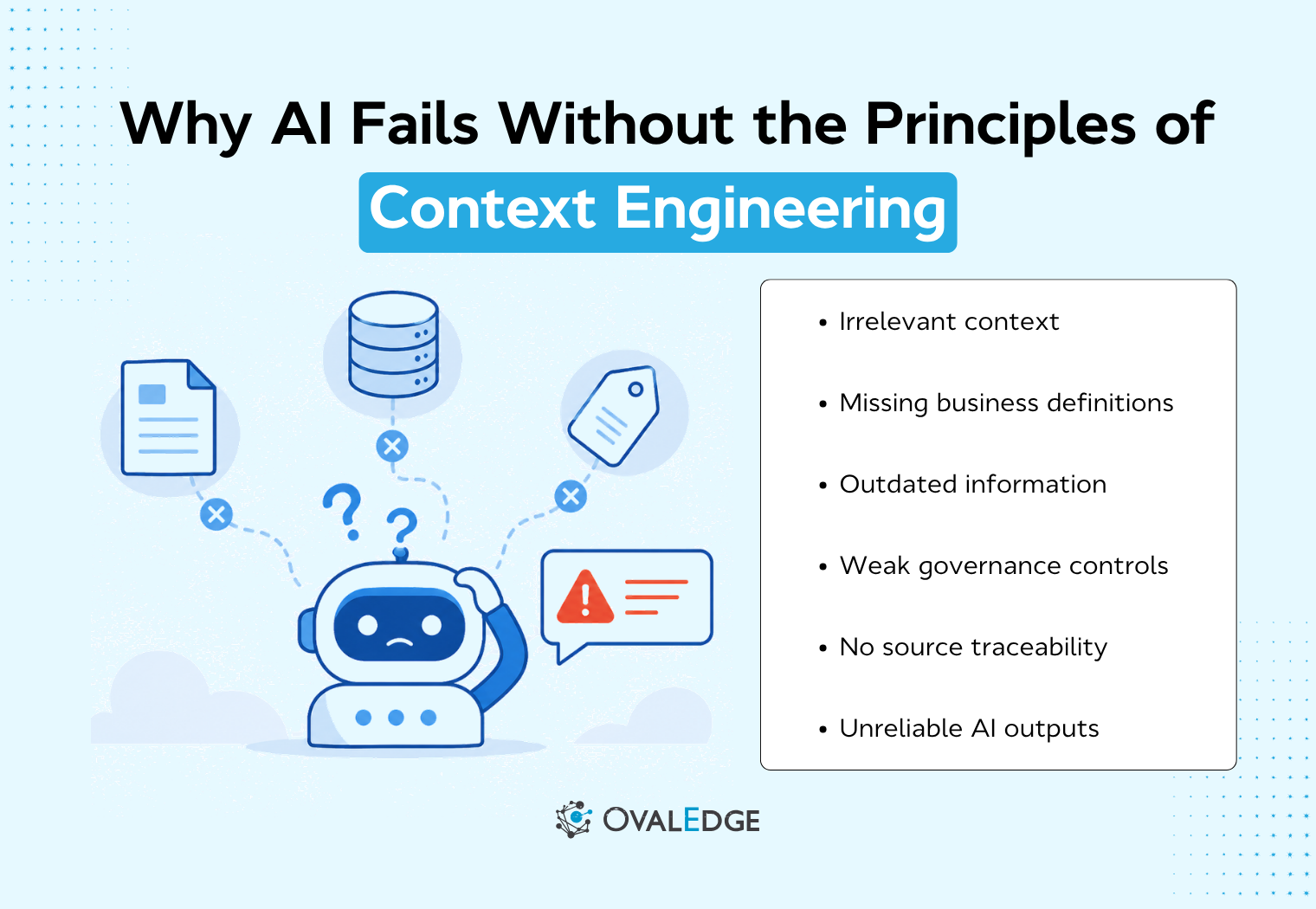
An AI model answering a revenue question retrieves figures from an uncertified dataset because it has no way to distinguish certified sources from uncertified ones and no visibility into the access policy that should have blocked the query. The data was there, but the context was not.
The pattern repeats across enterprise AI. Raw data, even when it is clean and well-structured, does not tell a model what a metric means, who owns it, whether it can be trusted, or which version is current. Without that surrounding context, AI outputs look confident but lack the grounding to be reliable.
Context engineering addresses this gap by selecting, organizing, and governing the information an AI system receives so it can produce accurate, relevant, and trustworthy outputs. This blog post breaks down the core principles behind it, how they work in practice, and why they matter for enterprise AI.
What are the principles of context engineering?
The principles of context engineering are the rules used to decide what information an AI system should receive before it generates an answer or takes action. The core set includes relevance, sufficiency, minimalism, freshness, provenance, governance, and evaluation.
Together, they help AI systems cut noise, lean on trusted information, respect context window limits, and return more reliable outputs. The point is not to pack every available document into the model. Context engineering is about designing the information flow into the model, deciding what gets in and what stays out.
That flow can carry a lot of different things. Context includes instructions, retrieved documents, memory, metadata, business definitions, tool outputs, permissions, and workflow state. Each piece either sharpens the answer or muddies it.
The goal is to give the model enough useful information to do the job without burying the signal. A lot of the raw material for this already lives inside an organization's catalog and enterprise metadata management, where definitions, ownership, and source details are already recorded. Context engineering decides which of those details the model actually needs for a given task.
Why context engineering principles matter
The principles of context engineering matter because they help organizations improve AI reliability, trust, and governance at scale. As AI systems become embedded in business processes, the quality of the context they receive increasingly determines the quality of their outputs.
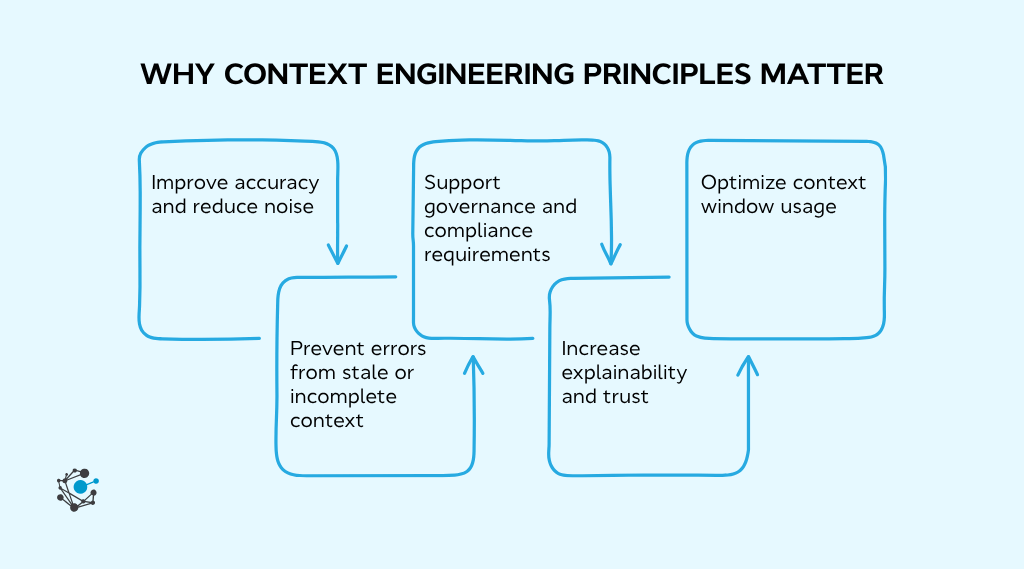
The principles of context engineering matter because they help organizations:
-
Improve accuracy and reduce noise: Ensure the model receives relevant, high-value information instead of excessive, duplicate, or unrelated content.
-
Prevent errors from stale or incomplete context: Prioritize current, complete, and trustworthy information so AI systems can generate reliable outputs.
-
Support governance and compliance requirements: Incorporate approved definitions, policies, permissions, and controls into AI-driven workflows.
-
Increase explainability and trust: Provide clear provenance, traceability, and links to authoritative sources behind AI-generated responses.
-
Optimize context window usage: Select the most useful information for the task instead of overwhelming the model with unnecessary context.
These benefits become especially important in enterprise environments. A chatbot with poor context may produce a disappointing answer. An AI agent or analytics assistant with poor context can produce a confidently incorrect decision that triggers workflows, exposes sensitive information, or changes business records before anyone notices.
The importance of these principles is reflected in broader AI adoption challenges.
McKinsey’s 2025 State of AI survey found that more than 80% of organizations are not seeing tangible enterprise-level impact from their use of gen AI, even as adoption climbs past 78%.
The practices most correlated with bottom-line results are governance oversight, workflow redesign, and KPI tracking, not model capability alone. Building responsible AI practices into the governance layer is one way organizations are addressing this issue. Context engineering helps close that gap by ensuring AI systems receive information that is relevant, governed, and trustworthy.
At OvalEdge, we believe the transition from AI assistance to AI-driven action raises the importance of context governance. As AI systems gain greater access to enterprise data and business processes, the quality of context increasingly determines whether AI outputs can be trusted.
Ultimately, AI performance depends not only on model capability but also on the quality of the context that surrounds it.
Context engineering vs prompt engineering
The two get confused often, but they solve different problems. Prompt engineering shapes the instruction. Context engineering shapes the information environment in which the instruction runs.
Prompting asks, "How should we phrase the request?" Context engineering asks, "What should the AI know before it answers?" A great prompt paired with bad context still produces a bad answer.
|
Area |
Prompt engineering |
Context engineering |
|
Main focus |
How the instruction is written |
What information does the model receive |
|
Scope |
A prompt or prompt template |
The full information environment |
|
Inputs |
Task, role, format, tone |
Prompt, retrieval, memory, metadata, tools, policies |
|
Goal |
A better immediate response |
Grounded, repeatable AI behavior |
|
Risk if weak |
Vague output |
Wrong, outdated, noisy, or untrusted output |
Prompt engineering tends to hit a ceiling fast. Once the instruction is clear, further gains come from the context, not the wording. That is why teams running AI on enterprise data spend more time on retrieval, definitions, and permissions than on rephrasing prompts.
Core principles of context engineering
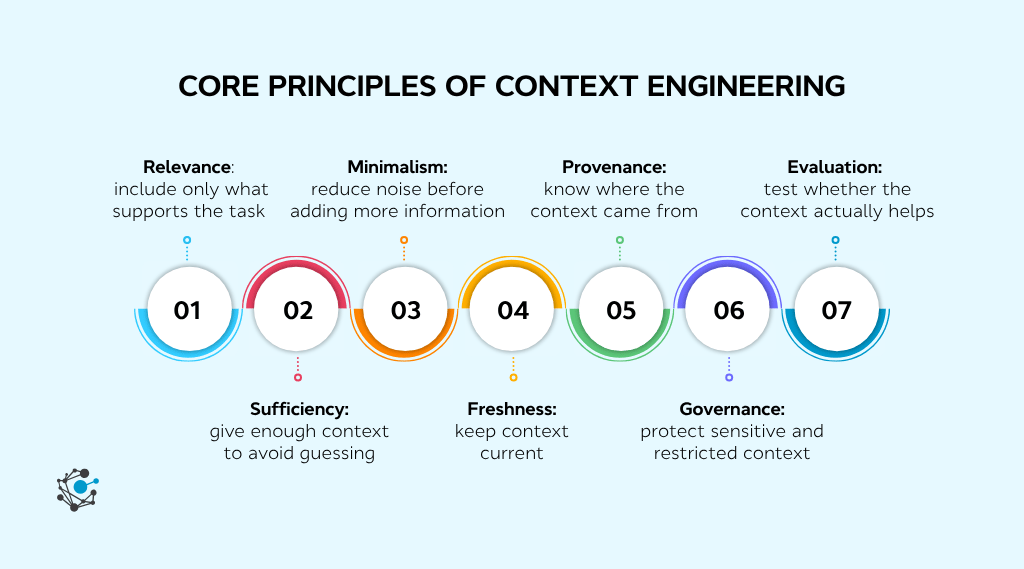
The principles of context engineering help determine what information should reach an AI system, what should be excluded, and how context should be maintained over time. Together, they provide a practical framework for delivering context that is accurate, trustworthy, governed, and useful.
1. Relevance: include only what supports the task
The model should receive information that directly helps answer the request. Irrelevant context does not simply sit unused. It competes for attention, consumes context space, and can pull the model toward weaker answers.
For example, when answering a customer churn question, useful context might include approved churn definitions, business glossary terms, data lineage, and quality-certified datasets. Including every customer-related document in the organization is more likely to reduce answer quality than improve it.
Practical tactics:
-
Retrieve context based on user intent rather than broad keyword matches.
-
Prioritize certified and authoritative sources.
-
Rank retrieved information by business relevance before sending it to the model.
2. Sufficiency: give enough context to avoid guessing
Relevant context alone is not enough if important information is missing. The model needs sufficient detail to understand the task, the business context for data quality involved, the source material, and any constraints that apply.
A useful test is simple: can the model answer without making assumptions? If it must infer missing definitions, business rules, or requirements on its own, the context is not sufficient.
Example: A hospital network found that “readmitted patient” used a 30-day window in CMS reporting, a 15-day window in internal quality dashboards, and no fixed window in finance. An AI system pulling from any of these sources without the governed definition would return a different number depending on which system it hit first.
Practical tactics:
-
Include business definitions alongside raw data.
-
Provide task requirements and output expectations.
-
Ensure key assumptions are explicitly represented in the context.
3. Minimalism: reduce noise before adding more information
More context does not automatically produce better results. Excessive context introduces noise, surfaces contradictions, increases processing costs, and makes important information harder to identify.
Improvement often comes from removing information rather than adding it. Governing unstructured data is especially important here, since documents and reports are often the largest source of redundant context. Duplicate content, outdated documents, and irrelevant background material should be filtered out before expanding the context set.
For example, removing duplicate reports and outdated documentation often improves answer quality more than adding additional reference material.
Practical tactics:
-
Remove duplicate and overlapping sources.
-
Exclude outdated or low-confidence content.
-
Limit retrieval to the most relevant documents and assets.
4. Freshness: keep context current
AI systems can only be as current as the information they receive. Outdated policies, metrics, permissions, or business rules can lead to answers that appear credible but no longer reflect reality. Maintaining fresh context helps ensure AI outputs remain aligned with current business conditions.
Example: A data team updates its approved revenue definition mid-quarter. Downstream, an AI agent’s memory store still references the old definition. Without lineage visibility connecting the metric to its dependents, stale context continues to inform decisions until someone catches the discrepancy manually.
Practical tactics:
-
Refresh metadata and lineage information regularly.
-
Surface last-updated timestamps for key assets.
-
Prefer current certified sources over historical versions.
OvalEdge expert insight: Freshness is easier to maintain when metadata carries last-updated timestamps and certification expiry dates. Stale context is harder to catch than missing context because the model still uses it confidently.
5. Provenance: know where the context came from
Users need confidence that AI-generated outputs are based on trusted information. Provenance provides visibility into where information originated, who owns it, when it was updated, and whether it has been reviewed or certified.
For example, a finance team reviewing a KPI should be able to trace the metric back to its source table, business definition, and transformation logic. OvalEdge’s Enterprise Context Graph supports this exactly by linking lineage, ownership, and certification into one queryable layer that both people and AI can trace.
Practical tactics:
-
Link answers to their underlying sources.
-
Connect metrics to approved business glossary definitions.
-
Maintain data lineage between source systems and reports
6. Governance: protect sensitive and restricted context
An AI system should never retrieve or expose information that a user is not allowed to see. Governance over context covers access control, PII, and sensitive-data handling, approved-source rules, auditability, and human review for high-risk outputs.
The gap here is wide in practice.
IBM's AI at the Core 2025 research found that nearly 74% of organizations report only moderate or limited coverage of technology, third-party, and model risks in their AI risk and governance frameworks.
In practice, governance becomes most effective when it is enforced at the point of retrieval. Policies, permissions, and access rules should not exist only as documentation. They should actively determine what information an AI system can access and use.
OvalEdge makes this possible through the Enterprise Context Graph, which connects access policies, ownership rules, and classification labels that enterprises have already established across their governance programs. When an AI system retrieves context, the ECG ensures only authorized and relevant information reaches the model.
That distinction is the difference between an agent that respects permissions and one that quietly surfaces data it should not. Tying context retrieval to data access governance is what keeps the wrong information from reaching the model in the first place.
For example, an employee requesting payroll information should only receive data permitted by their role and access privileges.
Practical tactics:
-
Apply role-based access controls to retrieval systems.
-
Filter sensitive or regulated data before it enters the context layer.
-
Maintain audit trails for retrieval and response activity.
Organizations often discover that AI governance challenges begin long before a model generates a response.
7. Evaluation: test whether the context actually helps
Context engineering should be measured rather than assumed. Better context should produce better outcomes, and those outcomes should be validated through ongoing testing and monitoring.
Organizations should continuously assess whether context changes improve answer quality, increase trust, reduce hallucinations, and help users reach accurate conclusions more efficiently. For organizations scaling AI agents, agentic data governance provides a structured approach to maintaining oversight as autonomous systems interact with enterprise data.
If context changes but answer quality remains unchanged, the additional context may not provide meaningful value.
For example, if a retrieval change improves answer accuracy and reduces hallucinations, the context update is delivering measurable benefits.
Practical tactics:
-
Measure answer accuracy before and after context changes.
-
Track citation quality and source usage.
-
Monitor correction rates, user trust, and feedback signals.
OvalEdge expert insight: A context change that increases citation accuracy but surfaces sensitive data without permission is not an improvement. Evaluation should measure governance compliance alongside answer quality.
What makes good context engineering?
The seven principles describe what a good context should look like. What separates good context engineering from a setup that merely follows those principles on paper is how the system performs in practice.
The first indicator is outcome quality. Good context engineering is judged by the quality of the answers it produces, not by how much information is retrieved. A strong data governance framework provides the ownership structures and accountability models that make this sustainable.
If answer accuracy does not improve, the additional context is not delivering value.
The second indicator is consistency. The same question should return the same trusted answer, not a different one depending on which document or source happens to be retrieved.
The third indicator is maintenance. Context is not static. Definitions change, sources are updated, permissions shift, and documentation becomes outdated. Good context engineering treats context as a managed asset with clear ownership and regular refresh cycles.
A simple comparison highlights the difference:
|
Weak context engineering |
Good context engineering |
|
Judged by how much context was added |
Judged by whether answers improved |
|
Different answer each run |
Same trusted answer, repeatedly |
|
Built once, left to decay |
Owned, monitored, and refreshed |
|
No one is accountable for a given input |
Clear ownership and lineage behind each source |
|
Works in a demo |
Holds up in a regulated workflow |
|
Inconsistent AI decisions that require manual validation |
Reliable, repeatable, and governed AI outputs |
These differences matter most when AI systems work with enterprise knowledge, internal data, compliance information, or business-critical decisions. In those environments, weak context can create operational, financial, and compliance risks.
That is why trusted data, governance, and source quality are fundamental to effective context engineering.
How data governance supports better context engineering
Data governance provides many of the information assets that AI systems need at runtime. While models generate responses, governance assets help provide the business meaning, trust signals, and controls that guide those responses.
Several governance capabilities directly strengthen the AI context:
-
Metadata provides technical and business information about data assets, including ownership, descriptions, classifications, and usage details.
-
Business glossaries provide standardized definitions that help AI systems interpret business terms consistently across teams and applications.
-
Data lineage provides visibility into where information originated and how it has been transformed, supporting traceability and source validation.
-
Data quality supplies trust indicators that help AI systems prioritize reliable and certified information.
-
Access governance provides permissions and policy information that determine which context can be retrieved for specific users and use cases.
-
AI governance helps organizations define rules, controls, and oversight mechanisms for how AI systems access and use enterprise information.
At OvalEdge, we believe: Most enterprises are closer to AI-ready context than they think. The governance work they have already done around definitions, lineage, quality, and ownership is the raw material that context engineering turns into trusted AI inputs.
When exposed through APIs, retrieval systems, semantic layers, or agent frameworks, these governance assets become machine-readable context that AI systems can consume directly. Instead of relying solely on documents and raw data, AI can use definitions, lineage, quality signals, ownership information, and access policies as part of its reasoning process.
The Enterprise Context Graph is one way to make this connection. It links catalog metadata, business definitions, lineage, quality, ownership, and policies into a governed structure that AI systems can query directly. The result is a context layer that helps AI interpret information more consistently, trace answers to authoritative sources, and align outputs with organizational rules.
Conclusion
Context engineering is not about stuffing the context window. It is about giving AI systems the right information in the right form and validating that it improves outcomes.
Most enterprises already have much of what good context engineering requires. Data governance programs have created the definitions, lineage, quality rules, ownership structures, and access policies that AI systems need. The opportunity is to connect and activate that existing foundation so it becomes usable by AI.
OvalEdge does this through the Enterprise Context Graph, which links governed data artifacts into a structure that AI systems can query directly. For organizations pursuing analytical AI, this means the governance work they have already done becomes the context layer that drives more accurate, trusted, and explainable outcomes.
Schedule a demo to see how OvalEdge connects your existing governance foundation to analytical AI.