.jpg)
Enterprise AI has moved beyond experimentation. The harder challenge now is making sure AI systems understand the business meaning behind the data they can access. An agent may reach every table in a warehouse and still misinterpret a customer status, revenue metric, or relationship between two entities.
The Presenc AI Enterprise AI Adoption Statistics 2026 report shows how quickly the stakes are rising. As of Q1 2026, 78% of Global 2000 companies had at least one AI workload in production, up from 41% in Q1 2024. Global enterprise AI spending reached an estimated $247 billion, while the median enterprise reported a 2.4x ROI on AI investments.
At this scale, meaning matters. Ontology provides the structured concepts and relationships AI needs to interpret enterprise data consistently. This guide explains its components, standards, reasoning role, implementation, and evaluation.
What is ontology in AI?
Ontology in AI is a structured representation of concepts, their properties, relationships, and rules that gives an AI system explicit meaning and context for reasoning. It defines how business entities relate to one another so AI can interpret data consistently rather than relying only on field names, schemas, or statistical similarity.
For example, a schema may show cust_status as a two-character field in CUST_MASTER. An ontology goes further: Customer is a class, a Customer can hold multiple Subscriptions, each Subscription has an approved status, and a lapsed Subscription does not end the Customer relationship. These relationships allow an AI agent to reason about what the data represents.
Ontologies already underpin widely used standards such as SNOMED CT in healthcare, FIBO in financial services, Gene Ontology in life sciences, and Schema.org on the web.
In enterprises, ontology modelling applies the same approach to internal data. Business concepts become classes, relationships connect them, ownership becomes a property, and policies or business rules become constraints. This creates a machine-readable semantic layer that both people and AI agents can use to interpret enterprise information consistently.
Why AI systems need ontologies
AI systems can retrieve enterprise data without fully understanding its business meaning. The same term may represent different concepts across teams, creating ambiguity that retrieval alone cannot resolve.
Consider “high-risk customer.” Credit may define it by probability of default, retention by churn likelihood, fraud by transaction anomalies, and compliance by sanctions exposure. An ontology connects each meaning to its domain, calculation, source data, owner, and policies, helping an agent select the correct definition for the task.
The same applies to metrics such as “revenue,” which could mean booked, recognized, recurring, or net revenue. An ontology distinguishes these concepts and connects each to the appropriate calculation and data sources.
It also enables inference. If customer PII requires restricted access and a dataset contains customer PII, an agent can infer that the dataset requires the same restriction.
This gives AI systems consistent meaning, contextual disambiguation, and rule-based reasoning across enterprise data.
The core components of an ontology
Five elements do the work. Each one adds a capability the previous one lacks.
-
Classes are the concepts in the domain: Customer, Account, Claim, Policy, Dataset, Report. Classes can nest, so Premium Customer is a subclass of Customer and inherits everything true of it.
-
Individuals are the actual instances: customer 44821, claim CLM-9930. Classes describe the type. Individuals populate it.
-
Properties describe attributes and the values they accept: a Dataset has a sensitivity classification, a Customer has a tenure in months.
-
Relationships connect classes with direction and meaning: a Customer owns an Account, a Report consumes a Dataset, a Policy governs a Data Asset. Direction matters, since "owns" and "is owned by" carry different implications for access.
-
Axioms are the rules and constraints that make inference possible: a Claim must reference exactly one Policy, sensitive customer data requires access approval before model use, two Customers sharing a tax identifier are the same legal entity.
Axioms are the component teams skip, and skipping them is why many models get labeled ontologies when they are structured vocabularies. Without constraints, a system can store relationships. It cannot derive anything from them.
An agent that knows a Report consumes a Dataset, and that the Dataset carries a restricted classification, can conclude the Report inherits a restriction that nobody recorded on the Report itself.
Types of ontologies used in enterprise practice
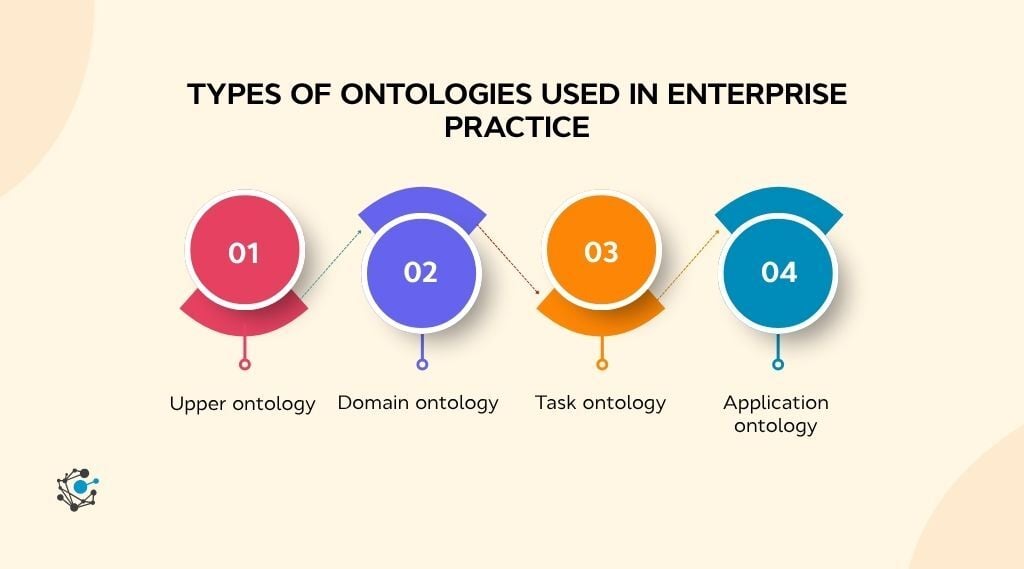
Four ontology types commonly appear in enterprise environments:
-
Upper ontology: Defines universal concepts such as objects, events, and processes.
-
Domain ontology: Models concepts and relationships within a field such as banking, healthcare, or insurance.
-
Task ontology: Represents concepts involved in a specific process, such as loan approval or claims processing.
-
Application ontology: Defines the concepts required by a particular application or AI system.
Most enterprises start with a domain ontology, often adapting an established industry standard, then extend it for specific processes and applications.
Ontology vs taxonomy vs knowledge graph vs semantic layer vs context graph
These structures solve different parts of the meaning and context problem. The key difference is whether they organize information, define meaning, store relationships, standardize metrics, or supply governed context for AI.
|
Structure |
What it defines |
Reasoning support |
Primary consumer |
|
Ontology |
Concepts, properties, relationships, and rules within a domain |
Yes, through relationships and constraints |
AI agents, semantic applications |
|
Taxonomy |
Hierarchical categories and parent-child groupings |
No, classification only |
Catalogs, content systems |
|
Knowledge graph |
Real entities and relationships represented as a graph |
Yes, when semantics and rules are defined |
Search, retrieval, AI applications |
|
Semantic layer |
Standardized business metrics, definitions, and calculation logic |
Limited to consistent interpretation |
BI, analytics, reporting |
|
Context graph |
Meaning connected with lineage, quality, ownership, policy, and operational context |
Yes, with governance and trust signals |
Governed AI agents, data teams |
|
Data model |
Tables, fields, keys, relationships, and storage structures |
No |
Databases, engineering teams |
The most important distinction is ontology vs knowledge graph. An ontology defines what concepts and relationships mean, while a knowledge graph represents actual entities and connections using those semantics. For enterprise AI, a context graph extends this further by connecting meaning with the governance, lineage, quality, and policy signals an agent needs at runtime.
How AI agents use ontology to reason over enterprise data
AI agents can retrieve information, interpret it, and take actions across enterprise systems. That makes ontology important at runtime because the agent needs to understand what a request means, which data it can trust, and what actions it is permitted to perform.
Three mechanisms support this reasoning:
-
Grounding maps a request to defined business concepts before retrieval begins. If an agent receives “build a customer profitability report,” the ontology identifies what qualifies as a customer, which revenue definition applies, which datasets are approved, and which fields are restricted.
-
Disambiguation resolves terms that carry different meanings across teams. If “high-risk customer” refers to credit risk, churn, fraud, or sanctions exposure, the ontology helps the agent select the appropriate definition based on the domain, user role, and workflow.
-
Action boundaries connect meaning with policies and permissions. They determine which assets an agent can access and which operations it can perform. Higher-risk actions can also be routed for human approval rather than executed autonomously.
OvalEdge expert insight: AI agents change the audience for governance. Definitions, policies, ownership, and access rules that people once consulted manually must now be available as machine-readable context that agents can evaluate at runtime.
This becomes especially important with RAG. Retrieval can find relevant information, but it cannot determine which of two conflicting definitions is authoritative without additional context. A governed ontology provides the meaning and rules needed to make that distinction.
OvalEdge makes this governed context available to AI applications through its API Integrations, allowing agents to access glossary definitions, lineage, quality signals, certifications, and governance information as part of their reasoning process.
RDF, OWL, and the standards that make ontology machine-readable
Four standards from the World Wide Web Consortium (W3C) carry most enterprise ontology work.
|
Standard |
What it does |
Role in ontology |
|
RDF |
Represents knowledge as subject-predicate-object triples |
Structures concepts and relationships |
|
OWL |
Defines classes, properties, constraints, and logical rules |
Enables semantic reasoning and inference |
|
SPARQL |
Queries RDF-based knowledge graphs |
Retrieves concepts and relationships |
|
SHACL |
Validates RDF data against defined shapes and constraints |
Enforces structural and data rules |
Together, these standards create a practical ontology stack: RDF represents knowledge, OWL defines its meaning and logic, SPARQL retrieves it, and SHACL validates it.
Open standards matter because governed meaning must move across catalogs, knowledge graphs, applications, and AI systems. Using standardized representations reduces the need to translate proprietary models at every handoff.
How to build an ontology for AI systems
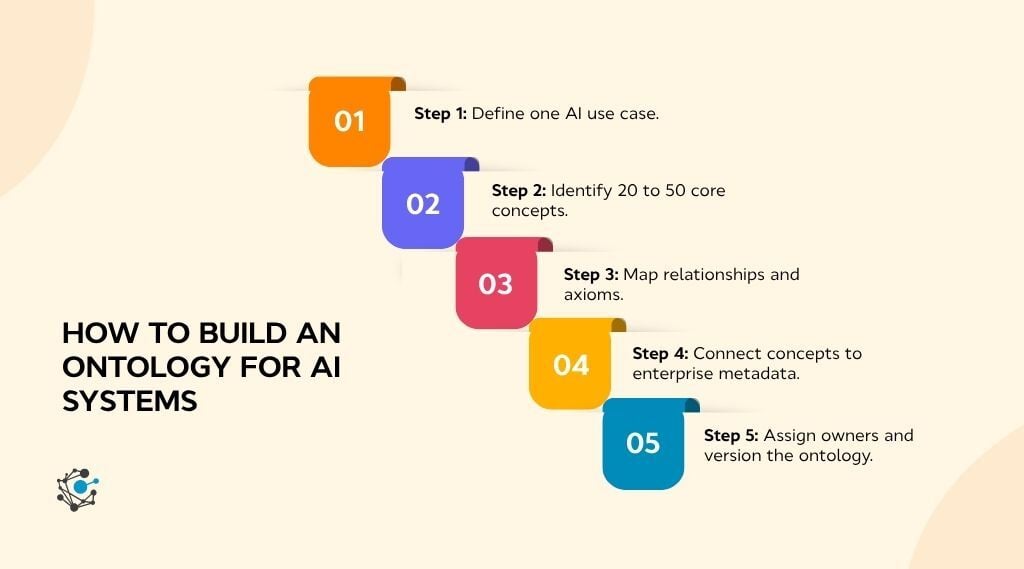
Enterprise ontology programs work best when they start with a specific AI use case and expand from proven value rather than attempting to model the entire organization upfront.
Step 1: Define one AI use case.
Specify what the AI system must answer, recommend, or automate and what happens if it applies the wrong meaning. Use competency questions to identify the terms it must understand, sources it should trust, rules it must follow, and data it cannot access.
Step 2: Identify 20 to 50 core concepts.
Pull candidates from business glossaries, frequently used reports, policies, and subject matter experts. Prioritize concepts involved in real business decisions rather than attempting to represent every field in a schema.
Step 3: Map relationships and axioms.
Define how concepts connect, the direction of each relationship, and the constraints governing them. These rules give the ontology its reasoning capability and distinguish it from a structured vocabulary.
Step 4: Connect concepts to enterprise metadata.
Map each concept to the tables, columns, reports, owners, policies, quality scores, and lineage that support it. This creates traceability between a business concept and the physical data used by AI.
Step 5: Assign owners and version the ontology.
Give every critical concept an accountable owner, approval workflow, and version history. As definitions and policies change, the ontology must change with them.
At OvalEdge, we believe the business glossary should evolve rather than be replaced. For AI, it needs to grow from a human-readable dictionary into a machine-readable meaning system connecting definitions with taxonomy hierarchies, ontology relationships, constraints, metrics, reports, and underlying data assets.
Governance Agents, including Nexus, support this evolution by discovering business concepts, identifying relationships, resolving synonyms, and assembling them into a semantic graph for steward validation.
Common pitfalls and why ontologies decay
Most enterprise ontology problems emerge after deployment as business definitions, systems, and processes change. Four pitfalls are especially common:
-
Modeling the enterprise instead of a use case: Trying to create a universal enterprise model upfront leads to long workshops, expanding scope, and little testable value. Start with the concepts required for a specific AI use case.
-
Building without axioms: Classes and relationships organize concepts, but constraints and rules enable inference. Without axioms, the ontology functions more like a structured vocabulary.
-
Leaving concepts disconnected from data: Concepts must map to the tables, columns, reports, and data products that represent them. Without these connections, an AI agent cannot trace business meaning back to trusted enterprise data.
-
Allowing silent drift: Definitions change, systems are replaced, and policies evolve. If the ontology does not change with them, agents can confidently reason from outdated context. Versioning, approval workflows, ownership, and continuous monitoring are therefore essential to effective ontology management.
How to evaluate an ontology for AI readiness
AI readiness should be measurable. These five dimensions show whether an ontology can reliably support enterprise AI systems and agents.
|
Dimension |
What good looks like |
How to test it |
|
Coverage |
Priority concepts have definitions, linked assets, and named owners |
Sample 20 high-use concepts and identify gaps |
|
Reasoning accuracy |
Relationships and constraints produce correct inferences |
Test representative business questions against expected answers |
|
Traceability |
AI responses can be traced to certified sources and lineage |
Trace several responses back to their source columns |
|
Access awareness |
Sensitive data is classified, and access rules are enforced at runtime |
Run restricted queries using a low-privilege role |
|
Adoption |
Ontology usage and connections to governed assets increase over time |
Track usage, mapped assets, and certification rates |
Traceability and access awareness deserve particular attention. AI outputs that cannot be traced to authoritative sources are difficult to validate or defend during an audit.
Likewise, an ontology should carry governance signals such as ownership, classification, quality, certification, and access rules so agents can distinguish trusted, permitted data from information they should not use.
Conclusion
Ontology creates value when it moves beyond modeling and starts shaping what AI agents can understand, trust, and act on. That requires business concepts to stay connected with lineage, quality, certification, ownership, and access policies, with clear accountability for keeping that context current.
Organizations that manage ontology as a living governance asset can produce AI outputs that are more consistent, traceable, and explainable. When ontology remains static documentation, definitions drift, and agents are left to reason from incomplete or outdated context.
OvalEdge brings ontology, glossary, lineage, data quality, ownership, and access governance together to turn governed meaning into operational AI context.

Book an Enterprise Context Graph demo to see how governed ontology can ground AI agents in trusted enterprise data.
.png?width=1081&height=173&name=Forrester%201%20(1).png)
.png?width=1081&height=241&name=KC%20-%20Logo%201%20(1).png)