.png)
Enterprise AI promises faster decisions, more intelligent automation, and better access to business knowledge. Yet deploying AI is only part of the challenge. Many organizations find that AI systems struggle to understand business context, resulting in inconsistent answers, poor reasoning, and limited trust.
This challenge is becoming more significant as enterprise adoption accelerates.
According to the State of AI Adoption 2025 report by AI Adoption Trends, by mid-2025, more than 72% of enterprises with over 1,000 employees had deployed at least one AI-powered tool in production, up from 55% just 18 months earlier.
As organizations expand the use of AI agents, GraphRAG, and enterprise copilots, choosing the right architecture becomes increasingly important. Although context graphs and knowledge graphs both use graph structures, they solve different problems.
Understanding how they differ and where they complement each other helps organizations build enterprise AI that is accurate, scalable, and explainable.
Context graph vs knowledge graph at a glance
A context graph and a knowledge graph both connect related information, but they address different enterprise AI requirements. A knowledge graph organizes persistent business knowledge and semantic relationships, while a context graph assembles the runtime information needed for a specific user or AI task.
|
Enterprise need |
Recommended approach |
|
Persistent business knowledge |
Knowledge graph |
|
Dynamic AI interactions |
Context graph |
|
AI agents with enterprise reasoning |
Both together |
|
Enterprise search |
Knowledge graph |
|
GraphRAG |
Both together |
|
Personalized copilots |
Context graph |
|
Governed enterprise AI |
Both together |
The right choice depends on your AI objectives. Many organizations use both architectures to combine long-term business knowledge with runtime business context.
What is a context graph?
A context graph is a dynamic graph that assembles the information an AI system needs for a specific task or query. Instead of storing permanent business knowledge, it connects relevant data, metadata, user permissions, and runtime signals to help AI generate accurate, context-aware responses.
Unlike a knowledge graph, a context graph changes with every interaction. For example, if a sales manager and a finance analyst ask, "What was last quarter's revenue?", the context graph can provide different answers based on their access permissions, business definitions, and the reports each user is authorized to view.
Why context graphs have emerged for enterprise AI
Traditional knowledge graphs help AI understand relationships between business entities, but they do not capture the changing context of each interaction. As enterprises adopt LLMs, AI agents, RAG, and GraphRAG, AI systems need more than connected knowledge. They need runtime context that reflects the current user, task, and business environment.
A context graph dynamically combines information such as:
-
Business metadata and definitions
-
User identity and access permissions
-
Conversation history
-
Data lineage
-
Data quality and trust signals
-
Governance policies
For example, an AI agent answering "Which customer accounts need immediate attention?" should not simply retrieve CRM records. It should also consider the user's role, recent customer interactions, data quality, ownership, and business rules before generating a recommendation.
OvalEdge expert insight: Enterprise AI is moving from answering questions to taking actions. As AI agents begin retrieving information, recommending decisions, and triggering workflows, the quality of context becomes as important as the capability of the model itself. AI agents can only act reliably when they understand governed business definitions, permissions, trusted relationships, and enterprise policies.
By assembling this information at runtime, context graphs improve AI grounding, retrieval accuracy, explainability, and policy compliance, making them a key component of enterprise context engineering, AI agents, GraphRAG applications, and intelligent copilots.
How context graphs support AI reasoning
A context graph improves AI reasoning by helping the model interpret information instead of simply retrieving it. It identifies the most relevant business context for a user's query and connects it before the AI generates a response.
For example, a business user asks, "Why did revenue decline in the Northeast last quarter?" A standard RAG system might retrieve quarterly reports containing the term revenue.
A context graph goes further by linking the approved revenue definition, regional sales data, related marketing campaigns, product performance, and recent business events. This allows the AI to produce a more complete and accurate explanation rather than summarizing isolated documents.
Context graphs also make enterprise AI more reliable by enabling it to:
-
Retrieve information based on business relationships instead of keyword matches.
-
Resolve ambiguous terms using approved business definitions.
-
Filter responses according to user permissions and governance policies.
-
Reference trusted datasets with lineage and quality information.
-
Explain why a particular answer or recommendation was generated.
These capabilities are particularly valuable for AI agents, GraphRAG, enterprise search, and context-aware copilots, where AI must understand both the user's request and the surrounding business context before taking action or generating a response.
What is a knowledge graph?
A knowledge graph is a structured representation of business knowledge that connects entities and their relationships in a machine-readable format. It helps people and AI understand how business concepts relate to one another across an organization, creating a consistent foundation for search, analytics, and decision-making.
Unlike a context graph, which changes with each interaction, a knowledge graph is persistent. It continuously represents enterprise knowledge regardless of who accesses it or what question is being asked.
For example, a retail knowledge graph can connect customers, orders, products, suppliers, and stores. When an AI application needs to understand which supplier provides a product or which customers purchased it, the knowledge graph already contains those relationships.
How enterprise knowledge graphs organize business knowledge
A knowledge graph organizes information using four core building blocks:
-
Entities: Business objects such as customers, products, employees, datasets, or reports.
-
Relationships: Connections between entities, such as owns, supplies, depends on, or reports to.
-
Ontologies: A shared vocabulary that defines business concepts and how they relate to one another.
-
Semantic relationships: Business meaning that enables AI to understand concepts beyond keywords.
Because these relationships span multiple systems, enterprise knowledge graphs create a unified view of business information.
For example, instead of maintaining separate definitions across CRM, ERP, and BI platforms, a knowledge graph connects them through common business concepts.
This connected knowledge supports several enterprise initiatives, including:
-
Business glossaries with standardized definitions
-
Metadata management across data platforms
-
Semantic search that understands business meaning
-
Master data management
-
Enterprise AI applications that require consistent business knowledge
By providing a shared understanding of enterprise data, knowledge graphs reduce inconsistencies, improve data discovery, and help AI interpret business concepts more accurately before runtime context is applied.
Implementation tip: Building a knowledge graph doesn't have to start from scratch. Organizations with mature metadata management and business glossary capabilities, such as those provided by OvalEdge, can use these governed assets as the foundation for creating enterprise knowledge graphs.
Context graph vs knowledge graph: Key differences
Although context graphs and knowledge graphs both use graph structures, they address different enterprise AI needs. A knowledge graph creates a persistent model of business knowledge, while a context graph assembles the information required for a specific user, task, or AI interaction.
|
Feature |
Knowledge graph |
Context graph |
|
Primary purpose |
Models enterprise knowledge and business relationships |
Builds runtime context for AI interactions |
|
Scope |
Organization-wide |
User, task, or session-specific |
|
Data model |
Persistent entities and semantic relationships |
Dynamic connections between relevant data, metadata, and context |
|
Semantic relationships |
Core capability |
Uses semantic relationships from the knowledge graph where relevant |
|
Context awareness |
Limited |
High |
|
Persistence |
Long-term |
Changes with every interaction |
|
Supports AI reasoning |
Provides business knowledge |
Applies business knowledge to a specific context |
|
RAG |
Improves retrieval through connected knowledge |
Personalizes retrieval using runtime context |
|
GraphRAG |
Supplies structured relationships |
Selects and enriches relevant graph context for each query |
|
AI agents |
Provides domain knowledge |
Guides agent decisions using user context, permissions, and business signals |
|
Governance |
Depends on governed metadata and business definitions |
Enforces governance policies during AI interactions |
|
Typical use cases |
Business glossary, semantic search, metadata management, master data |
AI agents, enterprise copilots, GraphRAG, conversational analytics |
Rather than replacing one another, the two technologies work together. A knowledge graph provides the enterprise knowledge, while a context graph applies that knowledge to a specific user, task, or AI interaction, enabling more accurate and explainable AI responses.
How context graphs and knowledge graphs work together
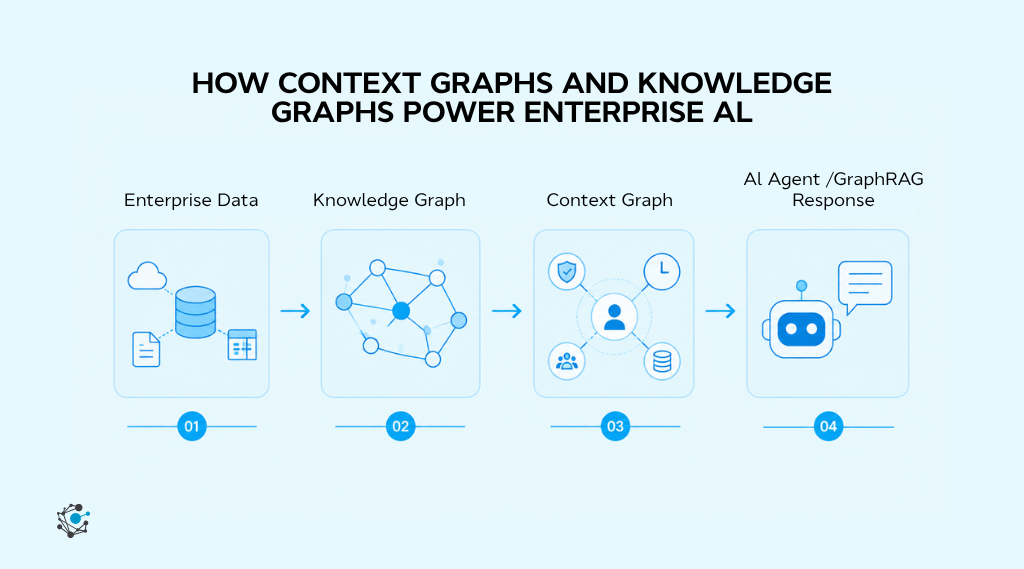
A knowledge graph and a context graph solve different problems, but they deliver the greatest value when used together. The knowledge graph provides a persistent understanding of business concepts and relationships, while the context graph selects and enriches the information needed for a specific AI interaction.
Together, they enable AI systems to retrieve trusted information, apply business rules, and generate responses that reflect both enterprise knowledge and real-time context.
1. Building a trusted foundation with enterprise knowledge
A knowledge graph acts as the long-term knowledge layer for enterprise AI. It connects business entities, definitions, and relationships into a consistent, machine-readable model that remains stable over time.
For example, a knowledge graph can define that a Customer places an Order, an Order contains Products, and a Product belongs to a Category. Because these relationships are centrally maintained, every AI application works from the same business understanding instead of creating its own interpretation.
This shared foundation improves semantic consistency, reduces conflicting definitions, and helps AI interpret business concepts accurately across departments and systems.
2. Adding real-time context to AI interactions
A context graph extends the knowledge graph by selecting only the information that is relevant for the current interaction. Instead of exposing the entire enterprise knowledge base, it assembles the business context needed for a specific user, task, or workflow.
For example, if two regional managers ask, "Which products need immediate attention?", both may reference the same knowledge graph. However, the context graph filters the response using each manager's region, permissions, and current business data, ensuring the recommendations remain relevant and compliant.
This is the pairing OvalEdge productizes through its Enterprise Context Graph, which brings your business glossary, metadata, lineage, data quality, ownership, and policies into one searchable context layer.
3. Improving RAG, GraphRAG, and AI agent performance
Knowledge graphs and context graphs improve AI in different ways. The knowledge graph provides structured business relationships, while the context graph helps AI retrieve the most relevant information for the current task.
This combination helps organizations:
-
Improve retrieval precision
-
Generate more context-aware responses
-
Reduce hallucinations with trusted business context
-
Explain how answers were derived
-
Support AI agents that adapt to changing business conditions
OvalEdge expert insight: RAG improves retrieval by bringing relevant information into the prompt. However, enterprise AI also needs governance signals such as approved business definitions, certified data, lineage, and permissions. These signals help AI determine whether retrieved information is suitable for business decisions, not simply whether it is relevant.
When should you use a context graph?
A context graph is the right choice when AI applications need to understand the user's situation, business context, and runtime conditions before generating a response. It continuously adapts to changes in users, permissions, conversations, and enterprise data, making it ideal for interactive AI systems.
It is particularly valuable for:
-
AI agents that make decisions based on business rules, user roles, and live enterprise data.
-
Agentic workflows where AI completes multi-step tasks across applications using contextual information.
-
Conversational analytics that tailor responses based on previous questions and current business conditions.
-
Enterprise copilots that provide role-specific recommendations instead of generic answers.
-
Personalized recommendations that combine user preferences with operational data.
-
Context-aware enterprise search that returns results based on business meaning, permissions, and relevance rather than keyword matching.
For example, an HR copilot answering "Show employees eligible for promotion" should consider company policies, employee performance, reporting hierarchy, and the manager's access rights. A context graph assembles this information before the AI responds, making the recommendation more accurate and compliant.
A context graph is less suitable when the primary goal is to model long-term business knowledge or maintain semantic relationships across the enterprise. In these scenarios, a knowledge graph provides a more appropriate foundation.
When should you use a knowledge graph?
A knowledge graph is the better choice when your goal is to create a consistent, long-term representation of business knowledge across the organization. It connects business entities and their relationships into a shared model that both people and AI can understand.
Knowledge graphs are commonly used for:
-
Enterprise knowledge management to organize and connect business information across systems.
-
Business glossaries that standardize definitions for key business terms.
-
Semantic integration to link data from multiple applications using common business concepts.
-
Metadata management by connecting datasets, reports, pipelines, and business assets.
-
Master data management (MDM) to establish a trusted view of core business entities such as customers, products, and suppliers.
-
Explainable AI by providing structured relationships that help AI justify its responses.
For example, a global manufacturer may use a knowledge graph to connect products, suppliers, factories, and distribution centers across ERP, CRM, and supply chain systems. This creates a unified business model that supports analytics, enterprise search, and AI applications.
A knowledge graph is less suitable for scenarios that depend on changing runtime information, such as user intent, conversation history, or session-specific permissions. In these cases, a context graph is needed to apply the appropriate context before AI generates a response.
How to choose the right graph architecture for enterprise AI
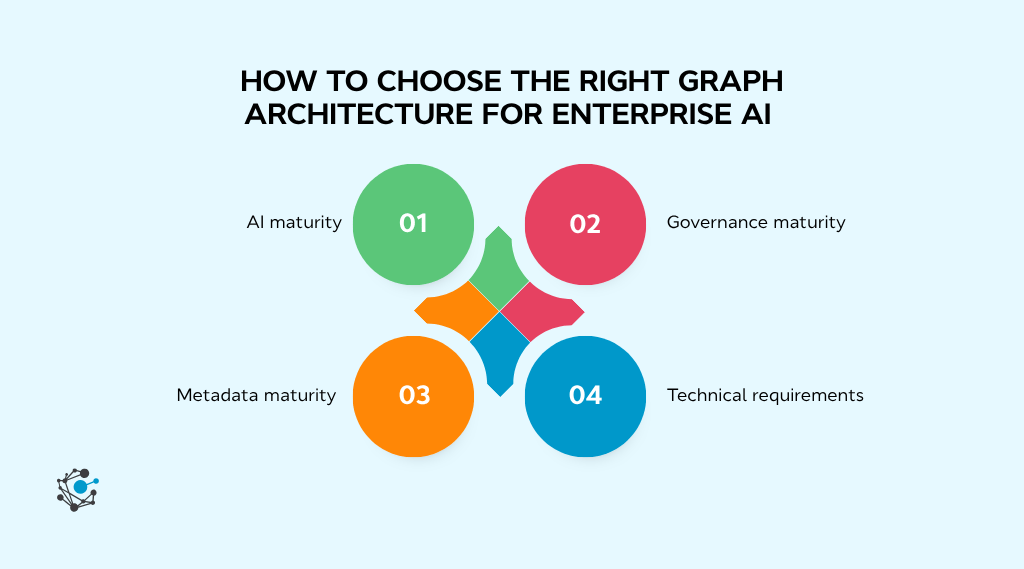
The right graph architecture depends on your AI goals, governance maturity, and metadata capabilities. Rather than choosing a technology first, evaluate how your organization manages business knowledge, contextual information, and trusted data.
Consider the following factors:
-
AI maturity: Use a knowledge graph for semantic search and enterprise knowledge. Add a context graph when building AI agents, GraphRAG, or enterprise copilots.
-
Governance maturity: Organizations with defined business glossaries, stewardship, policies, and access controls can deliver more trusted AI outcomes.
-
Metadata maturity: Complete metadata, lineage, quality, and semantic definitions provide the foundation for both graph architectures.
-
Technical requirements: Ensure the solution integrates with existing systems while meeting scalability, security, and performance requirements.
|
If your priority is... |
Recommended approach |
|
Standardizing business knowledge |
Knowledge graph |
|
Enabling context-aware AI |
Context graph |
|
Building AI agents and GraphRAG |
Both together |
|
Improving enterprise search |
Knowledge graph |
|
Scaling governed enterprise AI |
Both together |
As enterprise AI matures, many organizations combine both approaches. A knowledge graph provides trusted business knowledge, while a context graph applies that knowledge to each user, task, and interaction.
Governed metadata as the foundation for context and knowledge graphs
Neither a knowledge graph nor a context graph can provide reliable enterprise AI without governed metadata. While graphs connect information, metadata establishes the business meaning, ownership, lineage, quality, and governance that make those connections trustworthy.
Enterprise AI does not replace data governance. It changes the consumer of governance. Business glossaries, lineage, certifications, ownership, and governance policies that once guided people now help AI agents interpret business meaning, identify trusted sources, and operate within enterprise policies.
A governed metadata foundation enables organizations to:
-
Standardize business terminology.
-
Connect business concepts to trusted data.
-
Trace AI responses back to their source.
-
Apply governance consistently.
-
Scale enterprise AI with reliable business context.
Operationalizing context and knowledge with OvalEdge
Enterprise AI depends on governed metadata that remains consistent across data, analytics, and AI workflows. OvalEdge operationalizes this foundation by connecting business glossaries, technical metadata, lineage, data quality, ownership, and governance into a unified platform.
With OvalEdge, organizations can:
-
Connect business glossary terms with technical metadata.
-
Build an Enterprise Context Graph from governed metadata.
-
Link business context with lineage, stewardship, and quality.
-
Deliver trusted context to AI agents and AskEdgi.
-
Support enterprise search, RAG, and GraphRAG.
-
Govern AI through policies, ownership, approvals, and workflows.
By making governed metadata available across enterprise AI workflows, OvalEdge helps organizations deliver more accurate, explainable, and enterprise-ready AI.
Conclusion
The context graph vs knowledge graph discussion is not about choosing one technology over the other. A knowledge graph organizes enterprise knowledge, while a context graph applies that knowledge to a specific user, task, or interaction.
As enterprise AI continues to evolve, organizations will increasingly combine both architectures rather than treat them as alternatives. Together, they enable AI systems to retrieve, reason, and act using trusted business context.
The common foundation is governed metadata. Consistent business definitions, lineage, ownership, data quality, and governance ensure AI systems operate with reliable enterprise context at scale.
Ready to build trusted enterprise AI?

 Book an Enterprise Context Graph demo to see how OvalEdge transforms governed metadata into trusted business context for AI agents, GraphRAG, and enterprise search.
.png?width=1081&height=173&name=Forrester%201%20(1).png)
.png?width=1081&height=241&name=KC%20-%20Logo%201%20(1).png)