.jpg)
AI can sound confident and still be wrong about your business. Not because the prompt is weak, but because the model may not have the governed business context it needs.
In most enterprises, that context already exists across glossaries, catalogs, lineage maps, KPI definitions, ownership records, quality rules, and access policies. The problem is that this knowledge is often scattered, human-facing, and not packaged for AI systems to use at runtime.
That is where the conversation shifts from prompt engineering to context engineering.
Prompt engineering shapes how instructions are given to a model. Context engineering shapes what the model is allowed to know, trust, retrieve, and act on before it generates an answer.
In this guide, we’ll compare context engineering vs prompt engineering, explain why better prompts are not enough at enterprise scale, and show how governed metadata, lineage, classification, and business definitions become the foundation for reliable AI systems.
What is the difference between context engineering and prompt engineering?
Prompt engineering is about shaping the instructions you give to an AI model. It focuses on wording, format, tone, examples, and task structure. A prompt tells the model what to do in a specific interaction.
For enterprises, context engineering is the practice of making business definitions, governance policies, lineage, ownership, quality signals, and trusted data sources available to AI systems at runtime.
| Dimension | Prompt Engineering | Context Engineering |
| What it optimizes | How the question is phrased | What the agent knows when answering |
| Operates at | Interaction level | Infrastructure level |
| Persistence | Rewritten per use case | Shared across agents and workflows |
| Key artifact | Prompt template | Governed context layer |
| Governance | Hard to audit at scale | Governed, traceable, and enforceable |
| Primary failure mode | Inconsistent output | Missing or stale business context |
| Core skill | Instruction design | Data governance and knowledge architecture |
What has changed is who, or rather what, needs governance. Earlier, glossaries, lineage, policies, and ownership details were mostly there for analysts, stewards, and compliance teams. Now, AI agents need that same context while they answer questions, generate SQL, recommend actions, or move through workflows.
Prompt engineering and context engineering solve different problems. While one shapes how the model responds, the other controls the business context the model can use. In enterprise AI, they work best together.
Where the two disciplines overlap
Prompt engineering and context engineering are not opposites, since both influence the model’s output and shape what enters the context window. This is why they both matter in production AI systems.
The mistake is treating prompt engineering as a substitute for context infrastructure.
A prompt can tell an AI system to “use the approved revenue definition,” but context engineering makes sure the system actually has the approved definition, knows where it came from, whether it is certified, who owns it, and whether the user is allowed to access it.
Why prompt engineering breaks down at enterprise scale
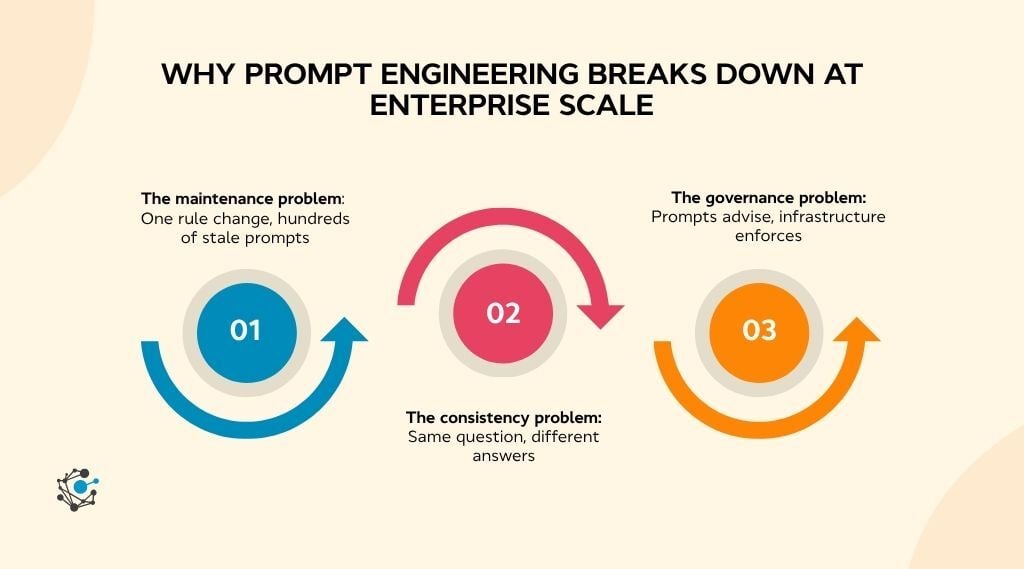
Prompt engineering works well when the task is simple, contained, and low-risk, but it starts to break when AI systems need to answer business-specific questions across many users, tools, datasets, and workflows.
The issue is that the business knowledge behind the answer is scattered across glossaries, dashboards, policies, lineage maps, access rules, and team-specific assumptions.
Context engineering only works at enterprise scale when that knowledge is governed, maintained, and delivered to AI systems at the moment of use.
The maintenance problem: One rule change, hundreds of stale prompts
A prompt library can quickly become a hidden maintenance burden. If every AI assistant carries its own version of metric definitions, access rules, product names, and fiscal calendar logic, one business change can create hundreds of stale prompts.
This is especially risky for enterprise data teams. A company may update how it classifies recurring revenue, customer tiers, or regional performance. If that logic lives inside scattered prompt templates, no one can easily see which prompts need updating.
A governed context layer solves this by keeping approved definitions, owners, source mappings, and usage rules in one maintained place, so agents inherit the latest version instead of relying on hardcoded prompt instructions.
Here’s a fact: IDC's FutureScape 2026 Predictions found that by 2027, companies that do not prioritize high-quality, AI-ready data will struggle to scale GenAI and agentic solutions, resulting in a 15% productivity loss. This is a direct consequence of leaving business definitions scattered across prompt templates instead of a governed infrastructure.
The consistency problem: Same question, different answers
Enterprise users expect the same business question to return the same business answer. Prompt-only systems often struggle with consistency because different users may:
-
Phrase the same question in different ways
-
Attach different files or supporting documents
-
Trigger different prompt templates or workflows
Consider a simple revenue question: two employees ask essentially the same thing, but one references a dashboard while the other uploads a spreadsheet. If the AI relies heavily on prompts and loosely connected sources, the answers may differ even though the underlying business question is identical.
That is a strong reminder that consistent answers come from governed context: approved definitions, certified sources, lineage, and quality signals that stay the same regardless of how a user phrases the question.
The governance problem: Prompts advise, infrastructure enforces
A prompt that says, “Do not include sensitive information,” can help, but it is not the same as access control.
In regulated industries, this difference matters because finance, healthcare, and insurance teams cannot depend on a model politely following a prompt when sensitive data is involved. Infrastructure-level governance enforces what the AI can retrieve, see, and use before the answer gets generated.
As organizations expand their use of AI agents, governance becomes even more important. The more decisions, workflows, and data sources an AI system touches, the greater the need for clear controls. Prompts can provide guidance, but governance built into the underlying infrastructure helps ensure those rules are applied consistently and reliably.
Did you know? In fact, Deloitte's 2026 State of AI in the Enterprise report found that while nearly three-quarters of companies plan to deploy AI agents within two years, only 21% have a mature governance model in place for those agents, underscoring exactly why governance cannot live inside a prompt.
Four signs your AI system needs context engineering, not better prompts
Your AI system likely needs context engineering when:
-
The agent gives confident answers that are wrong about your own business data.
-
Two users ask the same question and get different business answers.
-
The agent fails on internal product names, customer tiers, fiscal periods, or reporting hierarchies.
-
Prompt templates keep growing with business rules, exceptions, and edge cases.
If two or more of these apply, the issue is probably not how users phrase the question, but what the AI system knows.
The next step is understanding what context engineering actually includes. Once you move beyond prompts, the focus shifts to the systems, data, and knowledge structures that shape how AI agents retrieve information, make decisions, and generate answers.
What context engineering actually covers
Context engineering covers the governed business knowledge an AI system needs to produce useful, reliable, and policy-aware answers.
The four components of an agent's context window
A simple way to understand context is to think about what an AI agent carries into a task:
-
Working context: The current task, user request, and immediate instructions the agent is responding to.
-
Session memory: Information from earlier in the same interaction that helps maintain continuity.
-
Long-term memory: Persistent knowledge that carries across sessions and can be reused over time.
-
Tool context: The tools the agent can access, along with the data and outputs those tools provide.
In enterprise settings, the most important question is not just what fits into the context window, but whether that context is approved, current, traceable, and safe for the user’s role.
Prompt engineering mostly shapes the working context, while context engineering designs the broader system that feeds all four components, especially memory, tools, and trusted business knowledge.
How context engineering is different from RAG
RAG, or retrieval-augmented generation, helps an AI system pull relevant text from documents. It is useful, but it is not the same as context engineering.
A RAG system may retrieve a paragraph that mentions “net revenue,” whereas a context layer can give the AI the certified definition of net revenue, the system of record, the data owner, the lineage path, the access rules, and the freshness status.
Simply put:
-
RAG retrieves content.
-
Context engineering organizes meaning, trust, and rules around that content.
RAG, MCP, APIs, embeddings, and agent-facing search can help deliver context. They do not create trusted context by themselves. If the underlying definitions are unclear, ownership is missing, or access rules are weak, retrieval simply brings back ambiguity faster.
The two can work together seamlessly: RAG can supply source material, while context engineering tells the model which sources are trusted, current, and allowed for the user.
What goes into a context layer for enterprise AI
A governed context layer gives AI systems the business meaning, trust signals, and controls they need to answer reliably. Instead of treating metadata, glossary terms, lineage, policies, and quality checks as separate assets, it connects them into one usable foundation.
A strong enterprise AI context layer usually has five parts:
-
Context assets: These are the core governance assets AI systems need to reference. They include business glossary terms, metadata, certified datasets, approved reports, lineage records, classifications, ownership details, and governance policies.
-
Semantic meaning: This layer explains what business terms, metrics, entities, and relationships actually mean. It includes approved KPI definitions, calculation logic, customer or product relationships, reporting hierarchies, and usage rules.
-
Context delivery: This is how context reaches the AI system at runtime. Delivery can happen through RAG, APIs, MCP-style access, embeddings, agent-facing search, or a combination of retrieval methods.
-
Context control: This layer decides what the AI system can access, retrieve, reveal, or act on. It includes permissions, masking rules, sensitivity labels, access policies, certifications, quality thresholds, and freshness signals.
-
Context operations: This keeps the context layer current and trustworthy over time. It includes stewardship workflows, review cycles, version history, monitoring, feedback loops, and ownership updates.
That is why context engineering is not just an AI engineering concern. It depends on the governance work data teams already do: defining meaning, certifying sources, assigning ownership, tracing lineage, classifying sensitive data, enforcing policies, and maintaining trusted context over time.
When to use prompt engineering, context engineering, or both?
To figure out when it makes sense to use context vs prompt engineering, the practical question to ask is which problem you are actually solving.
Where prompt engineering still belongs
Prompt engineering is the right tool when the model already has the information it needs, but the answer needs better structure.
You use prompt engineering to control output format, guide tone, decompose a task, provide examples, or ask for a specific style of response. For example, you might ask the AI to summarize findings for a CFO, format results as a table, or explain a technical issue to a non-technical stakeholder.
None of those require the AI to understand your entire data environment. They only require clear communication.
Where context engineering belongs
Context engineering belongs where the AI must understand business-specific knowledge.
It is needed for metric definitions, entity resolution, data access rules, lineage, freshness, policy enforcement, and workflow-specific decisions. It is especially important for AI agents that take actions across tools or answer questions using enterprise data.
Expert insight: According to Gartner's June 2025 research, over 40% of agentic AI projects will be canceled by the end of 2027 due to escalating costs, unclear business value, or inadequate risk controls. This is a stark reminder that AI agents need more than clever prompts to survive at scale.
The practical decision: Which problem are you actually solving?
A simple way to think about it is to diagnose the problem before choosing the solution. Ask yourself: is the AI struggling with how to respond, or is it struggling with what it knows?
|
If you're seeing this problem... |
Start with... |
Why |
|
The agent writes awkward, inconsistent, or poorly formatted responses |
Prompt engineering |
The model has the information but needs clearer instructions on how to present it. |
|
The agent does not understand your business terms, metrics, or processes |
Context engineering |
The issue is missing business knowledge, not poor phrasing. |
|
Different users get different answers to the same business question |
Context engineering |
Shared, governed definitions create consistency across interactions. |
|
The agent struggles with complex, multi-step tasks |
Prompt engineering |
Better task decomposition and structured instructions can improve execution. |
|
The agent accesses or references data it should not use |
Context engineering |
Governance and access controls need to be enforced at the infrastructure level. |
The reality is that most enterprise AI systems need both.
-
Context engineering determines what the agent knows, what data it can access, and which business rules it follows.
-
Prompt engineering determines how the agent communicates, structures its response, and carries out the task.
In short, context engineering provides the trusted foundation, while prompt engineering helps the AI make the best use of that foundation.
What context engineering looks like for enterprise data teams
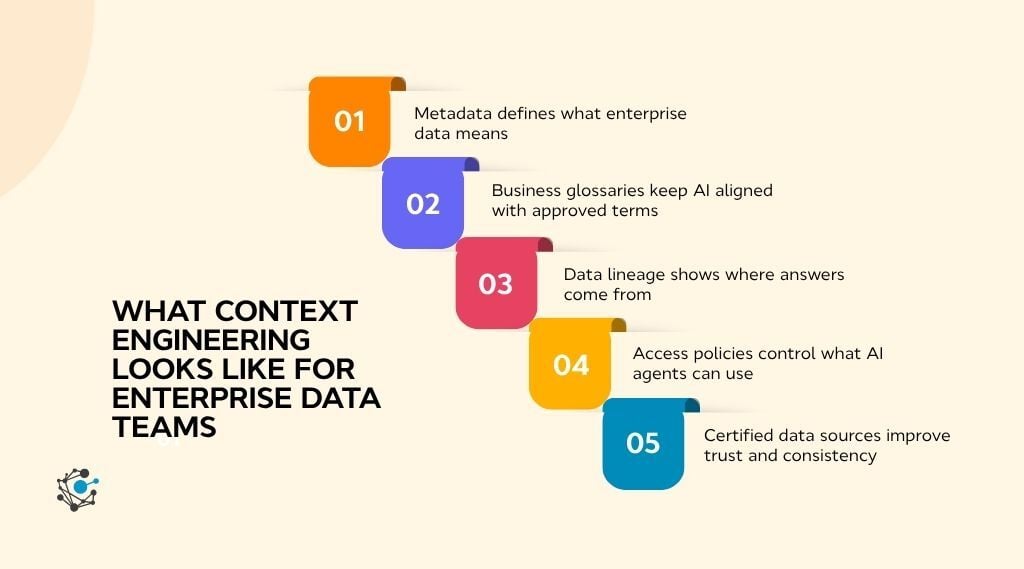
For data teams, context engineering turns familiar governance work into AI infrastructure that agents can use at runtime.
Why metadata is the raw material of context engineering
An AI agent needs to know what data means, where it came from, who owns it, and whether it can be trusted. That information lives in metadata.
Descriptions, classifications, lineage records, sensitivity tags, ownership fields, and quality scores all become inputs to the context layer. If metadata is incomplete or stale, the context layer will inherit that weakness. AI-ready metadata is the foundation for reliable enterprise AI.
How data governance policies become AI infrastructure
Data governance used to live mainly in documentation, access reviews, and compliance workflows. Context engineering turns governance into something agents can actually use.
For example:
-
Sensitive data classifications become retrieval, masking, and disclosure boundaries.
-
Certified datasets become preferred sources.
-
Data ownership becomes part of answer traceability.
As a result, governance moves from “rules people should follow” to “constraints AI systems inherit.”
Why data lineage belongs in your context layer
Without lineage, an AI agent can use a number without knowing whether it is current, certified, or authoritative.
Lineage helps the agent understand where data came from and whether it should be trusted for the current task. This moves lineage from a compliance artifact to an operational input. It also helps users trust the answer because they can see the source path behind it.
A practical starting point: One workflow, end-to-end
The best way to start is not to build context infrastructure for every agent at once. Start with one high-value workflow.
A practical approach looks like this:
-
Map the users, questions, data sources, decisions, and success metrics involved in the workflow.
-
Identify the business definitions, relationships, governance policies, and data freshness rules the agent needs to perform accurately.
-
Build the governed context layer for that specific workflow using approved definitions, certified sources, lineage, access rules, ownership, and quality signals.
-
Compare the results against a prompt-only approach to measure the impact of added context.
Following these steps creates a clear before-and-after view of accuracy, consistency, and trust, making it easier to demonstrate the value of context engineering before scaling to additional use cases.
Is context engineering replacing prompt engineering?
Context engineering is not replacing prompt engineering. It is simply replacing one misuse of prompt engineering: storing business knowledge, metric definitions, and governance rules inside long prompt instructions.
The change is practical:
-
Governed definitions, access rules, entity relationships, lineage, and freshness checks should move out of prompts and into shared infrastructure.
-
Output format, reasoning structure, tone, and examples can stay inside prompts.
This division keeps AI systems cleaner and also makes them easier to update, govern, and scale.
What this shift means for teams building AI on enterprise data
The shift from prompt engineering to context engineering changes how teams think about AI reliability.
Forrester’s 2025 State of AI report found that 70% of firms already have generative or predictive AI in production, yet many still lack the governance needed to realize its full value.
That gap is where context engineering becomes critical. It turns metadata, policies, definitions, and lineage into the trusted foundation AI systems need to scale reliably.
The teams that build useful enterprise agents will not be the teams with the longest prompt libraries, but ones that treat context as governed, versioned, reusable infrastructure.
For data teams, this expands the role of catalogs, glossaries, lineage, and governance systems. These tools are no longer only for compliance or documentation; they become the raw material AI agents need to answer questions with trust.
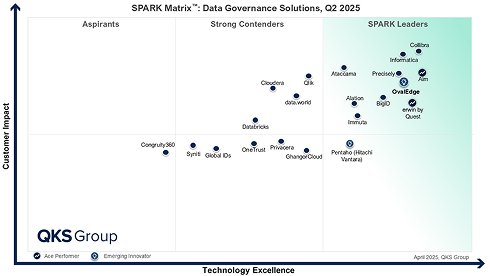
OvalEdge’s data governance and catalog platform brings together metadata management, data lineage, business glossary, and sensitive data discovery. For enterprises moving toward agentic analytics, that governed metadata foundation helps determine whether AI answers are trustworthy or merely confident.
Conclusion
As organizations move from AI assistants to AI agents, the next step is to evaluate how context flows through your AI ecosystem.
-
Are your business definitions centralized?
-
Can your AI systems understand data relationships, ownership, and access rules?
-
Do they have the metadata needed to deliver consistent and reliable outcomes?
This is where OvalEdge can help. OvalEdge helps enterprises turn existing governance assets, including business glossaries, metadata, lineage, classification, ownership, policies, and sensitive data discovery, into a governed context foundation AI systems can use.
By creating a trusted context layer across your enterprise data landscape, OvalEdge helps organizations build AI systems that are more accurate, explainable, and scalable.
If you’re ready to move from prompt-driven experimentation to enterprise-ready AI, schedule a demo with OvalEdge to see how governed context can help your teams build AI systems that are more accurate, explainable, and trusted.
.png?width=1081&height=173&name=Forrester%201%20(1).png)
.png?width=1081&height=241&name=KC%20-%20Logo%201%20(1).png)