.jpg)
Sensitive data discovery tools scan enterprise systems to identify and classify PII, PHI, payment card data, and confidential business records across cloud, SaaS, on-premise, and hybrid environments. Their output feeds everything downstream, including access controls, masking, encryption, and audit reporting.
The category has fragmented into four groups that solve different problems.
-
Governance-led platforms connect classification to ownership and lineage.
-
Security-focused platforms prioritise exposure and insider risk.
-
Cloud-native services go deep inside a single hyperscaler.
-
Privacy and compliance specialists centre on regulatory reporting and subject rights.
Teams often build a shortlist that spans two or three of these categories without noticing, which is why demos start feeling like comparisons between unrelated products. This guide compares nine platforms with the same structure for each: what it does well and where it falls short.
What are sensitive data discovery tools?
Sensitive data discovery tools are software platforms that scan enterprise systems to locate regulated and confidential information, classify what they find by type and sensitivity, and map where it resides. They give security, privacy, and governance teams a current inventory of sensitive data across structured and unstructured sources.
Common detection targets include personally identifiable information, protected health information, payment card data, credentials, and confidential business records such as contracts and intellectual property. Coverage spans databases, data warehouses, data lakes, object storage, file shares, collaboration platforms, and SaaS applications.
Most platforms combine pattern matching, dictionary lookups, and machine learning models, and the section on how these tools work covers where each method breaks down. Classification is the step that makes the results usable, and data classification software focuses on that layer specifically.
The category is easy to confuse with adjacent tooling. DLP controls data in motion across email, endpoints, and web traffic. DSPM extends discovery by mapping data to identities and exposure paths. Data governance platforms define ownership and handling rules. All three depend on discovery for their input. This category also has no connection to business intelligence data discovery, which describes visual analytics.
Sensitive data discovery tools compared
The nine platforms below span four buyer categories. Use this table to narrow the shortlist to the two or three worth a demo, then read the full profiles for detail on how each one detects, classifies, and remediates.
|
Tool |
Category |
Best for |
Deployment |
Notable limitation |
|
OvalEdge |
Governance-led |
Discovery tied to ownership, lineage, and stewardship |
Cloud, on-premise, hybrid |
Governance foundation, not an exposure-path or DSPM tool |
|
Collibra |
Governance-led |
Mature programs with formal stewardship models |
Cloud, hybrid |
Discovery depth often depends on add-ons |
|
BigID |
Security and privacy |
Large, heterogeneous data estates |
Cloud, on-premise, hybrid |
Broad scope extends deployment timelines |
|
Varonis |
Security-focused |
Unstructured data and insider risk |
Cloud, on-premise, hybrid |
Tuning effort is significant in complex estates |
|
Cyera |
Security-focused, DSPM |
Agentless multi-cloud exposure mapping |
Cloud, agentless |
Limited depth on legacy on-premise systems |
|
Microsoft Purview |
Cloud-native |
Microsoft 365 and Azure estates |
Cloud |
Coverage thins outside the Microsoft ecosystem |
|
Amazon Macie |
Cloud-native |
AWS environments with S3 as primary storage |
AWS only |
Single-cloud scope, consumption pricing scales with volume |
|
Securiti |
Privacy and compliance |
Subject rights workflows and regulatory reporting |
Cloud, hybrid |
Framed for privacy teams over security operations |
|
Ground Labs Enterprise Recon |
Compliance and precision |
PCI DSS scope reduction, legacy and air-gapped systems |
Agent, agentless, distributed |
No identity or exposure-path mapping |
The 9 best sensitive data discovery tools
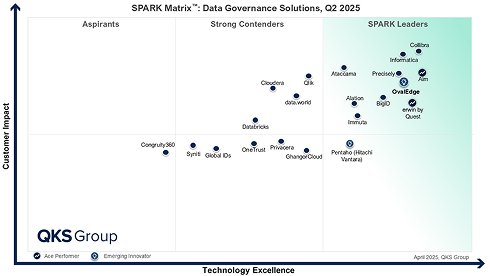
All the 9 platforms given below were selected on production maturity, coverage across cloud and on-premises environments, and independent presence in enterprise evaluations.
Governance-led platforms
These platforms treat classification as one output of a wider metadata layer. Discovery results connect to ownership assignments, lineage, business definitions, and access policies, which suits organisations where a named steward has to act on every finding.
1. OvalEdge
OvalEdge is a metadata-driven data governance and catalog platform that discovers, classifies, and maps sensitive data across hybrid environments. Classification results connect directly to lineage, stewardship assignments, and access policies, so a PII finding arrives with an owner attached and a record of where that data travels downstream.
Key features
-
Unified metadata inventory: Crawls databases, warehouses, cloud storage, BI tools, and pipelines to build a single data catalog that discovery and classification run against.
-
AI-assisted classification with steward review: Runs an AI model across a selected domain to detect potential PII, then presents each recommendation to a steward as a Yes or No confirmation. Confirmed classifications become part of the permanent metadata record.
-
Column-level lineage: Maps how classified data moves between systems, which supports impact analysis and regulatory traceability.
-
Continuous monitoring: Triggers alerts when new PII appears in scanned environments, so inventories stay current as schemas and pipelines change.
Pros
-
Classification is attached to an owner and a lineage path, which shortens the distance between finding sensitive data and acting on it.
-
Broad connectivity across databases, warehouses, cloud storage, and BI tools, with the same classification model applied consistently across on-premise and cloud sources.
OvalEdge expert insight: Classification reduces risk only when it reaches someone with authority to act. A finding with no owner is a record of risk, not a reduction in it.
If your discovery findings currently land without a named owner or an enforcement path, schedule a demo to see how OvalEdge closes that gap.
2. Collibra
Collibra is an enterprise data governance and catalog platform with sensitive data classification embedded in its stewardship and policy management framework. It is most common in large regulated organisations that already have defined ownership models, approval workflows, and documented policies to attach classification results to.
Key features
-
Catalog and stewardship framework: Centralises metadata, ownership assignments, and policy definitions across business domains.
-
Policy management: Supports rule definition, approval chains, and formal sign-off tied to classified assets.
-
Business glossary: Connects technical metadata to agreed-upon business definitions, improving consistency in how sensitive categories are applied.
-
Compliance documentation: Assists in evidencing regulatory obligations and control coverage for audit.
Pros
-
Mature policy and stewardship capabilities with deep adoption across banking, insurance, and healthcare.
-
Strong fit where governance is already an operating function.
Cons
-
Classification depth frequently depends on integrations or additional modules, so scanning capability needs careful scoping during evaluation.
Security-focused platforms
These platforms treat discovery as the first step in exposure reduction. They prioritise who can reach sensitive data, how much of it is overshared, and which findings need remediation first, which suits security and risk teams over stewardship functions.
3. BigID
BigID is a data discovery and intelligence platform spanning security, privacy, and AI risk use cases. It scans structured and unstructured sources, correlates findings back to individual identities, and supports both regulatory reporting and exposure reduction from the same inventory.
Key features
-
Broad source coverage: Scans databases, data lakes, file systems, SaaS applications, and cloud object storage.
-
Identity correlation: Links discovered records to the individuals they describe, which supports subject rights requests and breach scoping.
-
ML-based classification: Applies contextual models alongside pattern matching to improve accuracy on unstructured content.
-
Policy and risk workflows: Connects classification output to policy definitions, risk scoring, and remediation tasks.
Pros
-
Identity correlation makes it one of the stronger options for PII discovery at record level.
-
One platform serves security, privacy, and governance teams, which reduces tool sprawl.
Cons
-
Broad scope lengthens deployment and usually requires coordination across three teams to realise full value.
4. Varonis
Varonis is a data security platform built around unstructured data, permissions, and user behaviour. It combines discovery and classification with access analysis, showing not only where sensitive files exist but who can open them and who has been opening them.
Key features
-
Unstructured data depth: Strong coverage of file systems, SharePoint, OneDrive, Exchange, and collaboration platforms.
-
Permissions analysis: Maps effective access to sensitive files and flags overexposed data.
-
Behavioural detection: Baselines normal access patterns and alerts on anomalous activity against sensitive data.
-
Automated remediation: Removes excessive permissions and global access groups at scale.
Pros
-
Few platforms match its depth on unstructured data and permission analysis.
-
Discovery connects directly to threat detection, so findings feed active monitoring.
Cons
-
Implementation and tuning are demanding in large estates, and structured database coverage needs validating separately.
5. Cyera
Cyera is an AI-native data security posture management platform that discovers and classifies sensitive data across cloud environments without deploying agents. It maps discovered data to identities, permissions, and exposure paths, which places it closer to DSPM than to traditional scanning.
Key features
-
Agentless multi-cloud discovery: Connects across AWS, Azure, and GCP through cloud APIs with no software installed on data stores.
-
Shadow data detection: Surfaces forgotten buckets, snapshots, and copies that never appeared in any inventory.
-
AI-based classification: Uses contextual models to reduce false positives on ambiguous and unstructured content.
-
Exposure and risk prioritisation: Ranks findings by who can reach the data and how exposed it is.
Pros
-
Agentless deployment produces useful results within days rather than months.
-
Exposure context turns a list of findings into a ranked remediation queue.
Cons
-
Depth on legacy on-premise systems is limited compared with hybrid-first platforms.
Cloud-native services
These are first-party services from the hyperscalers. Each one runs deep inside its own platform, integrates natively with the surrounding security controls, and prices on consumption rather than seats. Google Cloud DLP fits the same pattern for GCP environments, with API-driven inspection that suits pipeline integration. Coverage stops at the provider boundary in every case, so multi-cloud estates end up running two or three of them or layering a vendor-neutral platform on top.
6. Microsoft Purview

Microsoft Purview is Microsoft's data governance and compliance suite, combining discovery, classification, sensitivity labelling, and policy enforcement across Microsoft 365 and Azure. Labels applied during classification travel with the file and drive downstream protection, which makes it the default choice for organisations whose sensitive data lives inside Microsoft services.
Key features
-
Native Microsoft 365 coverage: Scans Exchange, SharePoint, OneDrive, and Teams without connectors.
-
Sensitivity labelling: Applies persistent labels that trigger encryption, access restrictions, and DLP policies.
-
Azure and multicloud scanning: Covers Azure data services, with connector-based support extending to AWS S3 and some on-premise sources.
-
Copilot data controls: Restricts which classified content Microsoft Copilot can surface to users.
Pros
-
Classification connects straight to enforcement inside the Microsoft stack.
-
Licensing is often already in place through existing E5 agreements.
Cons
-
Coverage outside Microsoft services depends on connectors that vary in maturity and depth.
7. Amazon Macie
Amazon Macie is an AWS service that uses machine learning and pattern matching to discover and classify sensitive data in S3. It reports findings into Security Hub and EventBridge, so detection can trigger automated response without additional integration work.
Key features
-
Automated S3 discovery: Continuously inventories buckets and evaluates encryption and public access settings.
-
Managed data identifiers: Ships with detection rules for common PII, PHI, credentials, and financial data, with custom identifiers supported.
-
Native AWS integration: Publishes findings to Security Hub and EventBridge for automated remediation.
-
Sampling controls: Allows scan scope and frequency tuning to manage cost on large buckets.
Pros
-
Fastest route to sensitive data visibility for teams already inside AWS.
-
No infrastructure to deploy and no agents to maintain.
Cons
-
Scope is limited to AWS and centred on S3, and consumption pricing climbs quickly across large data volumes.
Privacy and compliance specialists
These platforms are built around a regulatory obligation rather than a security outcome. Discovery exists to answer a specific question an auditor, regulator, or data subject will ask, so reporting, evidence, and remediation records get as much attention as the scanning engine itself. Spirion belongs to this group too, with a long-standing focus on detection accuracy for privacy and data inventory work.
8. Securiti
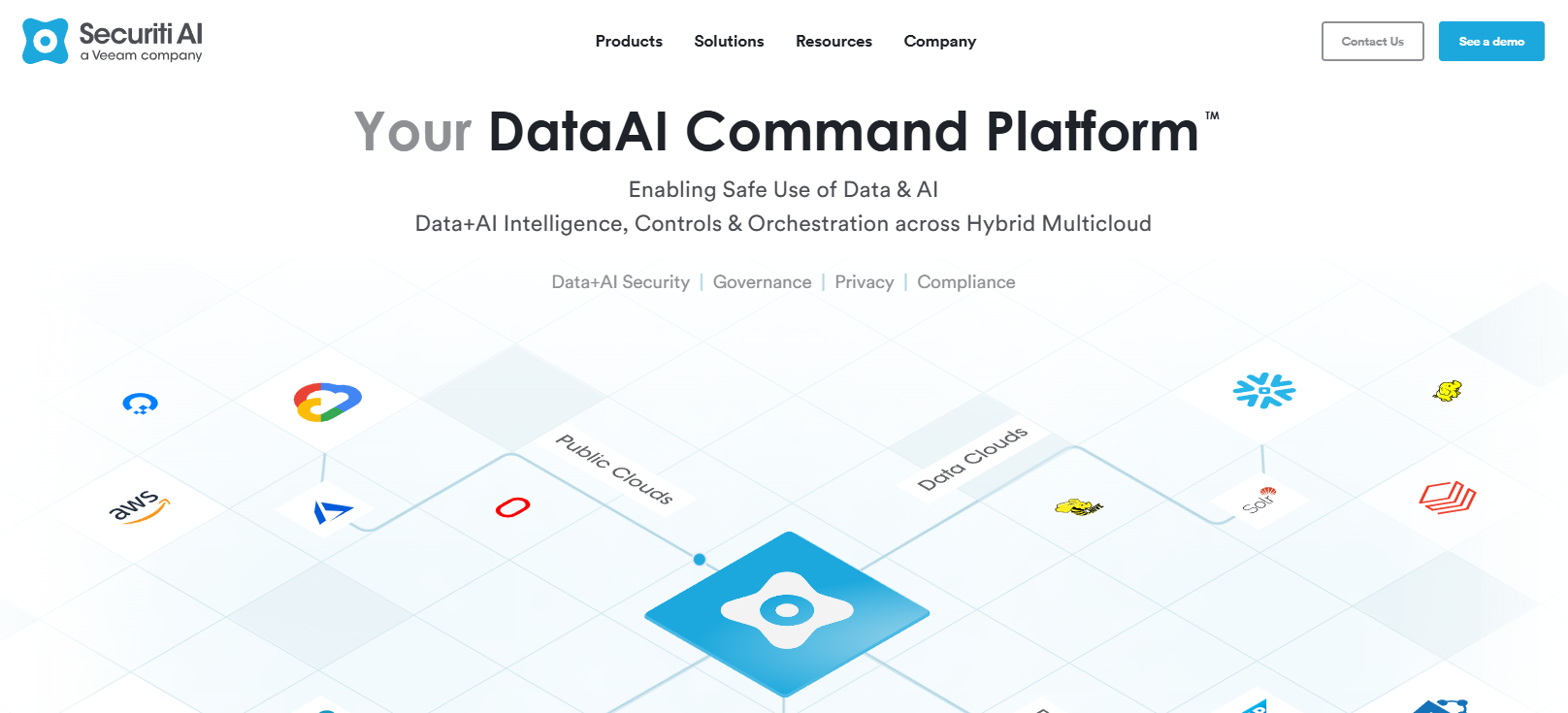
Securiti is a data command centre that combines sensitive data discovery with privacy operations, consent management, and AI data controls. Discovery feeds a unified data map that powers subject rights fulfilment, regulatory reporting, and policy enforcement across cloud, SaaS, and on-premise sources.
Key features
-
People data graph: Links discovered records to individuals, which allows subject access and deletion requests to be fulfilled without manual searching.
-
Automated privacy workflows: Handles DSR intake, verification, fulfilment, and audit records end to end.
-
Multi-regulation coverage: Maps obligations across GDPR, CCPA, HIPAA, and a wide set of regional privacy laws.
-
AI data controls: Governs which classified data can be reached by AI applications and assistants.
Pros
-
Strongest option here for organisations where subject rights volume is the operational pressure.
-
Discovery, consent, and reporting sit on one data map, which reduces reconciliation work.
Cons
-
Framing and workflows favour privacy teams, so security operations may find exposure and remediation tooling thinner than in DSPM-led platforms.
9. Ground Labs Enterprise Recon
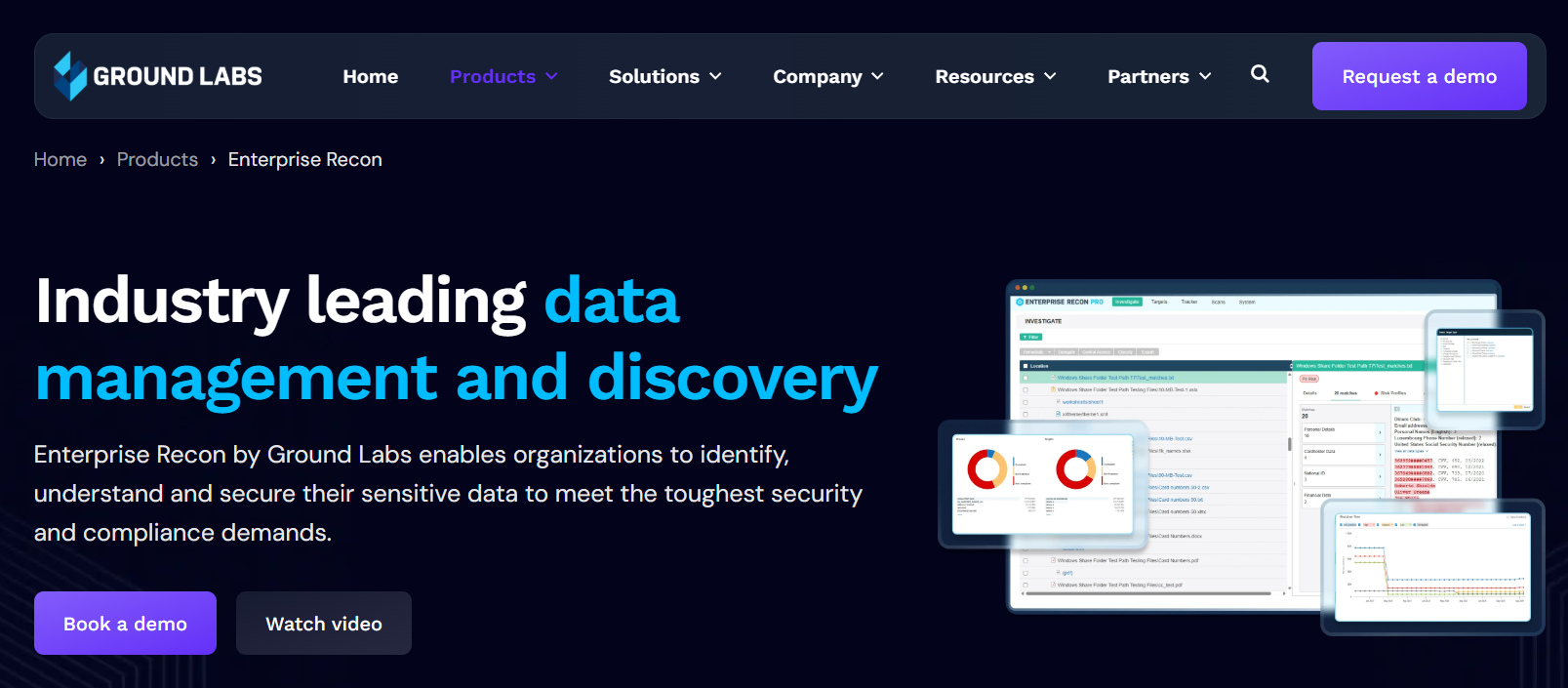
Ground Labs Enterprise Recon is a discovery and remediation platform focused on precise detection of regulated data at rest. It ships in PCI, PII, and PRO editions, and supports agent, agentless, and distributed deployment across Windows, macOS, Linux, FreeBSD, Solaris, HP-UX, and IBM AIX.
Key features
-
Cardholder data detection: Preconfigured account number formats from the major payment card providers, with QSA-ready reporting.
-
Broad operating system support: Native scanning on Unix variants and legacy platforms that most cloud-first tools do not reach.
-
Flexible deployment: Agent, agentless, and distributed options allow scanning to stay entirely inside the network perimeter.
-
Built-in remediation: Marks, moves, quarantines, or deletes discovered data at the point of detection.
Pros
-
Few platforms match its reach into legacy and air-gapped systems.
-
PCI scoping and evidence output are purpose-built rather than adapted from a general compliance module.
Cons
-
Focused on data at rest, with no identity mapping or exposure-path analysis for cloud environments.
How sensitive data discovery tools work
Discovery runs in three stages. A platform connects to data sources, scans contents against detection rules, and applies classification labels that downstream systems act on. Vendors differ in how deeply each stage reaches.
1. Connectivity and source coverage
Connectors read metadata and, where permitted, sample data across databases, warehouses, data lakes, object storage, file shares, collaboration platforms, and SaaS applications. Breadth is the constraint most often found late. A platform that cannot reach your ticketing system or your staging environments produces an inventory that looks complete and is not.
2. Detection methods
Most platforms layer three techniques. Regex and pattern matching catch predictable formats such as card numbers and national identifiers. Dictionaries and proximity analysis add domain vocabulary and read surrounding fields to resolve ambiguity, separating a nine-digit customer reference from a Social Security number. Machine learning models score confidence on free text using column names, metadata, and usage patterns.
Each fails differently. Pattern matching floods teams with false positives. Dictionaries miss anything outside their vocabulary. ML models need tuning before their confidence scores mean anything. Accuracy comes from combining all three against your own sources.
3. Continuous discovery and point-in-time scans
A point-in-time scan describes the environment on the day it ran. Where pipelines and SaaS integrations change weekly, that description decays immediately.
For example: A quarterly scan clears an environment in January. In February, a new pipeline lands raw customer records in a staging bucket. That exposure stays invisible until April.
Continuous discovery rescans automatically and updates classifications as systems change, which keeps the inventory current enough to drive access decisions.
Why sensitive data discovery matters now
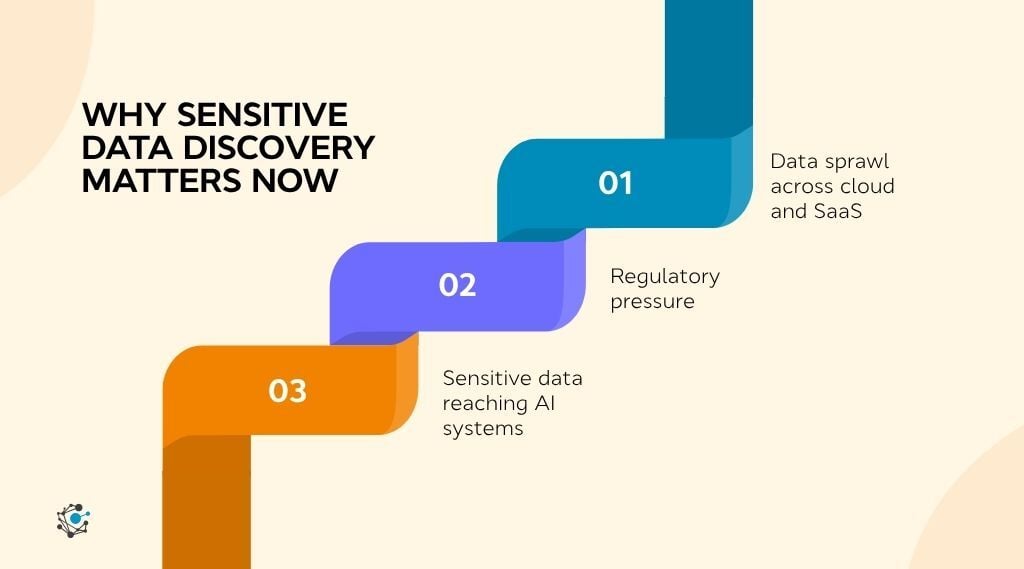
Three shifts have moved discovery from a periodic compliance exercise into a continuous operational requirement.
1. Data sprawl across cloud and SaaS
Sensitive data does not stay in the systems built to hold it. It spreads into warehouses, object storage, collaboration tools, analytics platforms, and staging environments every time a team builds a pipeline or adopts an application.
The 2025 Thales Cloud Security Study, conducted by S&P Global Market Intelligence 451 Research, found that 54% of cloud data is now classified as sensitive, up from 47% a year earlier.
The sensitive footprint is growing faster than manual inventory practices can track it.
2. Regulatory pressure
GDPR, HIPAA, CCPA, and PCI DSS all require organisations to show what regulated data they hold and where it resides. PCI DSS carries a direct commercial consequence, because accurate identification of cardholder data determines audit scope. Card data that goes unfound quietly expands the assessment boundary and the cost that comes with it.
Evidence is the practical burden. Auditors want current inventories, applied controls, and a record of who approved access to what. Classification output satisfies that only when it connects to enforcement, which is why findings need to feed data access policies directly. Teams working to a specific regulatory deadline will find GDPR data discovery covers that path in more detail.
3. Sensitive data reaching AI systems
AI assistants and copilots read from the same stores discovery scans. A model with access to an unclassified table of customer records will surface that content to anyone who asks the right question, with no access review in between.
Discovery defines what AI systems are permitted to touch. Without a current classification layer, access policies for AI have nothing to enforce against.
At OvalEdge, we believe discovery earns its cost at the moment a classification changes who can reach the data. Until that happens, the inventory is documentation.
Sensitive data discovery across cloud, hybrid, and on-premise environments
Where your data lives determines which tools can reach it. A platform built for cloud APIs will not scan an isolated network, and a platform built for file servers will not see a forgotten S3 bucket. Environment fit filters the shortlist faster than any feature comparison.
Multi-cloud and SaaS coverage
Cloud discovery mostly runs agentless. The platform connects through provider APIs, enumerates storage and database services, samples contents, and returns classification results without installing software on the data stores themselves. Deployment takes hours, and there is no performance cost to production systems.
The boundary problem shows up quickly. Amazon Macie covers AWS thoroughly and stops there. Microsoft Purview goes deep on Azure and Microsoft 365 and thins out elsewhere. Google Cloud DLP inspects GCP through its API. Thales Group report mentions that Organisations now run an average of 2.1 public cloud providers, so single-provider tools leave gaps by design, and stitching three consoles together produces three inventories with no shared classification standard.
SaaS applications are the harder gap. Customer records accumulate in CRM systems, support desks, shared drives, and collaboration tools that no cloud-native scanner reaches. Discovery platforms cover these through application APIs, and API coverage varies enough between vendors that it deserves checking against your actual application list.
Hybrid environments
Most enterprises are hybrid for years longer than planned. Warehouses move to the cloud while source systems, file shares, and mainframe data stay put.
The requirement is one classification standard applied consistently across both. When cloud and on-premise scanning run on separate tools with separate rule sets, the same data type gets labelled two different ways, and reconciling those labels becomes its own project.
On-premise and air-gapped deployments
Regulated industries, defence suppliers, and organisations under data residency rules often cannot let data leave the network perimeter, even for processing. That rules out most cloud-delivered discovery platforms regardless of what their marketing says about hybrid support.
Four questions separate genuine on-premise capability from a cloud tool with an on-premise connector:
-
Does scanning happen entirely inside your perimeter, with no data or samples sent to vendor infrastructure?
-
Can the platform deploy fully within the network, including its own control plane?
-
How are classification rules and detection signatures updated without outbound connectivity?
-
What is the performance impact on production systems during full scans?
OvalEdge, Collibra, and Ground Labs Enterprise Recon all support deployment inside the perimeter. Amazon Macie and Google Cloud DLP are not viable for air-gapped environments, since both operate as managed cloud services.
OvalEdge expert insight: Multi-cloud coverage is a connector question before it is a detection question. A platform with excellent classification accuracy still returns nothing from a system it cannot connect to.
DSPM versus traditional sensitive data discovery
Data security posture management extends discovery by connecting what was found to who can reach it. A discovery tool tells you a table holds customer records. A DSPM platform tells you that table holds customer records, that a service account with no owner can read it, and that the account is reachable from an internet-facing application.
|
Capability |
Discovery tool |
DSPM platform |
|
Sensitive data identification |
Yes |
Yes |
|
Multi-cloud visibility |
Limited or add-on |
Built in |
|
Identity and permission mapping |
Minimal |
Core function |
|
Exposure path analysis |
No |
Yes, with attack path context |
|
Remediation prioritisation |
Manual triage |
Risk-ranked automatically |
When discovery on its own is enough
Plenty of programs never need posture management. Discovery alone works when the driver is regulatory, when access is already controlled through established processes, or when the estate is small enough that permissions are known without being mapped.
An organisation preparing for a PCI DSS assessment needs to find cardholder data, prove the controls around it, and reduce scope. Exposure path analysis adds little to that. The same applies to subject rights fulfilment, where the question is which records relate to one person, and to data minimisation work, where the question is what can be deleted.
When DSPM becomes necessary
Posture management earns its cost once permissions stop being knowable by inspection. That threshold arrives with scale, with multi-cloud footprints, and with the volume of service accounts and machine identities that modern infrastructure generates.
The pattern is consistent: teams find the data, then cannot answer who can reach it. Shadow copies, snapshots, and dev environments cloned from production compound the problem, because each copy inherits its own permission set and none of them appear in the original inventory.
How the two relate to governance
DSPM answers who can reach the data. Governance answers who approved that access, which policy allows it, and who is accountable when it changes. Both depend on the same classification layer underneath.
Organisations tend to arrive at the full picture in sequence. Discovery establishes the inventory, DSPM surfaces exposure, and governance turns both into enforceable policy with named owners. Buying the third before the first produces a policy framework with nothing underneath it.
What to evaluate in sensitive data discovery software
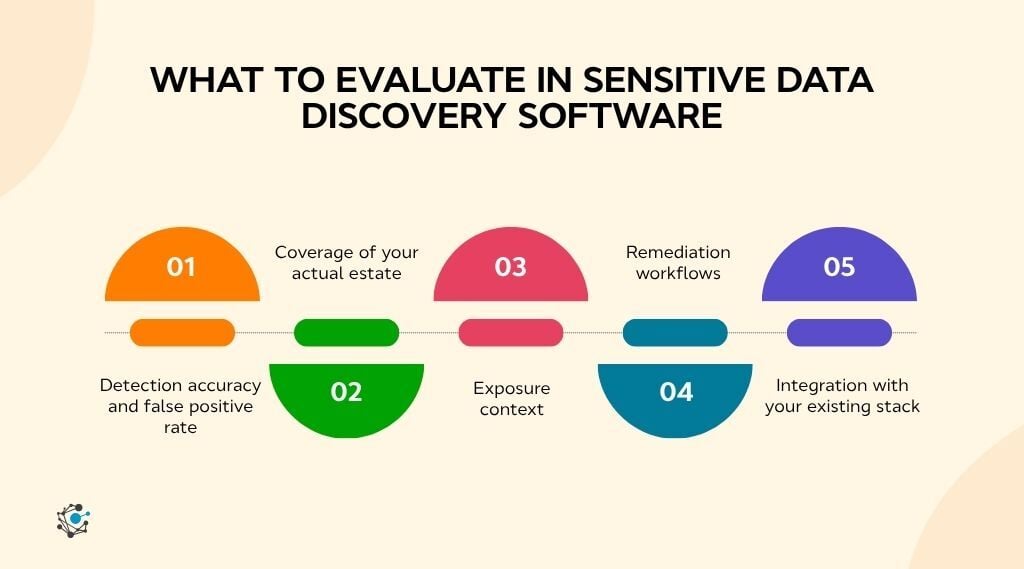
Five criteria predict whether a deployment succeeds. They are ordered by how often each one becomes the reason a tool gets abandoned.
1. Detection accuracy and false positive rate
Accuracy determines whether anyone trusts the output. A platform that flags every nine-digit number as a national identifier buries real findings under noise, and teams stop reviewing the queue within weeks.
Test against your own sources during proof of value, not vendor sample data. Run three scenarios: standard patterns every tool should handle, ambiguous internal identifiers that invite false positives, and industry-specific formats such as claim numbers or account references. Pay closest attention to unstructured content, where the gap between vendors is widest.
2. Coverage of your actual estate
List every location sensitive data may exist before looking at vendors, including legacy systems, staging environments, and SaaS applications nobody in IT provisioned. Then check that list against connector documentation line by line. Coverage gaps found after purchase are the most expensive mistake in this category.
3. Exposure context
A list of every file containing PII is not actionable. Strong platforms indicate which findings matter, separating a controlled archive from an overshared folder in an active workspace.
4. Remediation workflows
Visibility without remediation adds backlog. Check whether findings route to owners automatically, whether the platform supports tagging, quarantine, or masking at the point of detection, and whether resolution gets recorded for audit.
5. Integration with your existing stack
Classification results need to reach the systems that enforce policy. Confirm bidirectional integration with SIEM, DLP, CASB, and IAM platforms, and check whether classification labels persist when data moves between systems or arrive fresh on every scan.
How to choose the right sensitive data discovery tool
Start from your environment and your remediation model, not the vendor's category label. The table below maps common situations to a sensible starting point.
|
Your situation |
Start with |
|
Governance program with stewardship, lineage, and ownership workflows |
OvalEdge |
|
Mature enterprise governance with formal policy and approval chains |
Collibra |
|
Large, mixed estate serving security and privacy teams at once |
BigID |
|
Unstructured data and oversharing across file shares and Microsoft 365 |
Varonis |
|
Multi-cloud exposure mapping with fast time to first result |
Cyera |
|
Microsoft 365 and Azure as the primary data footprint |
Microsoft Purview |
|
AWS environment with S3 as the main store |
Amazon Macie |
|
High-volume subject rights and multi-jurisdiction privacy reporting |
Securiti |
|
PCI DSS scope reduction and cardholder data discovery |
Ground Labs Enterprise Recon |
|
Legacy, isolated, or air-gapped infrastructure |
Ground Labs Enterprise Recon or OvalEdge |
|
Engineering-led team willing to build and maintain tooling |
Open-source metadata frameworks with custom classification |
That last row carries a real cost. Open-source options remove licensing but move detection logic, tuning, and maintenance onto your engineers, which suits teams with capacity and suits nobody else.
Two checks apply whichever direction you go. Run automated data discovery against your messiest source before signing, and confirm that classification results can reach the systems enforcing your policies. A shortlist that survives both is usually two tools, and the decision between them comes down to which team owns remediation.
At OvalEdge, we believe the tool that gets adopted beats the tool that scores highest. Evaluation scores measure capability. Adoption measures whether anyone acts on what the platform finds.
Comparing options against your own environment is faster than comparing them against each other. A structured evaluation using your real sources and your existing stack will narrow the field in a week.
Conclusion
Choosing a sensitive data discovery platform comes down to three decisions. Which category fits the problem you are solving, whether the tool reaches every environment your data occupies, and whether its output lands somewhere that someone will act on.
The first two narrow the field fast. A shortlist spanning three categories produces demos that cannot be compared, and a platform that cannot reach your legacy systems or your SaaS applications will never be accurate enough to matter.
The third decision determines whether the investment pays back. Discovery reduces risk only when classification reaches the access controls, masking rules, and approval workflows that act on it.
Organisations that treat discovery as a governance input, with named owners and enforceable policy behind it, get further than those treating it as a reporting exercise. OvalEdge is built for that model, connecting classification to ownership, lineage, and access policy in one layer.

Book a demo to see how discovery works against your environment.
.png?width=1081&height=173&name=Forrester%201%20(1).png)
.png?width=1081&height=241&name=KC%20-%20Logo%201%20(1).png)