.png)
AI agents are rapidly becoming part of enterprise analytics, helping teams answer business questions, generate insights, and automate decisions. However, as adoption grows, many organizations struggle with inconsistent metrics, conflicting business definitions, and AI responses that cannot be traced to trusted data.
The challenge is rarely the AI model itself. It is the lack of a governed business context that helps agents interpret enterprise data correctly.
According to the Enterprise AI Adoption Statistics Report (2026) by Presenc AI, 78% of Global 2000 companies had at least one AI workload in production by Q1 2026, up from 41% in 2024, highlighting how quickly AI adoption is outpacing governance.
A context stack for agentic analytics addresses this gap by providing AI agents with governed metadata, semantic relationships, lineage, and policies. This guide explains what a context stack is, how its architecture works, and how to build one for reliable, explainable, and governed agentic analytics.
What is a context stack for agentic analytics?
A context stack for agentic analytics is a layered architecture of governed metadata, business definitions, semantic relationships, data lineage, and delivery mechanisms that AI agents use to interpret enterprise data accurately.
It provides the trusted business context that enables reliable, explainable, and governed AI-driven analytics, which is why business context management in data platforms has become a priority for enterprise data teams.
Why AI agents need a context stack
Large language models can understand natural language, but they cannot resolve enterprise ambiguity on their own. When an agent encounters a business term such as "active customer" or a metric like "gross revenue," it selects the definition that appears most relevant rather than the one the organization has approved.
Without a governed context, the agent cannot distinguish between certified and uncertified data or determine which business definition applies to a particular department or use case.
This creates several common challenges:
-
Definitional ambiguity: Sales, marketing, and finance may each define the same business metric differently. Without a governed business glossary, AI agents cannot determine which definition is authoritative.
-
Source ambiguity: Multiple datasets may contain similar information, but only one is certified for reporting. Without lineage and certification, agents may retrieve data from an untrusted source.
-
Governance blind spots: AI agents do not inherently know which data contains personally identifiable information (PII), requires regulatory approval, or is restricted by enterprise policies.
-
Trust erosion at scale: A single incorrect response may be overlooked, but repeated inconsistencies across departments quickly reduce confidence in AI-driven analytics and slow enterprise adoption.
OvalEdge expert perspective: AI does not replace data governance. It changes the consumer of governance. Metadata, business definitions, lineage, and governance policies that were traditionally designed to help people understand and trust data must now become machine-readable so AI agents can interpret enterprise information consistently and act with confidence.
Addressing these challenges requires more than better models or more data. It requires an architecture that delivers trusted business context alongside every query. That architectural shift is what distinguishes a context stack from a traditional analytics stack.
How a context stack differs from a traditional analytics stack
Traditional analytics stacks are designed for people. Analysts understand business terminology, question unexpected results, and validate reports before making decisions. AI agents cannot apply that level of judgment. They require business meaning and governance to be embedded directly into the architecture.
|
Dimension |
Traditional analytics stack |
Context stack for agentic analytics |
|
Primary consumer |
Human analysts or BI users |
AI agents and LLMs |
|
Definition resolution |
Analysts choose the appropriate definition |
Business glossary resolves approved definitions at runtime |
|
Governance |
Applied during reporting and data access |
Embedded throughout every architectural layer |
|
Query trigger |
User initiated |
Continuous, event-driven, or autonomous |
|
Trust mechanism |
Human validation |
Metadata, lineage, and governance accompany every response |
Building a context stack is not about introducing another layer of complexity. It is about enabling AI agents to consume enterprise knowledge the same way employees rely on business context to make informed decisions.
Once that foundation is in place, the next step is understanding the architectural layers that transform governed data into trusted context for agentic analytics.
Reference architecture for a context stack for agentic analytics
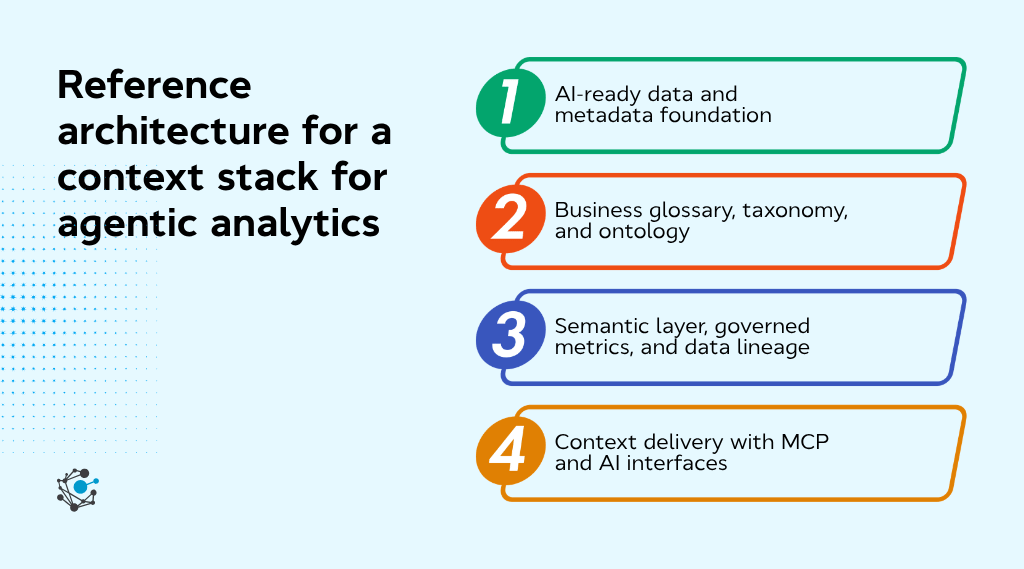
A context stack is a layered architecture in which each layer contributes a different type of enterprise context that AI agents need to reason accurately. Together, these layers help AI move beyond retrieving data to interpreting business meaning, applying governance, and generating reliable decisions.
1. AI-ready data and metadata foundation
Every context stack begins with an AI-ready data and metadata foundation. This layer prepares enterprise data for AI consumption by ensuring it is governed, well documented, and reliable. It provides the trusted data and contextual information that every other layer in the stack depends on.
An AI-ready foundation includes:
-
Structural readiness: Consistent schemas, standardized naming conventions, and certified datasets help agents locate and use the correct data assets.
-
Ownership readiness: Every critical dataset has a designated steward responsible for maintaining its quality, governance, and business context.
-
Data quality readiness: Quality rules and freshness checks ensure AI agents work with accurate and up-to-date information.
Metadata then helps AI agents interpret the assets they discover.
-
Technical metadata describes schemas, tables, columns, and relationships, enabling accurate data discovery.
-
Business metadata provides approved definitions and business usage.
-
Operational metadata captures freshness, pipeline status, and quality metrics so agents can determine whether data is suitable for a task.
Without this foundation, AI agents may retrieve data successfully but cannot determine whether it is accurate, trusted, or fit for the task.
Example: An AI sales assistant finds two customer revenue tables. Metadata identifies the certified dataset, its owner, and its latest refresh, allowing the agent to select the trusted source automatically.
Implementation tip: An AI-ready foundation starts with complete and trusted metadata. OvalEdge Data Catalog helps organizations automatically discover data assets, enrich metadata, assign ownership, and monitor data quality, providing the foundation AI agents need to identify and trust enterprise data.
2. Business glossary, taxonomy, and ontology
Discovering trusted data is only the first step. AI agents must also understand what that data means in a business context. This layer provides the business definitions, classifications, and relationships that enable consistent interpretation across the enterprise.
It consists of three key components:
-
Business glossary: Standardizes business terms, assigns ownership, and links definitions to trusted data assets.
-
Taxonomy: Organizes business concepts into hierarchical categories, helping AI agents classify and retrieve information consistently.
-
Ontology: Models relationships and business rules between entities. It is particularly valuable for domains with complex interconnected data, such as healthcare, finance, and supply chains.
Together, these components create a shared business language that AI agents can use across departments and systems instead of relying on inconsistent interpretations.
Example: An executive asks an AI agent for quarterly revenue. The business glossary resolves revenue to the approved definition, the taxonomy identifies the correct business unit, and the ontology, where applicable, maps related entities before the query is executed.
The result is a response aligned with enterprise standards rather than the first matching dataset.
Our experts at OvalEdge believe a business glossary should evolve beyond static definitions. It must become an AI-ready meaning system that helps agents determine not only what a business term means, but which approved meaning applies in a given business context, which is why aligning business glossary with data catalog matters so much for agentic use cases.
This shift enables AI agents to interpret enterprise language consistently instead of relying on the most readily available definition.
3. Semantic layer, governed metrics, and data lineage
Once AI agents understand business meaning, they must apply approved metrics and verify where the underlying data originated. This layer combines semantic models, governed metrics, and lineage to produce consistent and explainable business insights.
It consists of three key components:
-
Semantic layer: Maps business terms to the underlying data models, allowing AI agents to query data using business language instead of technical schemas.
-
Governed metrics: Centralizes approved KPI definitions and calculation logic so every agent uses the same business rules.
-
Data lineage: Traces data from its source through every transformation, giving AI agents visibility into where data originated and how it reached the final output.
Together, these components ensure AI agents retrieve not only the right metric but also the business logic and provenance behind it. This reduces conflicting calculations, improves explainability, and helps users verify that insights are based on certified enterprise data.
Example: A finance analyst asks, "How did quarterly revenue perform against target?" The semantic layer translates the request into the approved revenue metric; governed metrics apply the standardized calculation; and data lineage confirms the result came from the certified finance pipeline rather than an unverified data extract.
4. Context delivery with MCP and AI interfaces
After business meaning and metrics have been established, AI agents need a reliable way to access that information during inference. This layer delivers business definitions, metrics, lineage, and governance policies to AI agents at the moment they generate a response.
Enterprise AI assistants such as askEdgi rely on this governed context to answer business questions accurately, using trusted enterprise metadata rather than raw data alone.
This layer typically includes:
-
Model Context Protocol (MCP): Provides a standardized interface for AI agents to access governed enterprise context, including metadata, business definitions, and lineage.
-
Retrieval-Augmented Generation (RAG): Retrieves information from certified knowledge sources instead of relying solely on the model's internal knowledge.
-
APIs: Deliver governed data together with supporting context, such as business definitions, lineage, and access permissions.
-
Vector databases and semantic search: Improve the discovery of relevant enterprise content, while governance determines whether the retrieved information is appropriate for the request.
Our experts at OvalEdge believe that RAG helps AI agents retrieve relevant information, but relevance alone does not establish trust. Enterprise AI also needs governed metadata, business definitions, lineage, and policies so agents can determine which information is appropriate for the user, the task, and the business context.
This is why context delivery should always be built on a governed foundation rather than retrieval alone.
Together, these technologies enable AI agents to access the right enterprise context at the right time, ensuring responses are accurate, explainable, and aligned with business and governance requirements.
Example: A regional sales manager asks an AI agent for customer churn by region. Through an MCP server, the agent retrieves the approved churn definition, certified metric, lineage information, and access permissions before generating a response, ensuring the answer is both accurate and compliant.
How the context stack powers an agentic analytics workflow
Understanding the architecture is only part of the picture. The real value of a context stack becomes clear when an AI agent answers a business question. Instead of retrieving the first available dataset, the agent moves through each layer of the context stack to resolve business meaning, verify trust, enforce governance, and deliver an explainable answer.
From business question to trusted answer
Suppose an executive asks an AI agent, "How did this quarter's revenue perform against target?" Rather than retrieving the first matching dataset, the agent follows a governed decision process before generating a response.
-
Discover: Identifies the certified dataset and confirms it is current and suitable for the request.
-
Interpret: Applies the approved business definition for revenue instead of relying on the closest match.
-
Calculate: Uses the governed metric and standardized business logic.
-
Verify: Confirms the result through lineage and validates where the data originated.
-
Govern: Enforces access policies and determines whether the user is authorized to view the information.
-
Deliver: Returns the answer together with supporting definitions, lineage, and certification details.
Every stage adds information that the AI model cannot infer on its own. The result is autonomous data analytics with AI that users can understand, validate, and confidently act upon.
How context flows across the architecture
A context stack supports two complementary flows. Data flows upward as it is enriched with metadata, business definitions, semantic meaning, and governance. At the same time, AI queries flow downward, passing through each layer to resolve definitions, validate permissions, and retrieve trusted information before an answer is generated.
When a layer is missing, the quality of AI responses quickly degrades.
|
Missing layer |
What the agent loses |
Business impact |
|
Data catalog |
Cannot locate the correct asset |
Retrieves the wrong dataset |
|
Business glossary |
Cannot resolve approved definitions |
Applies inconsistent business logic |
|
Data lineage |
Cannot verify data provenance |
Uses unverified or stale information |
|
Governance |
Cannot enforce policies |
Risks exposing restricted data |
|
Context delivery |
Cannot access governed context at runtime |
Falls back to model assumptions |
A context stack is also designed to improve over time. Low-confidence responses, incorrect answers, or governance exceptions can be reviewed by data stewards, who refine business definitions, certify additional assets, or update governance policies.
This continuous feedback loop keeps the context stack aligned with changing business requirements and improves the quality of future AI-driven analytics.
How to build a context stack for agentic analytics
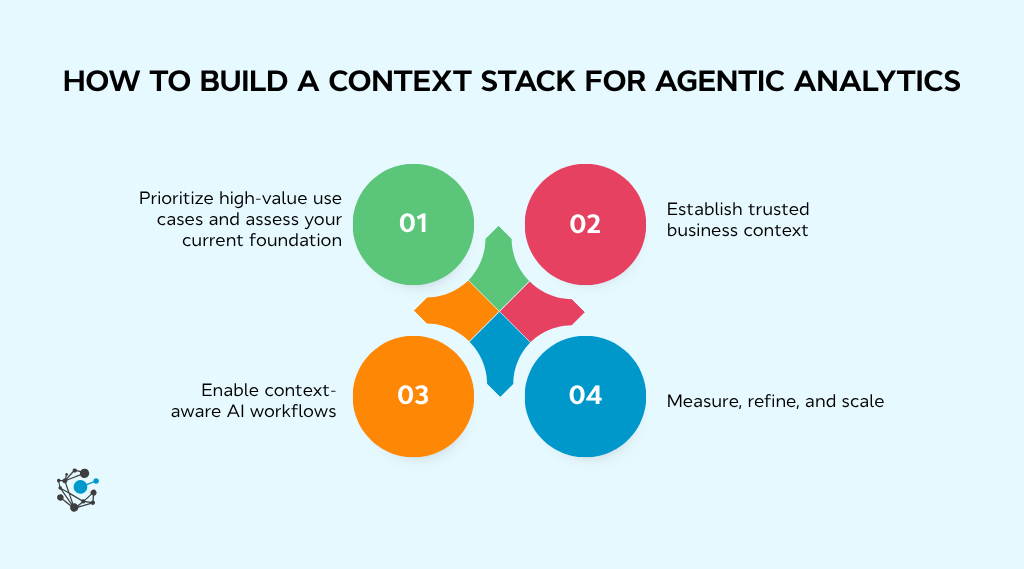
Most organizations are not starting from scratch. Data catalogs, business glossaries, governance policies, and lineage capabilities already exist across many enterprise data environments.
The challenge is connecting these capabilities into a unified context stack that AI agents can consume consistently. The following four steps provide a practical roadmap for building one.
Step 1: Prioritize high-value use cases and assess your current foundation
A context stack should be built around the business decisions AI agents need to support, not around governing every available dataset. Starting with a focused use case helps identify which governance capabilities already exist and where the gaps are.
Key activities
-
Select high-value AI use cases.
-
Inventory existing governance assets and metadata.
-
Identify gaps in ownership, quality, and business definitions.
Why this step matters
Most organizations already have many of the capabilities needed for a context stack. Assessing governance maturity helps prioritize improvements instead of rebuilding what already works.
Outcome: A prioritized use case with a clear understanding of the governance capabilities required to support it.
Step 2: Establish trusted business context
With the scope defined, the next step is to standardize the business context that AI agents will use. This ensures every response is based on approved definitions and certified data rather than assumptions.
Key activities
-
Standardize business terms and KPI definitions.
-
Link metrics to certified data assets.
-
Document lineage for business-critical datasets.
Why this step matters
Trusted business context allows AI agents to interpret enterprise data consistently across departments, reducing ambiguity and improving confidence in AI-generated insights.
Outcome: A governed business context that AI agents can interpret consistently.
Step 3: Enable context-aware AI workflows
The context stack only delivers value when AI agents can consume it during runtime. This step connects governance with AI workflows so every interaction uses trusted enterprise context.
Key activities
-
Configure MCP, APIs, or RAG pipelines.
-
Enforce access policies and data classifications.
-
Monitor quality before exposing assets to AI agents.
Why this step matters
Embedding governance into AI workflows helps ensure every response remains accurate, explainable, and compliant without requiring manual validation.
Outcome: AI agents consistently retrieve governed context while enforcing enterprise policies.
Step 4: Measure, refine, and scale
A context stack should evolve alongside enterprise data and AI use cases. Regular monitoring helps identify governance gaps, improve AI performance, and prepare the foundation for broader adoption.
Key activities
-
Track glossary coverage and certified asset usage.
-
Monitor AI response consistency.
-
Expand to additional domains once governance is stable.
Why this step matters
Continuous improvement keeps the context stack aligned with changing business requirements and supports long-term AI adoption.
Outcome: A scalable context stack that delivers trusted analytics across the enterprise.
Ready to operationalize your context stack?

Building a context stack doesn't require starting from scratch. Book a demo to see how OvalEdge helps connect metadata, governance, lineage, and AI into a unified foundation for trusted agentic analytics.
How OvalEdge supports a governed context stack for agentic analytics
Building a context stack does not require replacing existing governance investments. It requires operationalizing them so AI agents can consistently discover, interpret, and apply enterprise knowledge. OvalEdge provides the governed metadata, business glossary, lineage, data quality, and governance policies that form the foundation of trusted agentic analytics.
With OvalEdge, organizations can:
-
Operationalize governance for analytics and AI.
-
Turn enterprise knowledge into machine-readable context.
-
Improve confidence through certification, lineage, stewardship, and data quality.
-
Enforce governance consistently across AI workflows.
-
Deliver explainable AI decisions with enterprise-grade trust.
Built on this governed foundation, askEdgi enables users to interact with enterprise knowledge through natural language. It retrieves certified business definitions, lineage, and trusted metadata to deliver accurate, explainable, and context-aware responses for analytics and AI.
For a deeper understanding of how governed context enables conversational analytics and AI agents, explore our Agentic Analytics whitepaper.
Conclusion
As AI agents become active participants in enterprise decision-making, governance is no longer supporting only people. It is increasingly guiding how AI discovers data, interprets business meaning, applies policies, and generates decisions.
Most organizations already possess many of the capabilities required to build a context stack. The opportunity now is to connect those governance investments into an architecture that AI agents can consume consistently.
Organizations that operationalize governance for AI today will be better positioned to deliver explainable, scalable, and reliable agentic analytics tomorrow.
If you're ready to operationalize enterprise governance for AI, schedule a demo with OvalEdge to see how a connected governance platform can accelerate trusted agentic analytics.
.png?width=1081&height=173&name=Forrester%201%20(1).png)
.png?width=1081&height=241&name=KC%20-%20Logo%201%20(1).png)