.jpg)
As AI agents become more sophisticated, model intelligence is becoming less of a differentiator. What increasingly matters is the quality of the context surrounding every decision. Andrej Karpathy described context engineering as "the delicate art and science of filling the context window with just the right information for the next step."
The business impact of getting context wrong is significant.
According to Boston Consulting Group's 2024 AI adoption survey, 74% of companies struggle to achieve and scale tangible value from AI, with data quality issues, fragmented information, and context gaps among the major obstacles.
Many production AI failures can be traced back to context problems. Agents retrieve irrelevant information, rely on stale memory, use the wrong tools, or reason without sufficient governance controls.
This blog explores eight practical context engineering techniques that help organizations improve AI accuracy, reduce hallucinations, optimize costs, and build reliable agentic systems at scale.
What are context engineering techniques?
Context engineering techniques are methods used to control what information enters an AI model's context window, including what gets retrieved, stored, compressed, prioritized, or discarded.
Unlike prompt engineering, which focuses on writing instructions, context engineering manages the entire flow of information that influences model outputs. Most context engineering methods are built around four core operations: write, select, compress, and isolate.
What goes into the context window?
Every AI model operates within a limited context window. The information competing for that space typically includes:
-
System prompts and instructions: Define the model's behavior, constraints, and objectives.
-
User input: Provides the immediate task, question, or request.
-
Short-term memory: Captures relevant information from the current conversation.
-
Long-term memory: Retrieves stored knowledge from previous interactions.
-
Retrieved knowledge: Supplies external information through RAG systems.
-
Tool outputs: Includes results returned from APIs, databases, applications, or code execution.
Each component competes for the same finite token budget. Context engineering determines which information deserves space in the context window and which information should be compressed, prioritized, or excluded.
The quality of these decisions often depends on strong data quality management practices that ensure information entering the context window is accurate, complete, and trustworthy.
The 4 core operations of context engineering: write, select, compress, and isolate
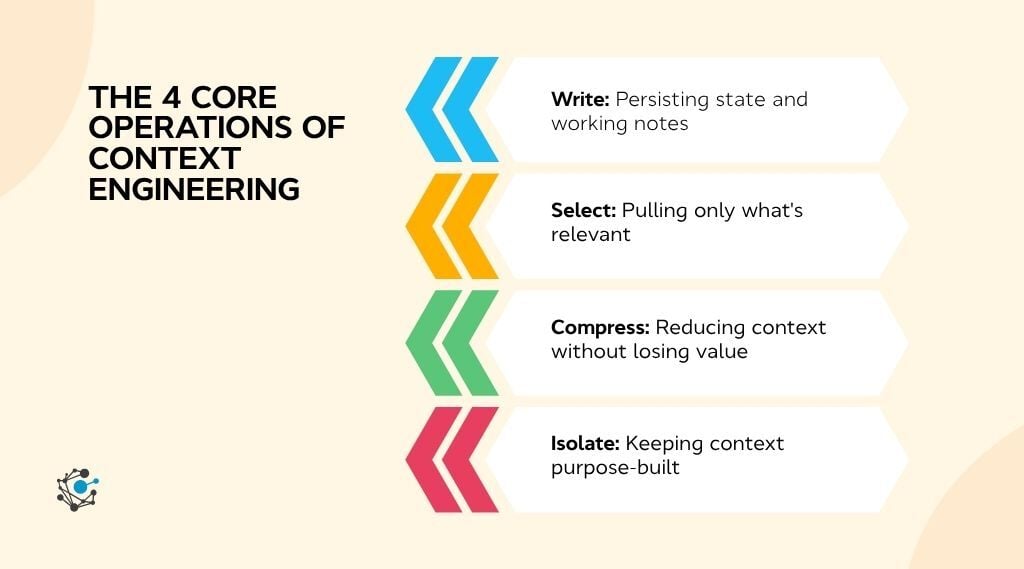
Every context engineering technique ultimately serves one purpose: ensuring the model sees the right information at the right time. Most modern frameworks organize this challenge into four core operations that control how information is stored, retrieved, optimized, and separated throughout an AI workflow.
1. Write: Persisting state and working notes
AI agents often perform tasks that extend beyond a single interaction. The write operation allows them to store important information outside the active context window through scratchpads, memory stores, or task states.
This helps preserve progress, user preferences, and intermediate results without repeatedly consuming context space.
2. Select: Pulling only what's relevant
Not every piece of available information deserves a place in the context window. The select operation determines what information should be retrieved based on relevance, recency, and importance.
Effective selection reduces noise and ensures the model focuses only on information that supports the current task.
3. Compress: Reducing context without losing value
Large documents, lengthy conversations, and detailed tool outputs can quickly consume available context. Compression condenses this information into shorter representations while preserving the facts and reasoning needed for accurate responses.
The goal is to maximize information density, not simply reduce tokens.
4. Isolate: Keeping context purpose-built
Different agents and workflows often require different information. Isolation ensures that each agent receives only the context relevant to its role.
Understanding these four operations provides the foundation for context engineering, but implementing them effectively requires specific techniques.
The following methods show how organizations apply retrieval, memory, compression, governance, and validation strategies to build AI systems that deliver more accurate, reliable, and trustworthy outcomes.
Technique 1: Retrieval-augmented generation (RAG)
Retrieval-Augmented Generation (RAG) is often viewed as the foundation of modern AI systems because it allows models to access external knowledge at runtime. Instead of relying solely on training data, a RAG system retrieves relevant information from documents, databases, knowledge bases, or enterprise systems before generating a response.
The effectiveness of RAG depends less on the retrieval mechanism itself and more on the quality of the information entering the context window. Poor retrieval can introduce noise, while effective retrieval ensures the model reasons from the most relevant and trustworthy information available.
Dense, sparse, and hybrid retrieval
RAG systems typically use two retrieval approaches. Dense retrieval uses vector embeddings to find semantically related content, while sparse retrieval uses keyword matching techniques such as BM25 to identify exact matches.
Because each approach solves different retrieval challenges, many production systems combine them through hybrid retrieval, improving both recall and relevance across a wider range of queries.
Contextual compression
Retrieving more information does not always improve outcomes. Contextual compression filters or extracts only the most relevant portions of retrieved content before it enters the context window. This reduces token usage while improving signal quality and helping models focus on the information that matters most.
However, retrieval quality depends on more than retrieval algorithms alone. AI systems also require well-documented, discoverable, and business-context-rich information to consistently retrieve the right content.
Do you know? Enterprise RAG initiatives are most effective when the underlying information is well-documented and easy to discover. OvalEdge’s Data Catalog and Business Glossary capabilities help create richer metadata that improves retrieval relevance and context quality.
Actionable takeaway: Before changing models, evaluate retrieval quality. Improvements in retrieval often produce larger gains than upgrading the underlying LLM.
Technique 2: Context compression
As AI systems interact with more data, context windows quickly become crowded. Long conversations, large documents, and detailed tool outputs can consume valuable tokens and reduce model efficiency.
Context compression helps preserve important information while minimizing unnecessary content.
Summarisation-based compression
Summarisation is the most common compression technique. Long conversations, reports, and tool outputs are condensed into shorter representations before being added to the context window.
The objective is not simply to shorten content but to preserve facts, decisions, and reasoning that remain relevant to future tasks.
Recursive summarisation for long conversations
A single summary may not be sufficient for extended interactions.
Recursive summarisation breaks content into smaller sections, summarises each section independently, and then creates a higher-level summary from those outputs.
This hierarchical approach allows AI systems to maintain continuity across lengthy workflows without overwhelming the context window.
Token budget management
High-performing AI systems actively manage token allocation.
Many organizations establish budgets for instructions, memory, retrieved content, and tool outputs. When a category exceeds its limit, compression occurs automatically before the next model call.
This prevents any single component from consuming disproportionate context space.
Prefix caching
Enterprise AI systems frequently reuse system prompts, governance policies, and reference documents.
Prefix caching stores processed versions of stable content so that it does not need to be reprocessed during every interaction. This reduces latency and lowers operational costs at scale.
Actionable takeaway: Treat context space as a limited resource. Allocate token budgets intentionally rather than allowing individual components to grow unchecked.
Technique 3: Memory management
Many AI systems can answer questions effectively but struggle to maintain continuity over time. They forget user preferences, repeat previously resolved issues, or lose track of long-running objectives.
Memory management addresses this challenge by determining what information should be stored, how it should be maintained, and when it should be retrieved.
Short-term vs. long-term memory
Short-term memory captures information within the current session. Long-term memory stores information beyond the context window and makes it available for future retrieval.
Both are necessary. Short-term memory supports immediate continuity, while long-term memory enables personalization and historical awareness.
Memory write strategies
Not every interaction deserves permanent storage.
Effective memory systems prioritize information such as:
-
User preferences
-
Explicit corrections
-
Important facts
-
Task outcomes
-
Organizational policies
Low-value conversational content should typically be excluded to prevent future retrieval noise.
Memory retrieval: Semantic search, recency, and frequency
Retrieving memories requires more than relevance matching.
Strong memory systems evaluate multiple signals, including semantic similarity, recency, and frequency of use. Combining these signals helps ensure that useful memories remain accessible while outdated information gradually loses prominence.
Memory decay and maintenance
Without maintenance, memory repositories accumulate outdated information.
Preferences change, business rules evolve, and completed tasks lose relevance. Memory decay mechanisms help remove or archive information that no longer contributes value.
Regular maintenance improves retrieval precision and reduces context pollution.
Pro tip: OvalEdge’s Data Lineage and Data Catalog capabilities can help teams understand how information changes over time, making it easier to maintain trusted memory stores and prevent outdated information from influencing AI decisions.
Hot, warm, and cold memory hierarchies
Many enterprise systems organise memory into tiers.
-
Hot memory contains active session information and the current context.
-
Warm memory stores frequently accessed facts and recent interactions.
-
Cold memory preserves historical information that may still be useful but is rarely accessed.
This approach balances performance, cost, and retrieval depth.
Actionable takeaway: Store information selectively. A smaller collection of high-quality memories often outperforms a large repository filled with low-value data.
Technique 4: Tool selection and context-aware tool use
Tools extend what AI agents can do, but they also consume context space. Many organizations focus on adding more tools when the bigger challenge is determining which tools should be available at any given moment.
Why do too many tools pollute the context
Every tool definition occupies part of the context window.
As the number of available tools increases, the model must spend more effort evaluating options before completing a task. This often reduces tool-selection accuracy and increases token consumption.
RAG-MCP for dynamic tool selection
Rather than loading every available tool into context, many systems now retrieve tools dynamically.
Tool descriptions are indexed and searched in the same way documents are retrieved in RAG systems, a pattern that shows up across any modern AI agent platform. Only the most relevant tools are provided to the model based on the current task.
This improves efficiency while reducing context overhead.
OvalEdge's view is that as RAG-MCP patterns become standard, the protocol handles the connection, but the governed context determines whether agents can safely act on what they retrieve. A tool that returns results without provenance or policy context puts the compliance burden on the agent, which is exactly the wrong place for it.
Structuring tool outputs to minimise token waste
Raw API responses often contain far more information than the model actually needs.
Pre-processing tool outputs allow systems to extract relevant fields before inserting them into the context window. This improves clarity and reduces unnecessary token usage.
Actionable takeaway: Focus on delivering the right tools at the right time rather than making every tool available for every task.
Technique 5: Context isolation for multi-agent systems
As organisations adopt multi-agent architectures, context management becomes significantly more complex.
Without clear boundaries, agents can unintentionally influence one another, leading to inconsistent reasoning and unpredictable outcomes.
Why isolation fails in practice
A common design mistake is passing large amounts of shared context between agents.
When agents receive information unrelated to their responsibilities, they spend resources processing unnecessary data and become more susceptible to errors.
Scoping context per agent role
Each agent should receive only the information required for its specific function.
An extraction agent needs source content and extraction rules. It does not need workflow history, user preferences, or outputs generated by unrelated agents.
Clear boundaries improve both efficiency and accuracy.
Preventing context bleeding between workflows
Concurrent workflows require strict separation mechanisms.
Memory, retrieval queries, and stored context should be partitioned by workflow, task, or session identifiers. Isolation must be enforced intentionally rather than assumed.
Actionable takeaway: Design context boundaries as part of the architecture, not as an afterthought.
Technique 6: Building trusted context with metadata and governance
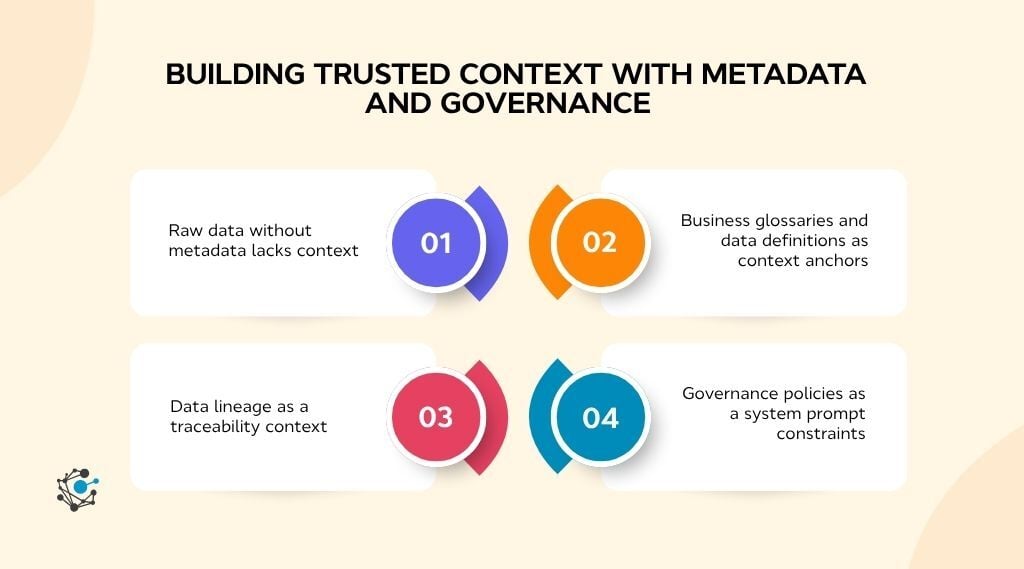
Many discussions about context engineering focus on retrieval algorithms and vector databases. In enterprise environments, however, the biggest challenge is often much simpler: the information being retrieved lacks business context.
Metadata, lineage, governance policies, and business definitions provide the foundation that makes every other context engineering technique more effective.
1. Raw data without metadata lacks context
A field named "rev_adj" may be meaningful to a finance analyst but meaningless to an AI system without supporting documentation.
Metadata provides the descriptions, ownership details, classifications, and business definitions needed to transform raw data into usable context.
2. Business glossaries and data definitions as context anchors
Business glossaries provide authoritative definitions for organisational terms.
If a company defines an "active customer" as someone who completed a transaction within the last 90 days, that definition should guide agent reasoning instead of assumptions derived from model training.
OvalEdge would push this one step further. The question is not whether the AI can understand the word 'customer.' The question is whether the enterprise has told the AI which customer to use. A model can retrieve four different definitions from four different systems and still pick the wrong one silently. That is the gap a business glossary is designed to close.
Implementation tip: OvalEdge's Business Glossary helps standardize these definitions across the enterprise, ensuring both people and AI systems reference consistent business terminology.
3. Data lineage as a traceability context
Data lineage provides visibility into where information originated, how it was transformed, and what downstream processes depend on it.
This context helps agents assess reliability while providing governance teams with an audit trail for compliance and oversight.
Example: How metadata influences retrieval and ranking
When an AI agent searches for a revenue definition, retrieval may return several documents. Metadata such as certification status, ownership, and freshness can help prioritize the approved finance definition over outdated or unofficial sources.
Metadata, therefore, influences not only how information is documented but also what information reaches the context window.
4. Governance policies as a system prompt constraints
Policies governing data access, privacy, retention, and compliance can be injected directly into context.
When governance rules become part of the context engineering process, agents are better equipped to make safe and compliant decisions.
Actionable takeaway: Before optimising retrieval, ensure the underlying information is documented, governed, and trustworthy.
Trusted context starts with trusted data. Book a demo to see how OvalEdge helps organizations build the metadata, lineage, governance, and data quality foundation required for reliable AI and agentic workflows.
Technique 7: Structured outputs and schema enforcement
Structured outputs improve reliability by constraining how models generate responses.
Instead of producing unrestricted text, models are required to follow predefined schemas, templates, or response formats. JSON schemas are a common example because they make outputs machine-readable and easier to validate.
Structured outputs also strengthen context engineering workflows. Information generated during one step can be reliably extracted, stored, and reused during future retrieval, memory, or orchestration processes.
As AI systems become more automated, structured outputs play an increasingly important role in maintaining consistency and reducing downstream errors.
Actionable takeaway: If AI-generated outputs will be reused by another system or agent, enforce a schema from the beginning.
Technique 8: Context validation and hallucination prevention
Even the most sophisticated context engineering strategy can fail if unreliable information enters the context window. Context validation acts as the final quality-control layer before information influences model reasoning.
A practical validation workflow follows five steps: retrieve information → validate the source → check data quality → generate the response → audit the outcome.
Grounding against certified data sources
Not all information sources should be treated equally. Certified and governed repositories should be prioritized, while unverified sources should be restricted from high-stakes workflows.
Data quality signals as context filters
After retrieval, data quality indicators can help determine whether information deserves inclusion in context. Common validation criteria map to the core data quality dimensions: accuracy, completeness, freshness, and consistency. Content that fails quality thresholds can be excluded automatically.
Context auditing in production
Once a response is generated, organizations should maintain visibility into what information entered the context window, what was retrieved, and what outputs were produced. This audit trail supports debugging, governance, compliance, and continuous improvement efforts.
Actionable takeaway: Treat context validation as a mandatory control layer rather than a final optimisation step.
Context engineering best practices: Quick reference
Organizations that consistently achieve reliable AI outcomes treat context as a system design challenge rather than a prompt-writing exercise. The following best practices help improve context quality, reduce hallucinations, optimize costs, and increase the reliability of AI systems in production.
Retrieval and context quality
-
Use hybrid retrieval (dense + sparse) unless there is a clear reason to use only one approach.
-
Apply data quality checks such as accuracy, completeness, freshness, and consistency before retrieval.
-
Never allow raw, undocumented, or ungoverned data into the context window for high-stakes decisions.
-
Place the most important retrieved fact near the end of the context where models are more likely to retain it.
Memory and context management
-
Build memory maintenance into the architecture from day one by tracking recency, frequency, and relevance.
-
Use recursive summarization for long-running conversations and agent workflows.
-
Implement context isolation boundaries at both the storage and retrieval layers.
Agent performance and efficiency
-
Set explicit token budgets for instructions, memory, retrieved content, and tool outputs before deployment.
-
Place the most critical instruction at the beginning of the system prompt.
-
Keep tool manifests under 20–30 tools per agent step and use RAG-MCP for larger tool libraries.
-
Prefix-cache stable context elements such as governance policies, system prompts, and reference schemas to reduce token costs.
-
Use structured outputs to make responses machine-readable and reusable in downstream workflows.
Governance and monitoring
-
Log every context window for auditing, including what was retrieved, inserted, and generated.
-
Maintain visibility into context sources, retrieval decisions, and generated outputs to support governance and compliance requirements.
Together, these practices help ensure that AI systems receive the right information at the right time, creating a stronger foundation for accurate, trustworthy, and scalable AI applications.
Conclusion
Context engineering is quickly becoming one of the most important disciplines in enterprise AI. Powerful models provide the reasoning engine, but the quality of their outputs depends on the quality of the context they receive.
The techniques covered in this guide, from retrieval, memory, and context compression to governance, validation, and monitoring, all serve the same goal: ensuring that AI systems receive the right information at the right time. Reliable AI depends not only on retrieving context but also on governing, validating, and maintaining that context throughout its lifecycle.
At OvalEdge, we believe context engineering is ultimately built on a foundation of trusted business knowledge. Metadata, lineage, business definitions, data quality, and governance controls help ensure that the information reaching AI systems is accurate, explainable, and aligned with enterprise requirements.
OvalEdge helps organizations build this foundation through Data Catalog, Data Lineage, Data Quality, Business Glossary, Data Privacy Compliance, and Agentic Data Governance capabilities.
Book a demo with OvalEdge to see how governed data and metadata can help improve AI reliability and support enterprise-scale AI adoption.
.png?width=1081&height=173&name=Forrester%201%20(1).png)
.png?width=1081&height=241&name=KC%20-%20Logo%201%20(1).png)