-1.png)
Open-source data governance tools have evolved well beyond basic metadata repositories. Leading projects now combine data discovery, lineage, ownership, quality, policy management, and capabilities for making enterprise metadata usable by AI applications and agents.
That shift matters as AI moves deeper into enterprise operations.
McKinsey’s 2025 global survey found that 88% of respondents said their organizations use AI in at least one business function, increasing the need for trusted metadata, clear ownership, lineage, policies, and business context that both people and AI systems can rely on.
Open-source tools can provide a flexible foundation, but they vary considerably in governance depth, integration coverage, AI readiness, and operating effort. A platform that excels at metadata discovery may still require additional components for quality, policy enforcement, or business-user workflows.
This guide compares some of the best open-source data governance tools across governance coverage, lineage, data quality, AI and context readiness, deployment effort, and best-fit use case. It also explains when open source remains practical and when a unified governance platform such as OvalEdge may become more relevant as governance complexity grows.
Open-source data governance tools compared
The seven tools below solve different parts of the governance problem. OpenMetadata and DataHub provide relatively broad catalog and governance capabilities, while Apache Atlas remains strongest in Hadoop-oriented environments. Apache Ranger complements Atlas with centralized access control and policy enforcement rather than cataloging.
Egeria focuses on exchanging and coordinating metadata and governance across heterogeneous systems, and Apache Gravitino takes a federated metadata approach designed to govern data and emerging AI assets across engines and environments. Amundsen rounds out the list with a lighter, search-first approach to data discovery.
|
Tool |
Best for |
Governance scope |
Lineage |
Data quality |
AI/context readiness |
Deployment effort |
|
OpenMetadata |
Teams wanting an integrated metadata and governance platform |
Broad: catalog, glossary, policies, classifications, domains, data products |
Strong |
Native testing, profiling, alerts, and quality workflows |
Strong and expanding |
Moderate |
|
DataHub |
Engineering-led teams managing complex modern data stacks |
Broad: discovery, ownership, governance, contracts, observability |
Strong |
Assertions, profiling, anomaly detection, and data contracts |
Strong, including agent and conversational capabilities |
Moderate to high |
|
Apache Atlas |
Hadoop-centric enterprises |
Metadata, classification, lineage, discovery, and Ranger-based controls |
Strong in supported ecosystems |
Limited as a native quality platform |
Limited compared with newer platforms |
High |
|
Apache Ranger |
Enterprises needing centralized access control paired with a catalog |
Access policies, data masking, row and column-level security, auditing |
Not applicable |
Not applicable |
Limited, access control only |
High |
|
Egeria |
Enterprises connecting governance across multiple tools |
Open metadata exchange, governance definitions, policies, zones, and automated governance actions |
Supported through its metadata ecosystem |
Depends heavily on connected services |
Moderate |
High |
|
Apache Gravitino |
Multi-engine and federated data environments |
Unified metadata, policies, access control, auditing, and data/AI asset management |
Developing relative to mature catalog platforms |
Not a primary strength |
Strong direction, including an MCP server for AI tools |
Moderate to high |
|
Amundsen |
Teams needing fast, search-first data discovery |
Discovery, metadata search, and ownership tagging, lighter on formal policy workflows |
Limited, connector-dependent |
Not a native strength |
Limited, search relevance only |
Moderate to high |
OpenMetadata now includes native table- and column-level quality tests, alerting, profiling, governance policies, classifications, domains, and data products.
Pro tip: Do not choose a governance tool by counting features. Start with the operating problem you need to solve, then assess how much infrastructure, integration, and governance work your team is prepared to own.
Deployment-effort ratings are an editorial assessment based on the infrastructure, configuration, and integration responsibilities described in each project's documentation.
7 best open-source data governance tools in 2026
The strongest open-source data governance tools do not all solve the same problem. Some provide a broad metadata and governance layer, while others specialize in interoperability, Hadoop governance, access enforcement, or federated metadata management.
That distinction matters because a platform can have excellent lineage or discovery without providing the policy workflows, quality controls, business context, or operational support required for a broader governance program.
The seven options below are evaluated by their practical fit, governance depth, AI and context readiness, and the work required to operate them.
1. OpenMetadata
OpenMetadata is an open-source metadata platform that combines data discovery, lineage, governance, data quality, observability, and collaboration in a single metadata environment. Compared with its earlier catalog-focused positioning, the project now covers a much wider portion of the governance lifecycle.
Best for: Organizations that want a relatively broad open-source governance foundation rather than assembling separate tools for cataloging, lineage, and data quality.
Key features:
-
Unified governance environment: Combines catalog, lineage, quality, observability, and collaboration instead of requiring separate tools for each function.
-
Broad metadata ingestion: Pulls metadata from databases, warehouses, dashboards, pipelines, messaging systems, and other data platforms.
-
Structured organization: Uses domains, ownership, tags, classifications, glossary terms, and data products to organize assets consistently.
-
Native data quality tools: Includes table and column-level tests, profiling, and alerting built directly into the platform.
-
Connected lineage: Links upstream and downstream dependencies so users can trace an asset's full data journey.
AI and context readiness: OpenMetadata increasingly treats metadata as context that can be consumed beyond the catalog itself. Its combination of business definitions, technical metadata, lineage, ownership, and quality signals creates many of the ingredients AI systems need to interpret enterprise data more safely. The practical value still depends on how consistently organizations curate those relationships and expose them to downstream AI applications.
Pros:
-
Reduces the need to stitch together separate catalog, lineage, and quality tools
-
Native quality workflows add operational trust signals that pure catalogs lack
-
Actively developed, with governance and AI-readiness features expanding quickly
Pro tip: Evaluate how much governance information a platform can maintain automatically and how much depends on stewardship. A large metadata inventory provides limited value when ownership, definitions, policies, or trust signals become stale.
2. DataHub
DataHub began at LinkedIn as a metadata platform and has developed into a broader data discovery and governance ecosystem built around a metadata graph. It suits engineering-led organizations that want programmable metadata management across a complex data stack.
Best for: Modern data teams that prioritize metadata discovery, lineage, observability, data contracts, and integration with engineering workflows.
Key features:
-
Metadata graph model: Models relationships between datasets, dashboards, pipelines, users, domains, glossary terms, ownership, and other entities.
-
Search and impact analysis: Supports fast search, lineage exploration, and impact analysis without treating each asset as an isolated record.
-
Data contracts and assertions: Lets teams express and enforce expectations around schema, quality, and operational behavior.
-
Governance workflows: Extends beyond documentation into structured governance processes tied to the metadata graph.
-
AI and agent context features: Expanding capabilities for conversational metadata access and agent-based use cases.
AI and context readiness: DataHub has moved aggressively into AI-assisted metadata and agent context, since enterprise AI needs more than raw table access. It also needs business definitions, ownership, lineage, usage relationships, and governance constraints to judge what a dataset means and whether it fits a task. Teams evaluating DataHub should confirm which capabilities are open-source versus commercial, since that distinction affects any feature comparison.
Pros:
-
Graph-based model supports richer relationship mapping than flat catalogs
-
Strong fit for engineering teams already comfortable with programmatic metadata management
-
Data contracts move governance from documentation into enforceable expectations
Did you know? Open-source evaluations can become misleading when community and commercial-edition capabilities are combined in the same feature checklist. Confirm the edition, deployment model, and licensing boundary for every capability that affects the buying decision.
3. Apache Atlas
Apache Atlas is an Apache Software Foundation project built for metadata management and governance, with particularly deep roots in Hadoop environments.
Best for: Organizations with substantial Hadoop investments that need metadata classification, lineage, and policy integration close to that ecosystem.
Key features:
-
Metadata type system: Models metadata entities and their relationships through a configurable type system.
-
Classification and propagation: Applies classifications to assets and lets governance labels follow related data through lineage relationships.
-
Lineage tracking: Traces dependencies across supported processes within the Hadoop ecosystem.
-
Metadata search: Lets administrators search and browse classified, cataloged assets.
-
Apache Ranger integration: Feeds metadata classifications into Ranger-based authorization and security policies.
AI and context readiness: Atlas can provide useful technical context through classifications, relationships, and lineage, but it was not designed around modern conversational discovery or AI-agent workflows. Organizations building an AI context layer on Atlas would generally need additional services to combine technical metadata with richer business meaning, quality signals, and AI-consumable interfaces.
Pros:
-
Mature project with a long production track record in big data environments
-
Tight integration with Ranger connects classification directly to enforcement
-
Classification propagation keeps governance labels consistent through lineage
4. Apache Ranger
Apache Ranger is an Apache Software Foundation project focused on centralized security administration and fine-grained access control across the Hadoop ecosystem. Ranger centralizes policy administration and enforcement, complementing catalog tools such as Atlas that handle discovery and lineage.
Best for: Enterprises that need centralized, auditable access control and are willing to pair it with a separate catalog such as Atlas for discovery and lineage.
Key features:
-
Centralized policy console: Manages access policies for multiple systems from a single administration interface.
-
Fine-grained access control: Applies policies at the file, folder, database, table, and column level, defined by user, role, or group.
-
Data masking: Returns partial values, hashes, or nulls for sensitive columns at query time without altering the underlying schema.
-
Tag-based policies: Ties access rules to classifications, often synced directly from Apache Atlas.
-
Audit logging: Records detailed access and modification history to support compliance reporting.
AI and context readiness: Ranger's role in AI readiness is indirect. It does not manage business definitions, lineage, or metadata context, but it enforces the access boundaries that keep sensitive data out of AI pipelines that should not have it. Organizations pairing Ranger with a catalog get enforced policy behind whatever context layer they build on top.
Pros:
-
Purpose-built for enforcement rather than documentation of policy
-
Works across Hive, HDFS, HBase, Kafka, Spark, and other Hadoop-ecosystem engines
-
Pairs naturally with Atlas, turning classifications into enforced access rules
5. Egeria
Egeria takes a different approach from a conventional data catalog. The Linux Foundation project focuses on open metadata standards, metadata exchange, and coordinated governance across heterogeneous technologies.
Best for: Large or complex organizations that need multiple platforms to exchange governance metadata rather than relying on one catalog as the sole metadata system.
Key features:
-
Open metadata exchange: Lets participating technologies share metadata through a common, standards-based ecosystem.
-
Governance definitions: Defines governance policies, roles, and organizational rules that apply across connected systems.
-
Zones and classifications: Segments metadata into governed zones with consistent classification rules.
-
Automated governance actions: Triggers governance workflows automatically based on metadata events.
-
Cross-platform coordination: Keeps ownership, classification, and policy consistent across many connected tools instead of one central system.
AI and context readiness: Egeria's connected-metadata approach can contribute to enterprise context because it is designed to maintain relationships across systems. The project is better understood as governance and metadata infrastructure than as an AI-first user experience.
Pros:
-
Well suited to environments where governance already spans many disconnected tools
-
Reduces the risk of conflicting ownership or classification records across systems
-
Backed by the Linux Foundation, with a strong interoperability focus
6. Apache Gravitino
Apache Gravitino is a newer Apache project focused on federated metadata management across data and AI assets. Instead of requiring every engine to maintain an isolated metadata view, Gravitino aims to provide a unified metadata layer across heterogeneous environments.
Best for: Engineering teams exploring federated governance across multiple data engines, catalogs, and emerging AI assets.
Key features:
-
Federated metadata layer: Unifies metadata across different underlying systems instead of leaving each engine with its own isolated view.
-
Extended asset coverage: Governs a broader set of data and AI resources beyond traditional tables.
-
Unified access control: Applies consistent policies and auditing across connected systems.
-
MCP server support: Exposes governed metadata to compatible AI tools through Model Context Protocol (MCP) integration.
-
Cross-engine consistency: Provides a consistent way to work with catalogs and assets across multiple engines.
AI and context readiness: Gravitino is particularly interesting because its architecture explicitly considers AI assets and machine-consumable metadata. MCP connectivity alone does not create trusted AI context, however. Reliable context still depends on accurate metadata, business meaning, policies, lineage, and controls behind the interface.
Pros:
-
Architecture explicitly designed around AI assets and machine-consumable metadata
-
Addresses the growing need for governance that spans warehouses, lakehouses, and AI workloads
-
Native MCP support gives it a head start on AI tool connectivity
7. Amundsen
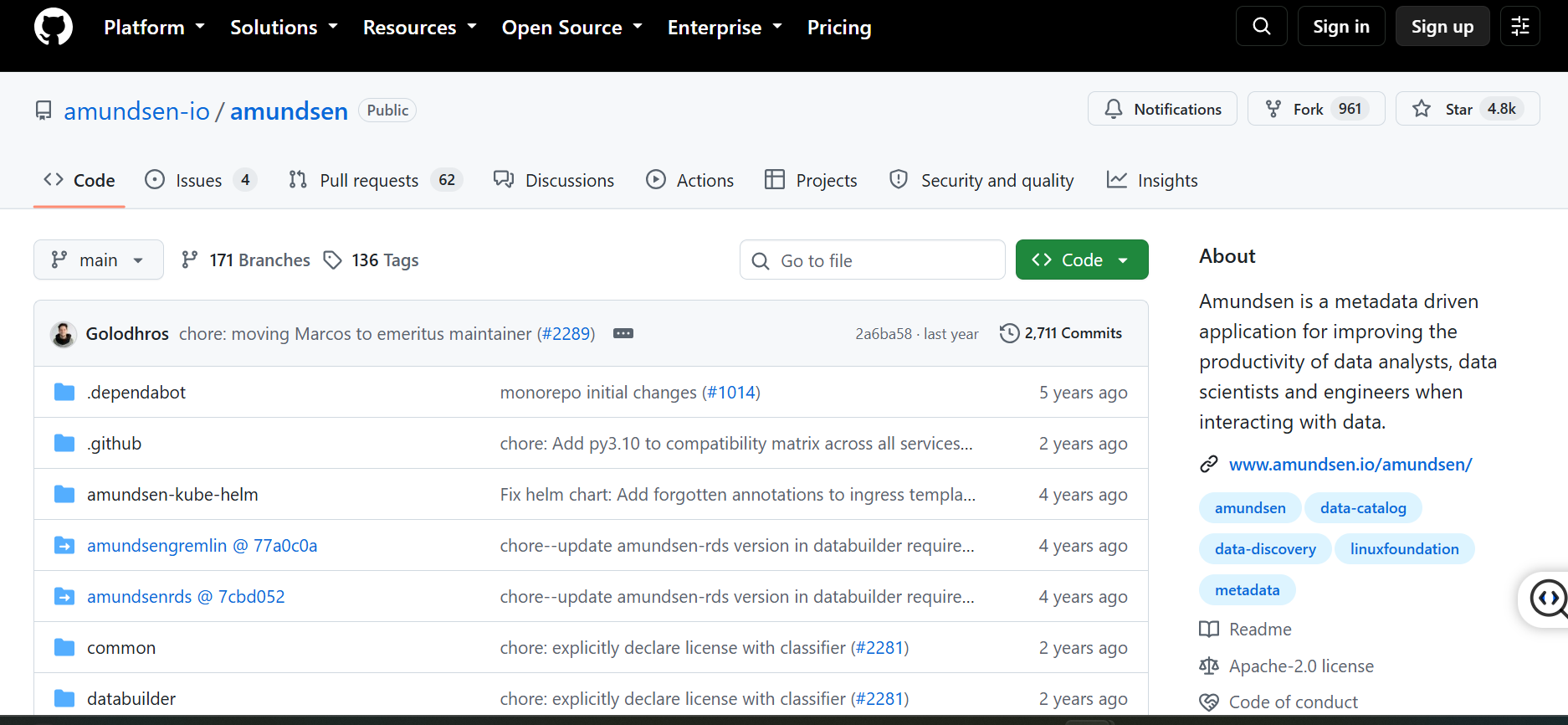
Amundsen is an open-source data discovery platform originally built at Lyft and now hosted as an incubation project under the LF AI & Data Foundation. It prioritizes fast, search-first data discovery over broad governance workflows.
Best for: Engineering-first teams that mainly need fast data discovery and are prepared to build governance, security, and quality features on top.
Key features:
-
Search-first discovery: Provides a simple, search-driven interface for finding tables, dashboards, and other data assets.
-
Graph-based metadata store: Uses a graph database to connect people, tables, and dashboards as related entities.
-
People as first-class assets: Treats employees as nodes in the metadata graph, connected to the data they use and own.
-
Usage-based ranking: Surfaces frequently queried tables higher in search results, based on real usage patterns.
-
Foundation governance: Developed at Lyft and now maintained as an LF AI & Data incubation project with an active community.
AI and context readiness: Amundsen was not built with AI agent context in mind. Its strength is helping people find data quickly, not exposing structured, governed context for machine consumption. Teams wanting AI-ready metadata on top of Amundsen would need to add that layer themselves.
Pros:
-
Simple, familiar search experience that lowers the barrier to data discovery
-
Backed by an active community and neutral foundation governance
-
Lightweight footprint compared with broader governance platforms
Key takeaway: The selection decision should follow the governance operating model. OpenMetadata and DataHub provide broader catalog-centered experiences, Atlas remains relevant for Hadoop governance, Ranger adds policy enforcement on top of a catalog, Egeria emphasizes cross-platform metadata interoperability, Gravitino addresses federated metadata across modern data and AI environments, and Amundsen offers a lighter search-first alternative for teams that mainly need discovery.
None of those architectural strengths removes the need to decide who will maintain context, enforce controls, resolve governance issues, and drive adoption across the organization.
How to choose an open-source data governance tool?
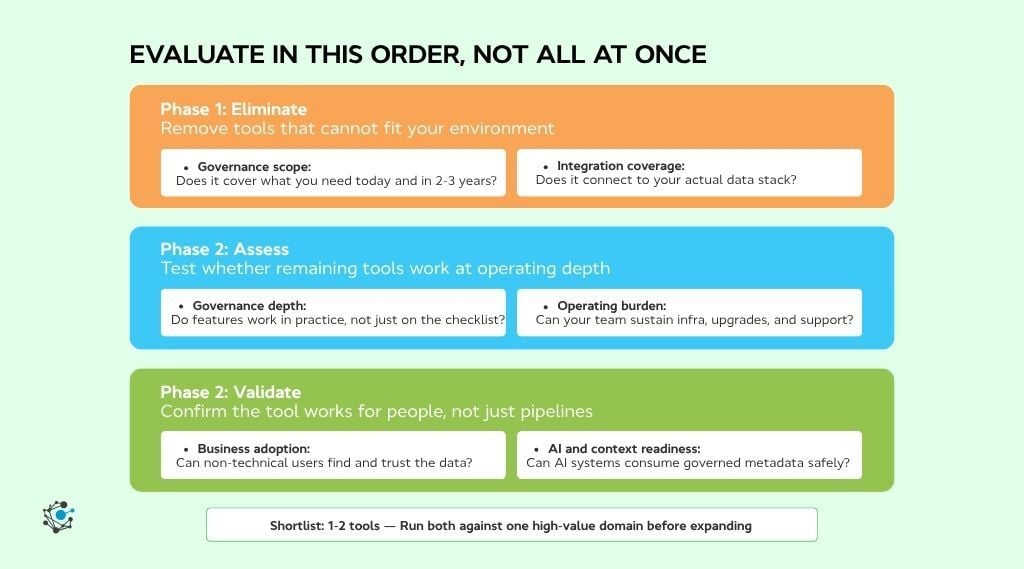
The six criteria below help you choose an open-source data governance tool. Let's discuss them one by one.
1. Define the governance scope
Start with the capabilities required today and over the next two to three years. A discovery-focused initiative may only need searchable metadata, ownership, and lineage. A broader governance program may also require glossary workflows, data quality, classification, privacy controls, policy enforcement, stewardship, certification, and auditability.
The important question is whether these capabilities work together. Governance becomes harder when ownership lives in one system, quality scores in another, policies in a third, and lineage somewhere else.
2. Check integration coverage against the actual data estate
Connector count alone is a weak comparison metric. Map the systems that matter: databases, cloud warehouses, lakehouses, extract-transform-load and extract-load-transform tools, business intelligence platforms, applications, and AI environments.
Then determine what each connector actually collects. A connector that ingests tables and columns may still miss stored procedures, transformation logic, dashboard relationships, permissions, or column-level lineage.
3. Evaluate governance depth, not feature labels
Terms such as “lineage,” “data quality,” and “governance” can describe very different capabilities. Assess how each feature works in practice.
For example, determine whether lineage is automatically discovered or manually maintained and whether the platform supports the data lineage best practices needed to keep dependencies accurate as systems change
4. Calculate the operating burden
Open source removes a software licensing barrier, but operating the platform still consumes resources. Include infrastructure, upgrades, security patches, connector maintenance, monitoring, troubleshooting, custom development, and internal support in the evaluation.
A technically successful proof of concept can still become difficult to sustain when the platform expands from one domain to hundreds of sources and thousands of users.
5. Test adoption with business users
Governance succeeds when analysts, stewards, owners, and data consumers can use governed information during normal work. A pilot should therefore test search quality, understandable definitions, ownership workflows, access requests, trust signals, and impact analysis with both technical and business users.
A technically sophisticated platform that requires specialists to interpret every result can create a second governance bottleneck.
6. Assess AI and context readiness
AI readiness now requires more than making metadata searchable. Enterprise AI applications and agents increasingly need machine-readable business definitions, ownership, lineage, quality signals, policies, permissions, and relationships to interpret data safely.
This makes context an important evaluation dimension. Metadata that remains fragmented across catalogs, documents, tickets, and security tools is harder for both people and AI systems to apply consistently.
Pro tip: Run the final two candidates against one high-value domain. Measure metadata coverage, lineage accuracy, governance workflow effort, business-user adoption, and ongoing engineering work before expanding the deployment.
When does a managed governance platform make more sense?
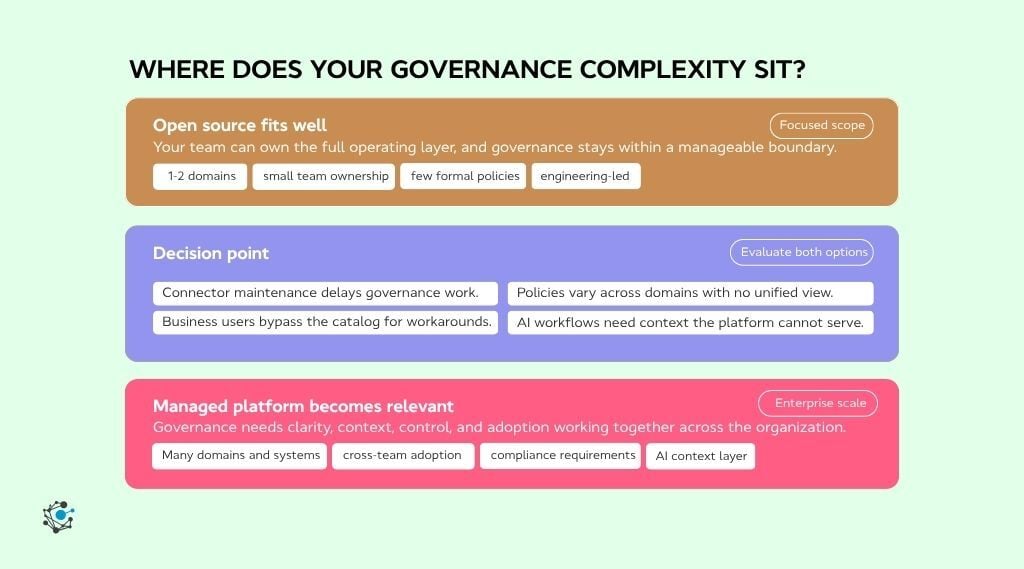
Every open-source rollout eventually reaches a decision point. The tools compared above can carry a governance program a long way, but scale, AI use cases, and cross-team demands change the calculus over time.
Here is how to tell when that shift is happening and what a managed platform adds once it does.
When open source starts to strain
An open-source approach remains practical when the governance scope is focused, the engineering team can own the operating layer, and customization is an intentional architectural choice. The economics begin to change when governance must work consistently across many domains, systems, policies, and business teams.
At that point, the decision extends beyond catalog functionality, and evaluating enterprise data governance tools becomes more relevant because policy enforcement, lineage, quality, compliance, and adoption must work across the same operating environment.
What does enterprise governance need to deliver?
-
Clarity: Know what data exists and who owns it.
-
Context: Connect technical assets to business meaning.
-
Control: Enforce policies, quality, privacy, and access rules.
-
Adoption: Make trusted information available inside everyday workflows.
Where does a unified platform fit?
Definitions, lineage, quality, ownership, and policy can no longer stay as documentation meant only for people. They increasingly need to become governed, machine-readable context that applications and AI agents can retrieve and apply during execution.
This is where unified governance platforms like OvalEdge become relevant. Its current platform model connects catalog, glossary, lineage, quality, policy, and other governance signals through an Enterprise Context Graph, while exposing governed context to people, applications, and AI agents. OvalEdge currently supports 170+ pre-built connectors across its ecosystem.
The transition point is operational rather than ideological
Open source can remain the right choice for organizations prepared to build and maintain the surrounding governance system. A managed platform becomes more compelling when maintaining that system begins to consume more effort than advancing the governance program itself.
Conclusion
Open-source data governance tools can be a strong choice when organizations have a clearly defined use case, the technical resources to operate the platform, and the discipline to maintain metadata, lineage, quality, and governance workflows over time.
The right choice depends less on which tool has the longest feature list and more on how well it fits your data environment, governance priorities, and operating model.
As governance expands across more systems, business domains, and AI use cases, the challenge shifts from collecting metadata to creating trusted context, applying consistent controls, and making governed information usable across everyday workflows. That is where a unified governance platform like OvalEdge can reduce fragmentation and operational overhead.
OvalEdge brings catalog, lineage, quality, policy, ownership, and governed context together in one platform, helping teams create greater clarity, context, control, and adoption across the enterprise.
Book a demo with OvalEdge to see how unified data governance works in practice.
.png?width=1081&height=173&name=Forrester%201%20(1).png)
.png?width=1081&height=241&name=KC%20-%20Logo%201%20(1).png)