AI adoption is accelerating across enterprises, but many organizations are discovering that access to powerful models does not automatically produce reliable business answers. AI analysts can query vast amounts of data and generate insights in seconds, yet inconsistent definitions, unclear ownership, and missing business context often lead to conflicting results.
According to Vention's 2025 AI Adoption Statistics report, 78% of organizations now use AI in at least one business function.
As AI becomes embedded in decision-making processes, the challenge is no longer access to data but ensuring AI systems understand the business context behind that data.
Most AI analysts already have access to more data than they can effectively use. The harder problem is giving them the same business context that experienced analysts rely on to interpret metrics, validate results, and identify potential issues before sharing insights with stakeholders.
This is where context engineering becomes critical. It focuses on delivering the definitions, lineage, quality signals, and governance rules that AI systems need to generate trustworthy answers.
This article explores why governance is the foundation of context engineering and how organizations can build a governed context that produces consistent, explainable, and defensible AI outputs.
What is Context engineering for AI analysts?
Context engineering for AI analysts is the discipline of designing what information an AI model sees before it generates an answer. It goes well beyond writing a prompt. It covers the business definitions, data lineage, quality signals, access policies, and retrieval strategies that together determine whether an AI's answer meets the standard of an enterprise AI trust framework, or is just confidently wrong.
The OvalEdge team views context engineering as the AI equivalent of analyst onboarding. New analysts need to learn definitions, trusted reports, ownership structures, business rules, and accepted exceptions. AI analysts need access to exactly the same knowledge, delivered through technology rather than tribal knowledge.
Context Engineering vs Prompt Engineering
Prompt engineering optimizes the text sent to a model for a single interaction. Context engineering optimizes the entire information environment the model operates in, across every query.
|
Attribute |
Prompt Engineering |
Context Engineering |
|
Scope |
Single interaction |
The entire AI information environment |
|
Primary focus |
Crafting instructions |
Delivering relevant business and data context |
|
Inputs |
User prompt and system instructions |
Definitions, lineage, metadata, policies, tools, memory |
|
Goal |
Improve response quality for a task |
Improve consistency, trust, and accuracy across tasks |
|
Output quality |
Can vary significantly by prompt wording |
More consistent when the context is governed |
|
Handles metric ambiguity |
Limited |
Yes, through governed definitions |
|
Governance role |
Minimal |
Core requirement |
|
Typical owners |
Developers, prompt writers |
Data teams, governance teams, analytics leaders |
A well-written prompt delivered into a poorly governed information environment will still produce wrong answers. Context engineering treats definitions, lineage, and governance as first-class inputs, not as afterthoughts appended to the prompt.
Why AI analysts give confident, wrong answers
AI analysts do not usually fail because of weak models. They fail because they receive an incomplete, conflicting, or poorly governed business context and still attempt to generate an answer.
1. Metric drift in practice
Consider a simple question: "How many active customers do we have?"
The AI analyst searches available data sources and returns 25,000 active customers. Finance reviews the number and says the correct figure is 18,000.
Both numbers are technically correct. Marketing defines active customers as anyone who engaged in the last 90 days, while Finance only counts customers with an active paid contract. Because the AI was not given a certified business definition, it selected one version of the metric without knowing which one the business intended.
This is a context problem, not a model problem. Understanding how business context improves data governance makes this clear: the AI can access the data, but it lacks the business rules needed to interpret that data correctly.
2. When the source is stale or uncertified
Now consider a different question: "What was our quarterly revenue last quarter?"
This time, the business has a certified revenue definition. The AI retrieves the correct metric but pulls it from an uncertified reporting table that has not been refreshed in several weeks. The finance team later discovers that the table excluded recent adjustments and revenue corrections.
The AI's calculation is accurate based on the data it received, but the underlying source is outdated. Because the AI had no visibility into data freshness, certification status, or quality signals, it treated an unreliable source as authoritative.
This is also a context problem. The issue is not the definition of revenue. The issue is that the AI lacks the metadata needed to determine whether the source should be trusted.
3. The real cost of context gaps
Context gaps create two major problems.
The first is operational inefficiency. Analysts spend time validating and correcting AI-generated answers before sharing them with stakeholders, reducing the productivity gains AI is expected to provide.
The second is loss of trust. When leaders receive an incorrect answer delivered with confidence, they become less likely to rely on AI-generated insights in the future.
As organizations scale AI adoption, the challenge is no longer giving AI access to data. The challenge is ensuring AI has access to the right business context, including approved definitions, lineage, ownership, and governance policies.
A five-layer framework for context engineering
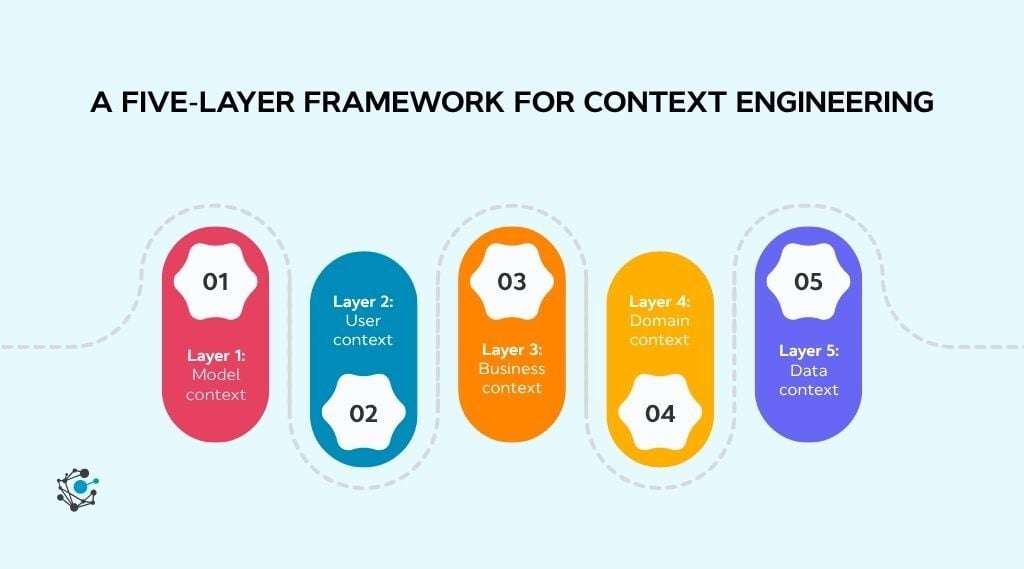
The five layers of context engineering build on one another. Each layer contributes information that helps AI systems interpret questions, evaluate evidence, and generate answers.
A weakness in any layer can reduce the reliability of the final response. Strong prompts cannot compensate for missing business definitions, and accurate data cannot guarantee trustworthy answers if permissions, domain knowledge, or governance signals are absent. Understanding these layers helps teams identify where context failures originate and how to address them systematically.
Layer 1: Model context
Model context includes system instructions, prompts, behavioral rules, and output requirements that guide how an AI responds. This layer is closest to traditional prompt engineering.
Problems emerge when instructions are too generic, incomplete, or contradictory. An instruction such as "answer data questions accurately" provides little guidance when multiple definitions of the same metric exist. The AI may follow the instruction correctly while still producing the wrong business answer.
Layer 2: User context
User context captures who is asking the question, including their role, permissions, responsibilities, and previous interactions.
This layer helps AI personalize responses and enforce access controls. Without user context, the AI may provide the same answer to every user, even when different stakeholders require different levels of detail or have different data access rights.
Layer 3: Business context
Business context contains the definitions and rules that determine how an organization measures and interprets performance. It includes business glossary terms, approved KPIs, metric definitions, and certified calculation methods, all of which OvalEdge's Data Catalog centralizes and governs across the enterprise.
For most enterprise analytics teams, this is the most critical layer. When business definitions are inconsistent or undocumented, AI systems can generate conflicting answers while appearing equally confident.
|
For example, if Sales and Finance use different definitions of monthly recurring revenue (MRR), an AI analyst may return different revenue figures depending on which definition it retrieves. This is often a governance problem rather than a technology problem. |
Layer 4: Domain context
Domain context provides industry-specific knowledge and business meaning. It helps AI understand how concepts are interpreted within a particular business environment.
For example, churn means something very different in a SaaS company than it does in a telecommunications or retail business. Without domain context, AI may apply the wrong assumptions even when the underlying data is accurate.
Layer 5: Data context
Data context connects AI responses to the underlying data assets. It includes data lineage, freshness, quality scores, ownership information, and access policies.
This layer helps AI determine where data originated, whether it can be trusted, and whether it is appropriate for a specific use case. Without data context, AI can produce an answer but cannot explain its source, reliability, or business impact.
Together, these five layers form the foundation of context engineering. At the same time, model and user context shape how AI interacts with people, business, domain, and data context determine whether its answers are trustworthy, explainable, and aligned with the business.
Building the business context layer: Where governance does the work
Most context engineering discussions center on retrieval pipelines, embeddings, and orchestration frameworks. For enterprise analytics, the more important challenge is ensuring that whatever the AI retrieves reflects approved business understanding, not simply whatever information happens to be nearest in the index.
At OvalEdge, we've found that most organizations already have much of the context infrastructure AI needs. Business glossaries, lineage documentation, catalog metadata, and quality certifications often exist across the enterprise. The opportunity is not rebuilding these assets, but connecting them to the business context layer in enterprise data platforms so they can serve as a trusted runtime context.
A strong business context layer is typically built on three governance foundations:
-
Governing metric definitions in a business glossary: Business terms and KPIs should have a single approved definition, a designated owner, and version control. This ensures AI analysts reference the same definitions used across the organization.
-
Using data lineage as context evidence: AI systems need visibility into where data originates, how it is transformed, and whether it comes from a trusted source. Lineage provides the traceability needed to make AI outputs explainable and auditable.
-
Delivering active metadata at runtime: Ownership information, quality scores, certification status, and usage patterns should be available when the AI generates an answer. This helps AI systems prioritize trusted data assets and business definitions.
Context engineering vs the traditional semantic layer approach
Semantic layers play an important role in analytics by standardizing metric definitions and business logic. However, AI agents require additional context beyond metric calculations to generate trustworthy and explainable answers.
|
Attribute |
Semantic Layer |
Governed Context Layer |
|
Primary consumer |
Human analysts and BI tools |
AI agents and AI analysts |
|
Purpose |
Standardize metrics and business logic |
Deliver trusted business context to AI |
|
Core inputs |
Metric definitions and SQL logic |
Definitions, lineage, metadata, policies, and quality signals |
|
Governance coverage |
Limited |
Comprehensive |
|
Handles metric drift |
Partially |
Yes, through governed and versioned definitions |
|
Trust signals |
Not included |
Includes lineage, certification, and quality indicators |
|
Access controls |
Typically external |
Embedded within the context layer |
|
AI readiness |
Supports AI indirectly |
Designed to support AI decision-making |
The semantic layer explains what a metric means. A governed context layer adds who approved it, where the data originated, whether it can be trusted, and who is authorized to use it.
For AI systems operating in enterprise environments, that additional context is what transforms a correct calculation into a trustworthy answer.
Building this foundation requires more than metric standardization alone. Organizations need metadata, lineage, data quality, governance policies, and business definitions working together as an AI-ready context. Book a demo to see how OvalEdge helps unify these capabilities into a governed context layer for enterprise AI.
How to implement context engineering for your data team
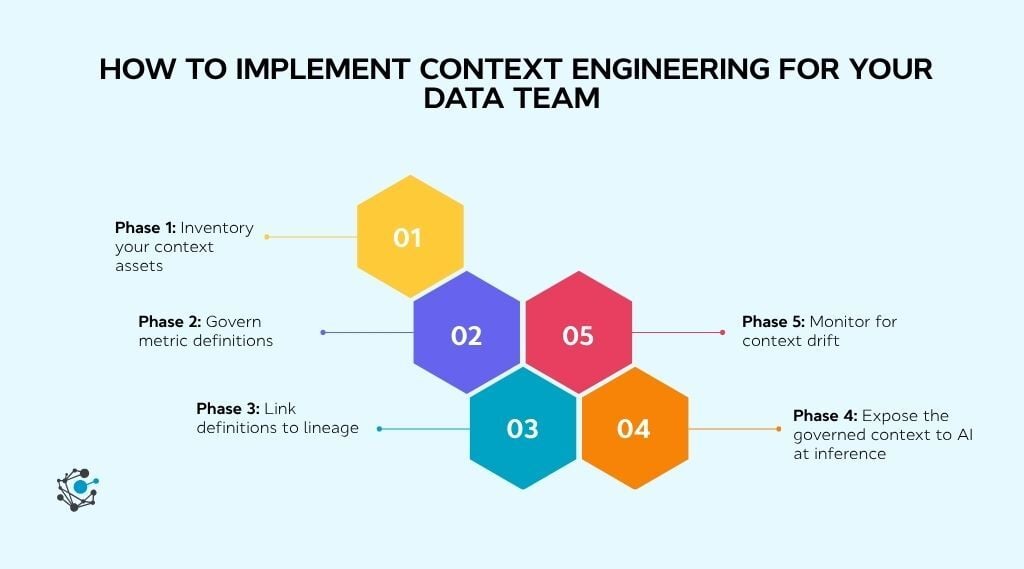
Successful context engineering initiatives rarely begin with the AI model itself. Organizations that achieve reliable AI outcomes typically start by governing the business knowledge, metadata, and trust signals that AI systems depend on.
The goal is not simply to give AI access to more information. It is to ensure AI receives the right information, in the right context, at the right time. Each phase below builds on the previous one, creating a governed context layer that AI systems can trust and use at runtime.
Phase 1: Inventory your context assets
The first step is understanding what context already exists across the organization. This includes business glossaries, lineage documentation, metadata repositories, certifications, data quality rules, and access policies.
In most enterprises, these assets are distributed across data catalogs, documentation platforms, spreadsheets, and analytics tools. Before building new infrastructure, identify where context lives, who owns it, and where governance gaps exist.
What this achieves: A documented inventory of context assets, owners, and governance gaps.
Phase 2: Govern metric definitions
Once context assets are identified, establish a trusted business foundation by governing the metrics and business terms users ask about most frequently.
For each metric, document the approved definition, calculation method, data owner, source system, and known exceptions. If "MRR" is a commonly requested metric, stakeholders should agree on its definition before it becomes part of the AI context layer.
This phase transforms scattered business knowledge into a set of approved and governed definitions.
What this achieves: A certified business glossary and governed KPI definitions.
Phase 3: Link definitions to lineage
After definitions are governed, link them to the data assets that support them. Each metric should be traceable to its source tables, transformation pipelines, ownership records, quality scores, and downstream reports.
This creates the evidence needed for AI systems to explain not only what a metric means, but also where it originated and whether it can be trusted.
What this achieves: Governed metrics connected to lineage, ownership, quality, and certification metadata.
Phase 4: Expose the governed context to AI at inference
With definitions and trust signals connected, make that governed context available to AI systems at query time.
Certified definitions, lineage information, ownership records, quality scores, and access policies should be delivered through MCP servers, retrieval pipelines, APIs, catalog integrations, or similar mechanisms. The principle remains the same: context should be governed at the source rather than embedded in prompts that quickly become outdated.
This phase operationalizes the governance work completed in the earlier stages.
What this achieves: A runtime context layer that AI systems can access dynamically.
Phase 5: Monitor for context drift
Once AI systems begin consuming governed context, monitor for changes that could reduce accuracy over time.
Business definitions evolve, pipelines change, and organizational terminology shifts. Monitor situations where AI-generated answers differ from approved definitions or stakeholder expectations. For example, if the AI begins reporting a different customer count than Finance, investigate whether the definition, source data, lineage, or certification status has changed.
This feedback loop helps ensure the context layer remains aligned with current business reality.
What this achieves: An ongoing governance process that keeps AI context accurate, trusted, and current.
Signs that context engineering is failing
A few reliable indicators that the context layer has a problem:
-
Different teams consistently report different numbers from the same AI query about the same metric
-
Analysts are regularly overriding or correcting AI-generated answers before sharing them with leadership.
-
The AI's answers look plausible, but cannot be traced to a source anyone can identify or verify.
-
The AI returns confident answers even when the underlying data is stale or uncertified.
-
New team members distrust the AI because it has been visibly wrong in front of leadership in the past.
The common thread across all of these is that they are governance failures, not model failures. Enterprise responsible AI governance starts from this same premise: the AI behaves exactly as it was designed to behave, and the problem is what it was given. Accountability for context quality sits with the people who govern it, not with the model.
Governed context engineering in practice: A revenue reporting example
A practical example helps illustrate the difference between AI systems that generate answers and AI systems that generate trustworthy answers.
The problem
A SaaS company asks its AI analyst for monthly recurring revenue (MRR). Finance, Sales, and Product all use slightly different MRR definitions. One team counts annual contracts divided by twelve. Another counts active monthly subscribers only. A third includes trials that have not converted yet.
The AI returns a number. It is not fabricated. It is also not the number anyone agreed on, and no one in the room can determine which definition was used to produce it.
What governed context engineering changes
The company creates a canonical MRR definition in its business glossary and has it certified by the CFO's office. That definition is linked to the approved revenue table and calculation logic through data lineage. Quality scores and certification status are also exposed to the AI at inference time.
|
Important note: OvalEdge's Data Quality capability surfaces quality scores and certification status to AI systems at inference time, helping ensure answers are grounded in verified and trusted data assets. |
When the same question is asked again, the AI does more than return a number. It returns the number alongside its context and traceability information:
|
"Based on the certified MRR definition, version 2.1, linked to the revenue_events table, last certified 14 days ago." |
The answer is now backed by approved definitions, lineage, and governance signals rather than assumptions.
Business outcome
The AI no longer returns a metric based on whichever definition it finds first. It returns the approved MRR definition, linked source data, lineage information, and quality status. Stakeholders can verify which definition was used, where the data originated, and whether the source is trusted.
That is the difference between confident AI output and trustworthy AI output.
Conclusion
Context engineering is becoming a prerequisite for enterprise AI, not an optional enhancement. As organizations move from AI assistants to AI analysts and autonomous agents, the challenge shifts from generating answers to ensuring those answers are trustworthy, explainable, and aligned with business intent.
OvalEdge's perspective is that the next phase of AI adoption will be defined by context readiness. Organizations that can deliver approved definitions, trusted data, governance policies, and quality signals at runtime will be better positioned to scale AI across business processes and decision-making workflows. Those who cannot will struggle with inconsistent outputs, low trust, and limited adoption.
In the years ahead, governed context may become as fundamental to enterprise AI as data governance became to modern analytics.
Ready to see how governed context can improve AI trust and accuracy? Book a demo with OvalEdge.
.png?width=1081&height=173&name=Forrester%201%20(1).png)
.png?width=1081&height=241&name=KC%20-%20Logo%201%20(1).png)