.jpg)
Agentic AI promises systems that can reason, plan, and act with increasing autonomy. Yet the emerging conversation around agentic context engineering often treats context as primarily an engineering challenge. In reality, enterprise agents rarely fail because context cannot be retrieved. They fail because the context they retrieve lacks authority, ownership, trust signals, or governance controls.
This problem is reflected in broader AI adoption trends.
According to the 2025 RAND Corporation presentation, “Why AI Projects Fail”, more than 80% of AI projects fail, roughly twice the rate of traditional IT initiatives.
Poor data quality, governance gaps, and inconsistent business context are among the leading causes.
Agentic context engineering addresses how agents acquire and refine context over time. But in enterprise environments, the greater challenge is ensuring that context is trustworthy. The goal is not simply to make context available, but to make it authoritative.
What is agentic context engineering?
Agentic context engineering focuses on making context available to agents. The next enterprise challenge is making that context authoritative. An agent that retrieves multiple definitions, policies, or metrics still needs a mechanism to determine which one should be trusted.
Agentic context engineering is the discipline of dynamically assembling, refining, and managing the information an AI agent receives before it reasons or acts. Unlike prompt engineering, which produces a fixed input for a single query, agentic context engineering treats the agent's context as a living system.
Teams building agentic AI for data teams are discovering that this shift in how context works is as significant as the shift to using AI agents in the first place.
Context engineering vs prompt engineering
The distinction matters more than it might seem. Prompt engineering is a writing task: craft the right words for one input. Context engineering is a systems discipline: design the information architecture that powers an agent across many tasks.
Most agent failures in production are not model failures. They are context failures. Wrong data retrieved, stale definitions injected, no memory of prior decisions. The comparison below shows why the shift from prompts to context is structural rather than stylistic.
|
Aspect |
Prompt engineering |
Context engineering |
|
Scope |
Static input per query |
Evolves across runs |
|
Lifespan |
Written once |
Continuously refined |
|
Memory |
No memory |
Accumulates domain knowledge |
|
Governance layer |
Not required |
Needs verified, structured context |
Why context has become the critical variable
The conversation is no longer just about improving prompts. It is about improving the quality, trustworthiness, and completeness of the information agents use to reason and act. As AI systems become more autonomous, context increasingly determines whether their outputs are useful, explainable, and aligned with business requirements.
This shift is becoming visible across the industry.
Cognizant announced plans to deploy 1,000 context engineers in 2025, while in 2025, Gartner declared that "context engineering is in, prompt engineering is out."
The message is consistent: AI systems are moving beyond prompt design toward the dynamic assembly and management of context.
At OvalEdge, we believe the next challenge is not simply making context available, but making it authoritative. Agents need more than retrieved information. They need trusted business definitions, ownership, certification status, lineage, and policy awareness to determine which information should be used.
As organizations move from AI assistants to autonomous agents, governed context becomes increasingly important for producing reliable and explainable outcomes.
The ACE framework: Generator, Reflector, Curator
A self-improving agent operating on ambiguous business definitions does not become more accurate over time. It becomes more confident in its mistakes. Context engineering solves availability. Governance solves authority.
The Core idea: Context as an evolving playbook
ACE treats the context window as a living playbook rather than a fixed document. It's a structured store of strategies that grows more specialized as the agent gains experience.
The framework builds on the Dynamic Cheatsheet memory system and uses incremental delta updates, targeted edits that preserve prior knowledge rather than overwriting it. This approach prevents two specific failure modes discussed in the next section.
The three roles in the ACE loop
The framework divides the work of context evolution into three distinct components:
-
Generator: Captures how the agent approached a task. It produces reasoning traces, action sequences, and candidate strategies, giving the system a complete view of the decision process rather than just the final output.
-
Reflector: Analyzes the Generator's traces. It identifies what worked, what failed, and what patterns generalize across tasks, extracting actionable lessons from raw execution data.
-
Curator: Takes the Reflector's insights and integrates them into the evolving context as small, targeted delta updates. It prunes redundant or low-value items and reorganizes the playbook using a "grow-and-refine" mechanism that keeps the context comprehensive without making it unmanageable.
ACE Performance Results
The ACE framework paper (Zhang et al., 2025) reports strong results across both benchmark types it tests.
On the AppWorld agent benchmark, ACE delivered a 10.6 percent accuracy improvement over prior context-adaptation baselines, and an 8.6 percent gain on financial reasoning tasks including FiNER and Formula. On efficiency, adaptation latency dropped by 86.9 percent on average, with token costs falling by 83.6 percent on financial benchmarks specifically, both compared to existing adaptive methods.
The most credible proof point is on the AppWorld public leaderboard. ACE, running on the smaller open-source model DeepSeek-V3.1, matched IBM CUGA, which runs on GPT-4.1, on the overall average and outperformed it on the harder test-challenge split. It did this without labeled supervision, adapting entirely from natural execution feedback.
These results demonstrate that adaptive context can significantly improve agent efficiency and performance, but benchmark success alone does not address the trust, governance, and data quality challenges that enterprises face in production environments.
Context collapse and brevity bias: The problems ACE solves
Understanding why ACE was built requires understanding the two failure modes it specifically addresses.
What is context collapse?
Context collapse happens when an agent's context is repeatedly rewritten rather than updated, summarizing existing knowledge each cycle. Each rewrite strips out domain-specific detail. Over time, the context loses the nuance that made it useful, and the agent reasons from increasingly thin, generic information.
Chroma's July 2025 technical report "Context Rot" tested 18 frontier models and found that models do not use their context uniformly; performance grows increasingly unreliable as input length grows. The degradation isn't gradual. It arrives sharply, well before the model's advertised context window limit is reached.
What is brevity bias?
Brevity bias is a related failure: when a model or system prioritizes concise summaries over detailed, domain-rich content. Edge cases, exceptions, and specialized knowledge get dropped in favor of shorter, simpler explanations.
In enterprise settings, this produces an agent that gives confident, compact, but incorrect answers. The shorter the context becomes, the more the agent fills gaps with plausible-sounding inference rather than verified information.
How ACE prevents both
ACE's incremental delta updates are the core fix. Instead of rewriting the full context, the Curator adds targeted edits that preserve prior knowledge while incorporating new insights.
The grow-and-refine mechanism prevents unbounded expansion by merging semantically similar items and pruning low-value entries. The playbook stays comprehensive without becoming unmanageable.
Why the ACE paper is not enough for enterprises
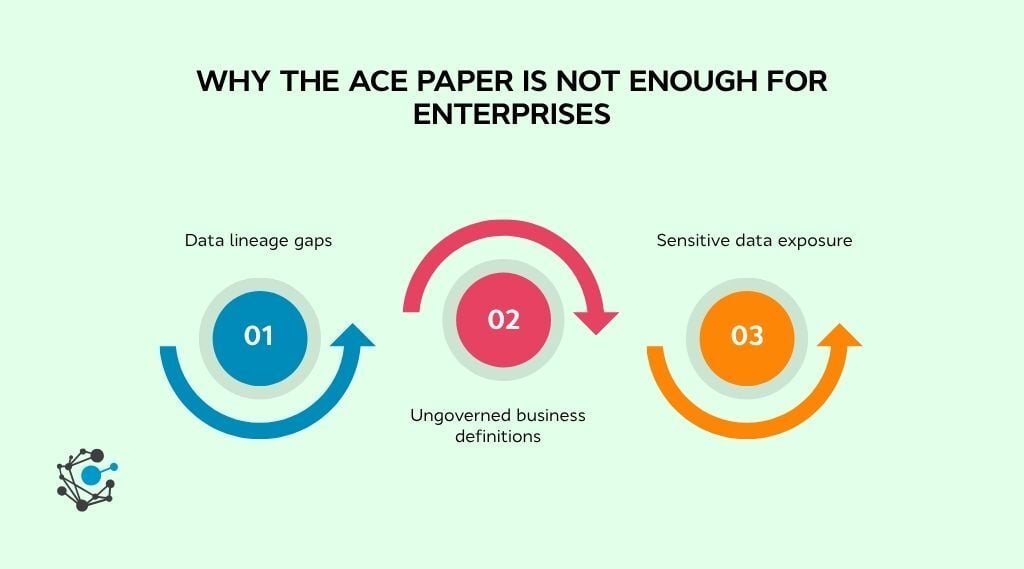
ACE is a research framework tested on controlled benchmarks. It assumes clean, structured execution traces as input to the Reflector and Curator. In production enterprise environments, that assumption breaks down immediately.
Agents don't work on tidy benchmarks. They pull from live data warehouses, business glossaries, metadata repositories, APIs, and real-time operational systems. If the metadata the agent retrieves is stale, ambiguous, or unverified, the playbook it builds will encode those errors. A self-improving agent with corrupted inputs doesn't get smarter. It gets confidently wrong.
Three specific enterprise realities the ACE paper doesn't address:
-
Data lineage gaps. Agents can't trace where the retrieved information came from, so they can't assess its trustworthiness. Without lineage, the provenance of any context item is opaque. Choosing from the right automated data lineage toolsis one of the first practical decisions enterprises face when addressing this gap.
-
Ungoverned business definitions. The same term, such as "revenue" or "active customer," may mean different things across systems. Without a governed glossary, the context carries that ambiguity forward and amplifies it with each iteration.
-
Sensitive data exposure. Without structured sensitive data controls, agents may retrieve and process PII, financial data, or regulated content, embedding it into the evolving playbook where it can persist across sessions and surface in outputs.
Traditional metadata management helps people discover data. Agentic context engineering requires a governed, interconnected context that enables AI agents to reason, act, and make decisions safely across enterprise systems.
Book a demo to see how OvalEdge helps transform governance assets into a trusted agent context.
Governed metadata: The foundation of trustworthy agentic context
Most discussions about agentic context engineering focus on how agents retrieve context. At OvalEdge, we believe enterprises should pay equal attention to how context becomes trusted. Governance assets such as business glossaries, stewardship models, lineage, certification workflows, ownership records, and policies are ultimately what determine whether context is authoritative.
In production agentic systems, context is only as reliable as the metadata it draws from. Governance is not a post-deployment checklist. It is the prerequisite for building a context layer that actually works.
1. Active metadata as the context supply chain
Active metadata refers to metadata that is continuously updated, connected, and ready for machine consumption, rather than a static catalog entry maintained on a quarterly schedule.
For agentic context engineering, active metadata provides the live signals a context layer needs: data ownership, classification, quality status, and change history. Without it, the agent operates on a snapshot of the world that may already be outdated by the time it is used.
2. Data lineage as a context provenance layer
When an agent retrieves a metric or policy rule to include in its context, it needs to know where that data came from, how it was transformed, and whether it has been certified.
Do you know? OvalEdge's automated data lineage applies this provenance layer at the metadata level, connecting every retrieved item back to its origin and transformation history so agents have something to verify against.
Without lineage, context is unverifiable. In regulated industries, unverifiable context becomes an audit liability. Lineage also helps identify when upstream changes have invalidated a context item, preventing the agent from carrying stale knowledge forward.
3. Sensitive data discovery prevents toxic context
Agentic context engineering without sensitive data controls creates a specific risk: agents that retrieve and embed PII, financial data, or regulated content into their context systems.
Once that data is in the evolving context, it can be carried across sessions, shared between agents, or exposed in outputs. Structured sensitive data discovery applied at the metadata layer before retrieval prevents this at the source rather than requiring remediation after the fact.
4. A governed business glossary as the semantic anchor
One of the biggest challenges in enterprise AI is not finding information. It is determining which information should be trusted. An agent may successfully retrieve multiple definitions of a metric, such as revenue, customer churn, or active accounts. The challenge is knowing which definition the organization has certified and agreed to use.
Context playbooks built without a shared semantic layer will encode inconsistent business definitions and carry them into every future run. A governed semantic layer for AI ensures that when the context refers to "churn," "revenue," or "active account," every agent in the system works from the same certified definition.
This is the difference between a self-improving agent that learns the right things and one that becomes increasingly confident about the wrong ones.
What an enterprise-ready agentic context stack looks like
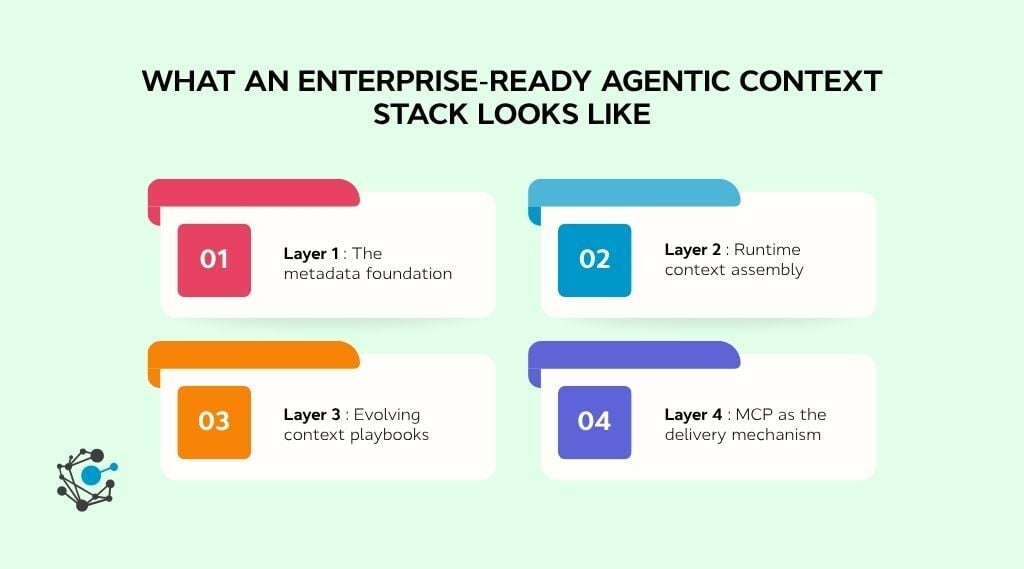
Building an ACE-style context system in the enterprise requires more than a retrieval pipeline. It requires a metadata foundation, a runtime assembly layer, and governance controls that keep the context playbook auditable and trustworthy.
These layers are sequential and interdependent. Each layer builds on the one beneath it, meaning weaknesses in the foundation propagate upward and affect every stage of context creation, refinement, and delivery.
Layer 1: The metadata foundation
A governed data catalog with certified definitions, ownership, data quality scores, and lineage is the raw material the context layer draws from. If the metadata layer for AI is inconsistent, everything downstream inherits those inconsistencies.
Key elements include:
-
Certified business definitions
-
Data ownership and stewardship information
-
Data quality scores and trust signals
-
End-to-end data lineage
This layer needs to be continuously updated through active metadata practices, not maintained manually on a periodic schedule.
Layer 2: Runtime context assembly
When an agent is triggered, it doesn't receive a static prompt. It assembles a context window at runtime from the metadata layer, pulling relevant definitions, policies, lineage paths, and prior decision traces. Retrieval-augmented generation (RAG) is one mechanism here, but it needs to be governed.
Without governance, unfiltered retrieval can introduce risks such as:
-
Stale information
-
Ambiguous business definitions
-
Sensitive or restricted data exposure
The context assembly layer applies access controls, quality filters, and relevance scoring before context reaches the agent.
Layer 3: Evolving context playbooks
Once the metadata foundation and runtime assembly are in place, the ACE loop, Generator, Reflector, and Curator can function reliably. Each iteration of the playbook draws from verified metadata, so the strategies the agent builds are grounded in accurate, governed knowledge.
To remain reliable over time, context playbooks should be:
-
Versioned
-
Tested against defined business queries
-
Subject to governance gates before promotion
Layer 4: MCP as the delivery mechanism
The Model Context Protocol (MCP) has emerged as a standard way to connect AI agents with tools, applications, and data sources. It provides a consistent mechanism for delivering context and enabling interactions across systems.
However, MCP moves context. It does not create, validate, or govern it. If the context being delivered is incomplete, inconsistent, or untrusted, MCP will simply transport those issues to the agent.
For this reason, governance must happen before context reaches the delivery layer. Metadata quality, business definitions, lineage, access controls, and policy enforcement should already be established before context is assembled and passed to agents.
For teams designing a broader enterprise metadata management strategy, the sequencing matters: metadata governance first, runtime delivery second.
How OvalEdge enables governed agentic context
The challenge for enterprises is not understanding what a trustworthy agentic context requires. The challenge is operationalizing those requirements at scale. Business definitions, lineage, quality signals, classifications, and governance policies must be continuously maintained and made available to AI systems at runtime.
OvalEdge provides the infrastructure that connects governance assets to agent workflows, helping organizations move from static governance documentation to machine consumable context.
|
Enterprise requirement |
How OvalEdge supports it |
|
Trusted business context |
Governed metadata, business glossary, and active metadata |
|
Context provenance |
Automated data lineage and traceability |
|
Context safety |
Sensitive data discovery and classification |
|
Runtime trust signals |
Ownership, quality scores, certifications, and metadata governance |
|
Governed AI experiences |
Agentic analytics and metadata-driven AI interactions |
Rather than requiring agents to interpret disconnected systems, OvalEdge provides a unified metadata foundation that makes governance assets available as machine consumable context.
Through active metadata, automated lineage, sensitive data discovery, and agentic analytics capabilities, organizations can help ensure that AI systems operate on trusted business knowledge rather than isolated data points.
Conclusion
Agentic context engineering represents an important step beyond prompt engineering because it helps AI agents learn, adapt, and accumulate knowledge over time. However, at OvalEdge, we believe enterprise success depends on more than improving how context is assembled. It depends on making governance part of the context layer itself.
A self-improving agent is only as reliable as the business knowledge it learns from. When definitions, lineage, ownership, quality signals, and policy controls are embedded into the context supplied to agents, AI systems can reason more consistently and produce outcomes that are easier to explain and trust.
The organizations that succeed will be those that connect governance assets directly to AI workflows, turning existing business knowledge into a foundation for how agents reason, act, and learn.
Ready to see how OvalEdge helps operationalize governance for trustworthy agentic AI? Book a demo.
.png?width=1081&height=173&name=Forrester%201%20(1).png)
.png?width=1081&height=241&name=KC%20-%20Logo%201%20(1).png)