%20(1).png)
Organizations generate data from applications, cloud platforms, IoT devices, APIs, and business systems every day. Some teams need raw data for machine learning and experimentation, while others depend on curated datasets for dashboards, reporting, and operational decisions.
According to the 2025 IDC Global DataSphere Forecast, global data creation is expected to reach 181 zettabytes in 2025, up from 147 zettabytes in 2024, equivalent to roughly 402 million terabytes of new data every day.
As data volumes continue to grow, organizations rely on different architectures to store and analyze it.
Data warehouses remain the standard for structured reporting, data lakes provide scalable storage for raw data, and data lakehouses combine lake flexibility with warehouse-style governance and performance.
This guide focuses on data lake vs data lakehouse, explaining their key differences, when to use each, and how they work together in modern data architectures.
Data lake vs data lakehouse: a short answer
A data lake stores raw, structured, semi-structured, and unstructured data cost-effectively using schema-on-read. A data lakehouse builds on that same storage by adding schema enforcement, ACID transactions, metadata, and governance, making the data reliable for analytics, reporting, and machine learning.
Data lake vs data lakehouse: key differences at a glance
While both architectures store and manage enterprise data, they serve different purposes within a modern analytics ecosystem. The table below compares their core characteristics to help you understand where each fits and when to use them.
|
Dimension |
Data Lake |
Data Lakehouse |
|
Primary purpose |
Low-cost storage and retention of raw data |
Analytics-ready access built on top of data lake storage |
|
Data types |
Structured, semi-structured, and unstructured |
Structured, semi-structured, and unstructured, managed through governed tables |
|
Schema |
Schema-on-read |
Schema enforcement with schema evolution |
|
Transactions |
No native ACID transactions |
ACID transactions at the table level |
|
Storage |
Object storage (Amazon S3, Azure Data Lake Storage, Google Cloud Storage) using open file formats |
Same object storage with open table formats such as Delta Lake, Apache Iceberg, or Apache Hudi |
|
Query performance |
Suitable for storage but requires optimization for analytics |
Optimized for fast analytics with indexing, caching, and data skipping |
|
Governance |
External governance tools are typically required |
Governance integrated through metadata, lineage, access controls, and quality features |
|
Best for |
Raw data retention, machine learning, experimentation, and large-scale ingestion |
Business intelligence, dashboards, self-service analytics, and governed AI workloads |
|
Main limitation |
Raw data requires additional processing before analytics |
Depends on a well-managed data lake as its foundation |
What is a data lake?
A data lake is a centralized storage system that ingests and stores raw, unstructured, and structured data at scale. It supports diverse formats, including logs, videos, documents, and tables.
Data lakes enable flexible, cost-efficient data ingestion and long-term retention. They use schema-on-read to delay structuring until analysis. Data lakes power machine learning, real-time analytics, and reporting workflows.
Cloud-native architecture ensures scalability and integration with open-source tools. Metadata management and governance frameworks enhance data discovery and security across layers.
Components of a data lake
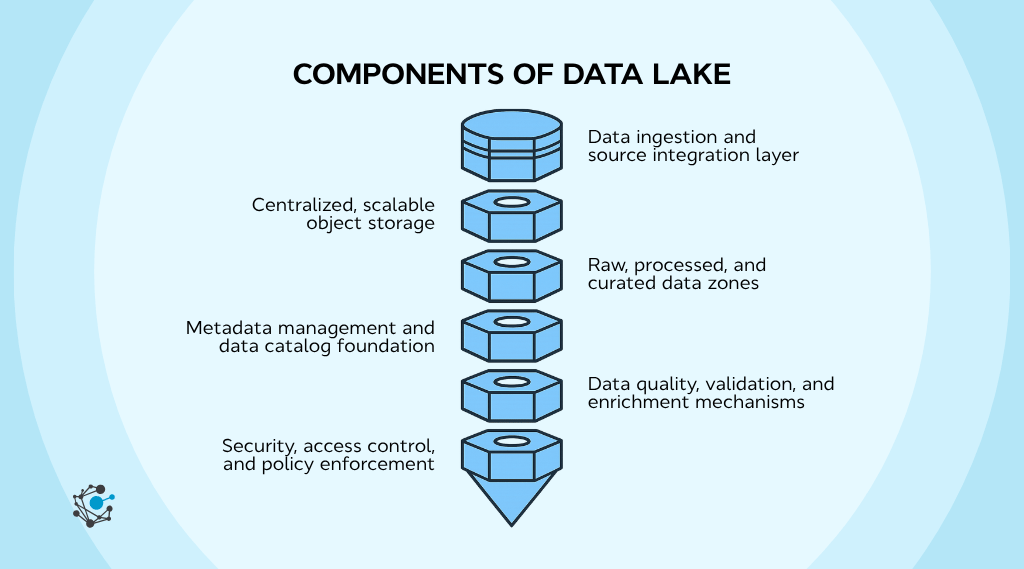
A data lake works only when its core components are designed to support scale, flexibility, and downstream analytics. These components are not isolated technical layers.
They directly determine how effectively a data lake can support a data lakehouse for governed analytics and business use cases.
1. Data ingestion and source integration layer
The ingestion layer collects data from applications, databases, APIs, logs, and streaming platforms. A well-designed data lake supports both batch and real-time ingestion, allowing organizations to onboard diverse data sources without enforcing a predefined schema.
Because data is stored in its native format, new sources can be added with minimal disruption. Once the data is validated and enriched, the lakehouse applies structure and optimization to prepare it for analytics and reporting.
2. Centralized, scalable object storage
Object storage provides the scalable, cost-effective foundation of a data lake. It stores data in open file formats such as Parquet, ORC, and JSON, enabling multiple processing engines to access the same data without duplication.
The lake retains raw and historical data, while the lakehouse builds governed tables on top of the same storage. This reduces storage costs and eliminates unnecessary data copies.
3. Raw, processed, and curated data zones
Data lakes organize information into raw, processed, and curated zones to support different stages of the data lifecycle. Raw data is preserved for auditability, processed data is standardized and enriched, and curated data is prepared for business consumption.
This layered approach improves data quality while allowing the lakehouse to expose trusted datasets for analytics, reporting, and machine learning.
4. Metadata management and data catalog foundation
Metadata makes data discoverable, understandable, and governed. Modern data lakes capture information such as schemas, ownership, lineage, freshness, and access policies to improve trust and usability. This is the same foundation on which an enterprise data catalog is built.
Platforms like OvalEdge's Data Catalog extend this by connecting metadata across data lakes, lakehouses, and downstream systems, giving users consistent business context and end-to-end lineage.
5. Data quality, validation, and enrichment mechanisms
Data quality processes identify duplicates, missing values, inconsistent formats, and other issues before data reaches downstream analytics. Validation, profiling, and enrichment improve the reliability of both reporting and AI workloads.
By resolving quality issues early, organizations reduce rework and ensure the lakehouse serves trusted, analytics-ready data.
6. Security, access control, and policy enforcement
Enterprise data lakes require governance beyond simple storage security. Access policies, encryption, audit logging, and data classification protect sensitive information while supporting regulatory compliance.
Applying these controls at the data lake layer ensures the same policies remain effective as data moves into governed lakehouse tables.
What is a data lakehouse?
A data lakehouse is a modern data architecture that combines the scalable storage of a data lake with the performance, governance, and reliability of a data warehouse.
It stores data in open formats on cloud object storage while adding schema enforcement, ACID transactions, and optimized query execution. This allows organizations to manage structured, semi-structured, and unstructured data on a single platform.
Lakehouses enable organizations to analyze structured, semi-structured, and unstructured data from a single platform, which is why strong unstructured data management solutions matter as volumes grow. By combining transactional reliability, schema management, and optimized querying with cloud object storage, they support trusted analytics and AI without sacrificing scalability.
Key features of a lakehouse architecture
A lakehouse extends the capabilities of a data lake by adding governance, transactional reliability, and analytics performance. The following features explain how lakehouses make raw data ready for trusted business use.
1. ACID transactions on top of data lakes
ACID transactions ensure data updates are consistent, reliable, and recoverable, even when multiple users or pipelines access the same datasets simultaneously. Readers never see incomplete or partially written data.
This enables reliable incremental updates, concurrent workloads, and production-grade analytics without the workarounds traditionally required in data lakes.
2. Unified storage and compute for structured and unstructured data
A lakehouse enables structured, semi-structured, and unstructured data to coexist on the same storage layer. Analytics engines can query these datasets without moving or duplicating data.
This simplifies analytics, supports machine learning, and reduces infrastructure complexity while preserving the scalability of the underlying data lake.
3. Support for open table formats
Open table formats such as Delta Lake, Apache Iceberg, and Apache Hudi add capabilities like schema evolution, versioning, and time travel to cloud object storage.
These formats improve interoperability across analytics engines, reduce vendor lock-in, and allow data structures to evolve without disrupting downstream users.
4. Integrated metadata, lineage, and governance controls
Lakehouses integrate metadata, lineage, and governance to improve data discovery, trust, and compliance. Users can understand where data originated, how it changed, and who can access it.
OvalEdge's automated data lineage extends these capabilities by capturing end-to-end lineage across data lakes, lakehouses, ETL pipelines, and BI tools, helping organizations apply consistent governance across the entire data ecosystem.
5. High-performance query execution and caching
Lakehouses optimize analytics with techniques such as indexing, column pruning, predicate pushdown, data skipping, and caching. These capabilities significantly improve query performance on cloud object storage.
Fast, interactive queries make lakehouses well-suited for dashboards, self-service analytics, and AI workloads without requiring data to be copied into a separate warehouse.
When to use a Data Lake vs a Data Lakehouse
A data lake and a data lakehouse address different business needs, but they are often used together in modern data architectures. The table below summarizes when each architecture is the better fit.
|
Scenario |
Data Lake |
Data Lakehouse |
|
Store raw data at scale |
Best choice |
Not the primary role |
|
Run dashboards and reports |
Limited |
Best choice |
|
Support machine learning |
Raw data and experimentation |
Curated data for production AI |
|
Govern enterprise data |
Requires additional governance |
Built-in governance capabilities |
|
Reduce data duplication |
Storage foundation |
Analytics on the same data |
|
Modern enterprise architecture |
Used as the storage layer |
Built on top of the data lake |
Most enterprises do not choose one architecture over the other. Instead, they use the data lake as the scalable storage foundation and the data lakehouse as the governed analytics layer, enabling engineering, analytics, and data science teams to work from the same data while supporting different workloads.
How data lake support a data lakehouse
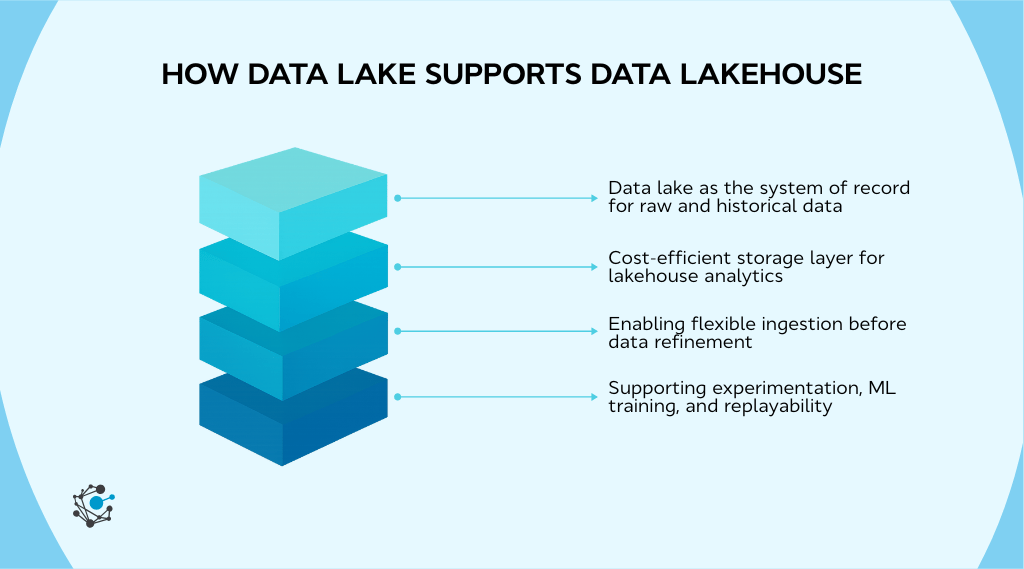
A data lake and a data lakehouse serve complementary roles. The data lake stores and preserves enterprise data at scale, while the lakehouse transforms that data into trusted, query-ready assets for analytics and AI.
1. Data lake as the system of record for raw and historical data
The data lake stores raw and historical data from enterprise systems, preserving it in its original form for traceability, compliance, and future reprocessing. This makes it the trusted foundation for lakehouse analytics.
Key benefits include:
-
Retains original data for auditability and compliance
-
Supports data reprocessing as business requirements evolve
-
Provides a reliable foundation for curated lakehouse tables
2. Cost-efficient storage layer for lakehouse analytics
Cloud object storage enables organizations to store large volumes of data economically while allowing the lakehouse to query the same data directly without duplication.
This approach:
-
Reduces storage costs
-
Eliminates unnecessary data copies
-
Supports independent scaling of storage and analytics workloads
3. Enabling flexible ingestion before data refinement
Data lakes support schema-on-read, allowing structured, semi-structured, and unstructured data to be ingested without predefined schemas. The lakehouse then refines and structures this data for analytics.
This enables organizations to:
-
Onboard new data sources quickly
-
Handle evolving schemas with minimal disruption
-
Prepare trusted datasets for reporting and AI
4. Supporting experimentation, ML training, and replayability
The data lake preserves high-fidelity data needed for experimentation, feature engineering, and model training, which is where solid AI data management practices pay off. At the same time, the lakehouse delivers curated datasets for production analytics and AI applications.
This balance supports:
-
Machine learning experimentation
-
Historical replay and model retraining
-
Governed data for production workloads
How data lake and data lakehouse work together
A modern data architecture combines a data lake for scalable storage with a data lakehouse for governed analytics. Together, they support the complete journey from data ingestion to business consumption.
1. End-to-end data lifecycle from ingestion to consumption
Data enters the data lake through batch or streaming pipelines, where it is stored in its native format before being cleaned, enriched, and validated. The lakehouse then exposes curated datasets for reporting, analytics, machine learning, and AI.
This layered approach supports the entire data lifecycle, from raw ingestion to governed consumption, while reducing data duplication and maintaining a single source of truth.
2. Separation of storage, compute, and consumption layers
The data lake provides scalable object storage, while the lakehouse delivers optimized compute and governed data for business users. Separating these layers allows organizations to scale storage and analytics independently.
This architecture improves performance, controls infrastructure costs, and enables multiple analytics engines to access the same data without unnecessary duplication.
3. Shared metadata, lineage, and governance across layers
A shared metadata layer keeps business definitions, lineage, quality rules, and access policies consistent as data moves from storage to analytics. This improves trust, compliance, and discoverability across both architectures.
With shared metadata, organizations improve data discovery, strengthen compliance, and give users greater confidence in the data they consume for analytics and AI.
4. Supporting multiple teams and workloads without duplication
A shared data foundation enables engineers, analysts, and data scientists to work from the same governed data while accessing different levels of refinement based on their needs.
This reduces duplicate datasets and inconsistent business logic, allowing teams to collaborate efficiently while maintaining a single, trusted source of truth.
Modern data architectures succeed when data is easy to discover, trusted for analytics, and ready for AI. Book a demo to see how OvalEdge helps organizations turn their data lake and data lakehouse into a reliable foundation for business decisions.
How to design and implement an integrated data lake and data lakehouse framework
Building a successful data lake and data lakehouse architecture requires more than selecting the right technologies. Organizations need a clear strategy that defines the role of each layer, applies governance consistently, and supports analytics, AI, and future business growth.
1. Define clear roles for the data lake and data lakehouse
Start by assigning distinct responsibilities to each layer. The data lake should act as the centralized repository for raw, semi-structured, and unstructured data, while the lakehouse should provide curated, governed datasets for analytics and reporting. Keeping these responsibilities separate prevents unnecessary data duplication and simplifies architecture management.
Example: Store application logs, IoT data, and clickstream events in the data lake, then publish curated customer, sales, and finance datasets through the lakehouse for dashboards and business intelligence.
2. Choose the right open table formats
Select open table formats such as Apache Iceberg, Delta Lake, or Apache Hudi to add transactional consistency, schema evolution, and better query performance while maintaining the flexibility of cloud object storage. Open formats also improve interoperability across multiple analytics engines and reduce vendor lock-in.
Example: An organization using Apache Spark for data engineering and Trino for analytics can use Apache Iceberg so both platforms access the same governed tables without creating duplicate datasets.
3. Design governance across both architectures
Governance should span both the data lake and the lakehouse rather than being applied only after data is curated. This is where automated data governance helps, using centralized metadata, lineage, quality rules, and access controls to maintain consistent business definitions and improve trust across the entire data lifecycle.
Example: If customer data is classified as sensitive in the data lake, that classification and its access policies should remain consistent when the same data is exposed through the lakehouse for reporting or AI.
4. Align the architecture with business workloads
Different teams need different levels of data readiness. Engineers require raw data for processing, analysts need curated datasets for reporting, and data scientists often work with both. Designing the architecture around these workloads enables all users to access the same governed foundation without creating separate pipelines.
Example: Data scientists can train models using raw transaction data stored in the lake, while business users analyze curated sales metrics through the lakehouse using BI tools.
5. Build for long-term scalability
Design the architecture so storage, compute, and governance can scale independently as business needs evolve. A modular approach makes it easier to onboard new business domains, users, and governance requirements without redesigning the platform.
Example: As new business units adopt analytics, the organization can scale compute resources for reporting while continuing to use the same centralized storage, governance framework, and metadata foundation.
Common challenges in data lakehouse implementation
Implementing a data lakehouse is not simply a technology upgrade. Organizations must ensure that governance, metadata, and data quality scale alongside the architecture to deliver trusted analytics.
-
Metadata and lineage gaps: As data moves from the data lake into governed lakehouse tables, lineage can become fragmented. Without end-to-end visibility, teams struggle to validate reports, perform impact analysis, and maintain trust in analytics.
-
Inconsistent governance across layers: Access policies, data classifications, and governance rules often differ between the data lake and lakehouse. Applying consistent governance across both layers is essential for compliance and secure data access.
-
Open table format complexity: Choosing between formats such as Delta Lake, Apache Iceberg, and Apache Hudi while supporting multiple query engines increases operational complexity. A 2025 Forrester study found that 73% of organizations prefer fully or partially managed services for open table formats to simplify operations.
-
Data quality issues: A lakehouse improves analytics, but it does not automatically improve data quality. If inaccurate or incomplete data enters the lake, those issues continue into dashboards, reports, and AI models unless quality checks are applied upstream.
-
Managing compute costs: Although storage and compute are separated, poorly optimized queries and inefficient workloads can significantly increase compute costs. Performance monitoring and query optimization are essential for controlling spending.
Most implementation challenges stem from inconsistent governance, fragmented metadata, and weak data quality practices rather than limitations of the lakehouse architecture itself. A unified metadata catalog and governance framework help organizations address these challenges while maintaining trusted analytics at scale.
Conclusion
As enterprise data continues to grow, the challenge is no longer just storing it but making it trusted, governed, and ready for analytics and AI.
A data lake provides scalable storage for diverse enterprise data, while a data lakehouse adds the structure and reliability needed for analytics, reporting, and AI.
Together, they create a modern architecture that supports reporting, machine learning, and self-service analytics without unnecessary duplication. The organizations that succeed will be those that define clear roles for each layer and apply consistent metadata, lineage, data quality, and governance across both.
Ready to build a trusted data lake and lakehouse architecture?

Book a demo to see how OvalEdge unifies metadata, lineage, data quality, and governance to accelerate trusted analytics and AI at enterprise scale.
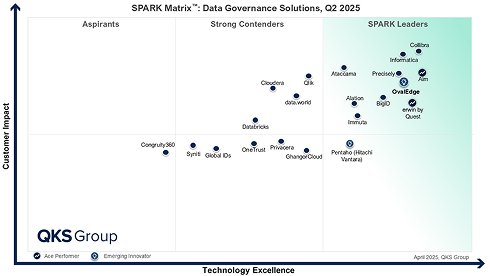
.png?width=1081&height=173&name=Forrester%201%20(1).png)
.png?width=1081&height=241&name=KC%20-%20Logo%201%20(1).png)