A Large Online Educational Institution's Journey to Building a Governed Data Foundation for Cloud Analytics and AI
Hallmark built a trusted data foundation with OvalEdge to improve visibility and governance of consumer data, supporting privacy use cases such as Right to Know and Right to Delete. Building on that foundation, Hallmark is now extending its governance programme into Data Quality, self-service analytics, and future AI-enabled data use cases.
“Having a single platform that could do the cataloging, the glossary, the definitions, the lineage—all of that in one place—was a huge part of our decision to go with OvalEdge.”
JENNA MATTHEWS, PRINCIPAL DATA STRATEGIST
Client profile
An entirely online educational institution based in Alabama is serving students in the United States and internationally. Its online model gives students flexibility in how and when they complete their coursework, helping it support learners across different locations and circumstances.
Client context
The organization's data environment had evolved over more than 20 years and included long-standing platforms, internally developed systems, commercial applications, cloud technologies, and multiple reporting tools.
Documentation and institutional knowledge existed across different systems and teams. The organization wanted to bring this information together so users could more easily understand what data was available, where it was located, how frequently it was updated, and how different data assets related to one another.
The initial objective was to establish a structured system for data governance and documentation. The organization needed a solution that could provide visibility across tables, views, stored procedures, reports, dashboards, and other data assets while accommodating both existing and modern technologies.
A related opportunity involved business terminology. Different departments sometimes used the same term in different operational contexts. For example, "active student" could refer to a student currently attending a class, a student receiving financial aid during a particular year, or a student who had started full-time, depending on the department and business requirement.
These distinctions were valid within their individual contexts. However, when they were not documented and connected to the relevant reports, leaders could enter discussions with different interpretations of the same term.
The organization wanted to create an authoritative source that would preserve these distinctions, connect definitions with reports and calculations, and help teams establish a shared understanding before making decisions.
The broader goal was to create a governance foundation that could improve visibility, establish shared and contextual business definitions, organize important institutional knowledge, and support cloud modernization, analytics, and AI.
Why the educational institution chose OvalEdge
The organization completed an extensive evaluation of the data governance market. It began by reviewing approximately a dozen platforms and then narrowed the evaluation to three vendors.
Several factors distinguished OvalEdge during this process: its unified product architecture, relative simplicity, practical fit, compatibility with the organization's technology landscape, and cost.
One of the most important considerations was that OvalEdge offered multiple governance capabilities within a single product. The organization could use the same platform for data cataloging, glossary management, definitions, lineage, documentation, and related governance activities.
OvalEdge was a single product. It was like being able to buy a loaf of bread instead of being given the ingredients and having to work out how to put them together.” — Jenna Matthews, Principal Data Strategist
The organization also needed a platform that could work across its varied technology environment, including internally developed systems, cloud platforms, and multiple reporting and visualization tools.
Pricing further strengthened the business case. OvalEdge was more affordable than the other shortlisted platforms while providing a close fit with the organization's intended governance model. Its hosted SaaS deployment also allowed the organization to begin without provisioning additional servers or creating a separate team to operate the underlying infrastructure.
What the educational institution implemented with OvalEdge
The organization initially focused its OvalEdge implementation on three primary capabilities: the Data Catalog, Business Glossary, and Data Stories. It also implemented connectors, tags, and automated lineage to support these areas.
Creating enterprise visibility with the Data Catalog
The Data Catalog was the organization's first and largest implementation priority.
The team established connectors to internal SQL Server databases, Snowflake, SQL Server Reporting Services, Power BI, and Tableau. This gave the organization a consolidated view of systems, databases, tables, reports, dashboards, code, and related data assets.
[According to the organization’s March 17, 2026 Data Governance KPI dashboard, its cataloged environment included 9 connectors, 73 databases, 6,481 tables, and 2,462 crawled reports.]
By cataloging these assets, the organization gained a structured view of the scale and composition of its data environment. The catalog also established a foundation for documenting how important reports and dashboards were supported by underlying data.
Creating shared meaning with the Business Glossary
The Business Glossary became the organization's second major area of implementation.
The team organized business terms using a domain, category, and subcategory structure and connected those terms with relevant reports and code. This allowed the organization to document both the meaning of a term and how that meaning applied within a particular reporting or operational context.
As the governance program developed, the organization refined its original domain structure to align it more closely with the way data was organized and used. OvalEdge allowed the team to reorganize glossary terms and Data Stories within this updated structure.
[As of March 17, 2026, the organization's governance dashboard tracked 28 published terms, 8 terms certified in OvalEdge, and 3 terms certified in Tableau.]
The Business Glossary now provides an authoritative reference for definitions and calculations. Users can understand what a term means, how it is calculated, and what it represents when it appears in a particular report or dashboard.
Organizing institutional knowledge with Data Stories
The organization created Data Story zones for its domains and categories. These spaces allow teams to organize policies, processes, regulatory information, and supporting documentation alongside related governance content.
One important use case supports the organization's international student initiatives. Because it serves and recruits students internationally, its teams need access to information about different privacy, education, and data-handling requirements. These include frameworks such as GDPR and FERPA as well as country-specific requirements.
The organization used Data Stories to collect and summarize this information within its governance environment. This made relevant regulatory and process documentation accessible alongside its data definitions and domain knowledge.
Automating lineage across complex data environments
The organization implemented OvalEdge's automated lineage capabilities across its student and financial data systems.
The team established the relevant connectors and used crawling, profiling, and lineage processes to trace relationships across tables and other assets. This helped the organization create a connected view of its data environments while reducing the need to map every relationship manually.
The resulting lineage allowed users to trace relationships across tables, systems, and reports. It also helped the team identify the source tables and views supporting important reporting assets.
“We would set up the initial connector and then do the crawl, profile, and lineage. That let us come back later and trace across different tables without manually going through and setting it up.” — Jenna Matthews, Principal Data Strategist
Bringing in-house reports into the business catalog
One of the organization's most distinctive implementation use cases involved its in-house student information and reporting system.
Employees use the system's reporting capabilities to meet different operational requirements. An academic advisor, for example, might use a report to identify students who need to register for courses. Users can also export report results into Excel for additional analysis and team-specific reporting.
When the organization began cataloging its reporting environment, the team found that these business-facing reports were technically represented as stored procedures in SQL Server. OvalEdge could identify the stored procedures as code, while employees recognized and searched for them as reports.
The organization worked with OvalEdge to connect these two perspectives.
The team identified the stored procedures supporting the reports and created lookup tables connecting procedure names with their business-facing report names. It then used external AI tools to analyze the SQL and identify relevant tables, fields, and conditions.
The resulting metadata was prepared for OvalEdge's file-based metadata-loading capability. This allowed assets that appeared technically as stored procedures to be represented in the OvalEdge interface as reports with report columns.
Business users could then find the assets in a familiar form, identify the reports and columns they used, and add information about how those assets supported their work.
OvalEdge impact
Informing the educational institution's cloud data strategy
One of the most important outcomes of the organization's cataloging and lineage work was its contribution to the first iteration of its cloud data infrastructure.
The organization's long-standing data systems were primarily hosted in on-premises SQL Server environments. Its data office began building a cloud environment using Snowflake as its data warehouse, supported by dbt and Databricks.
The team wanted to take a focused approach to this transition. Rather than moving every existing data structure to the cloud, it sought to prioritize the assets supporting its most important reports.
OvalEdge helped identify the tables and views feeding those reports. This gave the organization's data engineers a practical basis for prioritizing the initial cloud environment and recreating important reports with improved update cadences.
“We really didn’t want to just copy and paste all of our legacy systems into the cloud. We wanted to be able to optimize and validate data.” — Jenna Matthews, Principal Data Strategist
By connecting reports with their underlying sources, the governance initiative became a direct input into the organization's cloud-development roadmap.
Making leadership discussions more productive
The organization's Business Glossary has helped teams become more explicit about what they mean when discussing institutional terms and metrics.
A term such as "active student" can be used correctly in several contexts. The important requirement is ensuring that participants understand which definition and calculation apply to the number being presented.
The organization can now document the applicable definition and connect it with the relevant report. Leaders have a shared reference point before interpreting results or considering a course of action.
“Now they’re spending less time debating what is meant by ‘active student’ or ‘enrollment’ and more time saying, ‘This is what it means, this is the number—what do we do about it?’” — Jenna Matthews, Principal Data Strategist
This allows leadership discussions to move more quickly from interpretation to decision-making.
Supporting rapid executive and board reporting
The organization's governance documentation has also supported the development of executive and board-level dashboards.
Over a period of approximately two months, its broader data office created about half a dozen high-level dashboards. The documentation developed through the governance program helped data engineers establish the required pipelines and tables and helped analysts assemble the dashboards.
The organization also brought glossary definitions directly into the reporting experience. The data governance team used stabilized term and metric definitions to create information buttons within executive dashboards.
Executives receiving dashboards through email subscriptions could therefore access the relevant context without opening another application or separately searching the Business Glossary. This made governance information more portable and helped leaders interpret metrics within the natural flow of their work.
The OvalEdge differentiators the educational institution values most
One platform, no stitching
Having catalog, lineage, glossary, and supporting documentation in one platform was one of the most important factors in the organization's decision to select OvalEdge.
“Having a single platform that could do the cataloging, the glossary, the definitions, the lineage—all of that in one place—was a huge part of our decision to go with OvalEdge.” — Jenna Matthews, Principal Data Strategist
The breadth of the platform gives the organization room to expand its governance program without introducing a separate product for each new requirement.
Works wherever you do
OvalEdge's ability to work across the organization's existing data landscape was another important differentiator.
The organization needed to govern data across internally developed schemas, long-standing data environments, newer cloud platforms, and multiple reporting and visualization tools.
OvalEdge allowed the organization to establish a connected governance foundation across these environments. It also supported its move toward cloud-based analytics while maintaining continuity with its existing systems and workflows.
Pricing meets you where you are
OvalEdge's pricing model helped the organization begin with its immediate governance priorities and expand as its requirements evolved.
OvalEdge was more affordable than the other shortlisted platforms, while its hosted SaaS model reduced the infrastructure required for the initial setup.
As the organization added connectors and users, OvalEdge also provided contractual flexibility. The team could make adjustments during the contract period or as part of a new contract rather than waiting for the next renewal cycle.
“As we went through the process and added more connectors or more users, that was a really smooth process.” — Jenna Matthews, Principal Data Strategist
This gave the organization a practical path to begin with focused governance use cases and expand the platform as its program developed.
Building governed context for analytics and AI
The organization's OvalEdge implementation is providing context for both current and future AI use cases.
The organization is already using business descriptions and detailed definitions collected in the Business Glossary to provide metadata and context to internal AI tools being developed by its engineering and data science teams.
The organization is also exploring how its Data Stories could provide a foundation for semantic views. These views could bring together metadata, processes, potential questions, and functional context so that an AI agent could respond more accurately to questions about a particular area of the organization.
For example, information within the organization's compliance domain could provide additional context when executives work on accreditation narratives. An AI assistant could draw on relevant reporting requirements, process information, and supporting documentation captured in Data Stories.
This semantic-view use case is planned rather than fully implemented. The organization is also considering an OvalEdge MCP integration proof of concept as a potential next step.
By connecting technical metadata, business definitions, lineage, reports, and institutional documentation, the organization is creating a reusable governance layer for cloud, analytics, and AI. This foundation helps users move from locating data to understanding its meaning, and from interpreting numbers to acting on them with greater confidence.
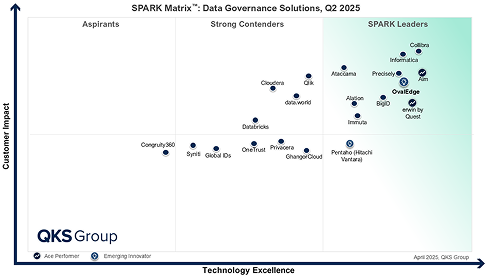
OvalEdge Recognized as a Leader in Data Governance Solutions
Gartner, Magic Quadrant for Data and Analytics Governance Platforms, January 2025
Gartner does not endorse any vendor, product or service depicted in its research publications, and does not advise technology users to select only those vendors with the highest ratings or ...
Ready to get started?
Experience data governance that delivers