Customer Case Study

BCU: Building a Trusted Data Governance Foundation for Lineage, Data Quality, and AI-Enabled Governance

Modern Credit Union Facade

BCU partnered with OvalEdge to build a scalable data governance foundation, improving data visibility, quality, and trust across the organisation. By connecting data cataloguing, lineage, impact analysis, and data quality, BCU replaced manual, time-consuming processes with a more efficient, connected approach to governance. Today, teams can identify downstream impacts in minutes, improve data quality, and build the trusted data foundation needed for future AI initiatives.

bcu_header_121x55

“It (Impact analsysis) came down from multiple people working for hours and hours to a single analyst spending 10–15 minutes. You’re talking about thousands and thousands of dollars per occurrence.”

1517622991191

MICHAEL GLANTSMAN, HEAD OF ENTERPRISE DATA GOVERNANCE

Client profile

BCU is a not-for-profit, member-owned credit union focused on helping members achieve financial freedom. With more than 370,000 members and over $6 billion in assets, BCU provides consumer banking services such as checking and savings accounts, loans, credit cards, mortgages, wealth management resources, and digital banking.

As a credit union, BCU operates in a financial-services environment where data accuracy, auditability, compliance, and trust are essential. At the same time, the organization manages a large and complex data footprint relative to its size. That combination made data governance a strategic priority: BCU needed a practical, scalable way to help teams understand data, improve quality, manage downstream impact, and build confidence in data-driven decisions.

Client context

BCU already had a Board-mandated data governance program in place. The next challenge was to make that program more scalable, more structured, and easier for business and technical teams to use in daily work.

A major need was end-to-end lineage. Teams needed to understand how data moved from source systems through tables, code, reports, and business processes. This was especially important for auditability, compliance confidence, and day-to-day decision-making.

Impact analysis was another critical requirement. When a product type, product number, field, table, report, or business rule changed, teams needed to understand what would be affected downstream. Without connected lineage and impact analysis, this type of work could require long research cycles, meetings, email chains, and dependence on subject matter experts (SMEs).

BCU also needed a better way to organize and expose governance knowledge. Critical data elements, business definitions, object-level metadata, custom fields, quality rules, and ownership context needed to be available in a structured platform rather than scattered across manual documentation and spreadsheets.

The goal was to move from manual, people-dependent governance to a connected operating model — one where users could understand what data means, where it comes from, how it moves, whether it is trusted, and what could be impacted when something changes.

Why BCU chose OvalEdge

BCU selected OvalEdge after a detailed evaluation of data governance platforms. The decision was shaped by several factors: platform potential, usability, cost fit, integration flexibility, customer service, and the ability to support a broader governance program rather than a narrow point solution.

One important factor was vision. Michael Glantsman, Head of Enterprise Data Governance at BCU, saw not only what OvalEdge could do at the time of purchase but also how the platform could evolve. As Michael explains:

“The biggest factor for me was potential. I had been monitoring the tool for about two years before purchasing it. I saw the vision — the proper vision — not just the functionality.”

Usability and cost also mattered. BCU needed a platform that could support mature governance requirements without forcing an expensive, all-or-nothing enterprise ecosystem. OvalEdge offered a more practical path for a credit union with a large data footprint and a lean operating model. This made OvalEdge a better fit for BCU’s need to scale governance without adding unnecessary platform complexity.

OvalEdge also stood out because it could support BCU’s broader governance operating model. This included cataloging, glossary, lineage, data quality, critical data elements (CDEs), custom metadata, workflows, communication, and integration with other tools.

Customer service and partnership emerged as clear differentiators. Michael was particularly emphatic about customer service:

“Where OvalEdge beats everyone that I’ve met with is the customer service. Exceptional, I would say.”

BCU has continued to work with OvalEdge to suggest enhancements, improve usability, and influence roadmap priorities. For a governance program that evolves over time, this responsiveness matters.

What BCU implemented with OvalEdge

BCU has implemented OvalEdge across several major governance areas: Data Catalog, Business Glossary, Critical Data Elements, custom fields, lineage, Data Quality, impact analysis, AI-generated descriptions, workflow integration, and governance collaboration.

The scale of adoption is significant. BCU has identified and governed critical data elements across major systems, including 85 CDEs in Temenos LOS and 723 CDEs in the data warehouse. Approximately 3,500 business glossary terms have been created. More than 35 custom fields are used for each object to store policy-related and compliance-related information. Together, these capabilities help users see important context around data objects, including definitions, ownership, source information, and governance attributes.

Lineage is central to the implementation. Using OvalEdge, BCU maps how data moves from its data lake into the data warehouse and on to tables and downstream reports. BCU continues to work with OvalEdge on extending lineage further upstream. This connected view gives analysts a clear picture of dependencies before a data change is made, and it is the foundation for BCU’s impact analysis. As BCU expands its governed footprint beyond the data warehouse into additional systems, that foundation will continue to grow.

Data Quality is another major area of adoption. BCU has implemented more than 750 data quality rules, with 700+ rules running daily on transactional data. Data quality results are reported through leadership channels, including steering committee and board-level reporting.

The platform has around 130 users, with adoption extending beyond a single team. Impact analysis is used by the data team, analyst community, and PMO to evaluate the effect of changes across the data ecosystem.

BCU is also using AI-generated descriptions extensively. This helps business owners and end users avoid starting from a blank page when writing definitions. Instead, they can review and refine a proposed definition, reducing manual effort while keeping the business in control of the final meaning.

OvalEdge impact

Before OvalEdge, understanding the downstream impact of a data change could require weeks of research, meetings, and input from multiple people. Michael describes the change:

“With OvalEdge lineage and impact analysis, teams can now identify downstream impact in minutes and share the results with IT or project teams.”

The time savings also translate into substantial cost savings for each change event requiring impact analysis. As Michael explains:

“It came down from multiple people working for hours and hours to a single analyst spending 10–15 minutes. You’re talking about thousands and thousands of dollars per occurrence.”

The benefit goes beyond efficiency. When changes are made without a clear understanding of dependencies, reports, processes, or business users can be affected unexpectedly. By making those downstream impacts visible before a change is implemented, OvalEdge helps reduce the risk of breakage and improves the quality of change execution.

Data quality has also delivered measurable, visible results. As BCU expanded its rule coverage, data quality pass rates improved from 95% to approximately 99.5%, giving leadership greater confidence that the governance program is producing tangible value.

The platform has improved business understanding of critical data elements. Users now have better visibility into CDEs and object-level metadata, while the process of defining CDEs has helped teams become more disciplined about what truly qualifies as critical.

OvalEdge has helped make governance more operational by fitting into the tools and workflows BCU already uses. Michael points to the Microsoft DevOps integration as one example:

“We integrated with Microsoft DevOps, so we can automatically create DevOps tickets, features, and bugs. It’s a very powerful feature. In addition, OvalEdge has a built-in service desk.”

Michael also highlights the OvalEdge platform’s ability to support communication:

“The communication ecosystem within OvalEdge is pretty substantial. You can communicate within the tool; you can communicate outside of the tool.”

Building the context for AI enablement

BCU’s OvalEdge foundation is creating the governed context needed for future AI-enabled data work. By connecting business meaning with technical metadata, lineage, quality rules, ownership, and semantic-to-physical linkage, OvalEdge helps users understand not only where data sits, but also what it means, how it moves, who owns it, and how it affects downstream reports and processes.

The future opportunity is to make this governed information available to external AI engines such as Microsoft Copilot, Google tools, or other AI platforms through MCP/API-style integration. In that model, OvalEdge provides the trusted governance context, while AI tools use it to answer questions, generate rules, support analysis, or automate parts of the data governance workflow.

OvalEdge Recognized as a Leader in Data Governance Solutions
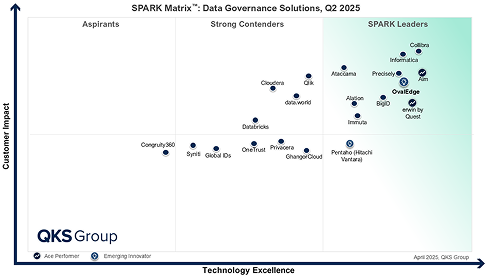
SPARK Matrix™: Data Governance Solution, 2025
Final_2025_SPARK Matrix_Data Governance Solutions_QKS GroupOvalEdge 1
Total Economic Impact™ (TEI) Study commissioned by OvalEdge: ROI of 337%
“Reference customers have repeatedly mentioned the great customer service they receive along with the support for their custom requirements, facilitating time to value. OvalEdge fits well with organizations prioritizing business user empowerment within their data governance strategy.”
Named an Overall Leader in Data Catalogs & Metadata Management
“Reference customers have repeatedly mentioned the great customer service they receive along with the support for their custom requirements, facilitating time to value. OvalEdge fits well with organizations prioritizing business user empowerment within their data governance strategy.”
Recognized as a Niche Player in the 2025 Gartner® Magic Quadrant™ for Data and Analytics Governance Platforms

Gartner, Magic Quadrant for Data and Analytics Governance Platforms, January 2025

Gartner does not endorse any vendor, product or service depicted in its research publications, and does not advise technology users to select only those vendors with the highest ratings or ...

get-a-demo-form-bg

Ready to get started?

Experience data governance that delivers